English
 Español
 Français
 Deutsch
 Italiano
 Português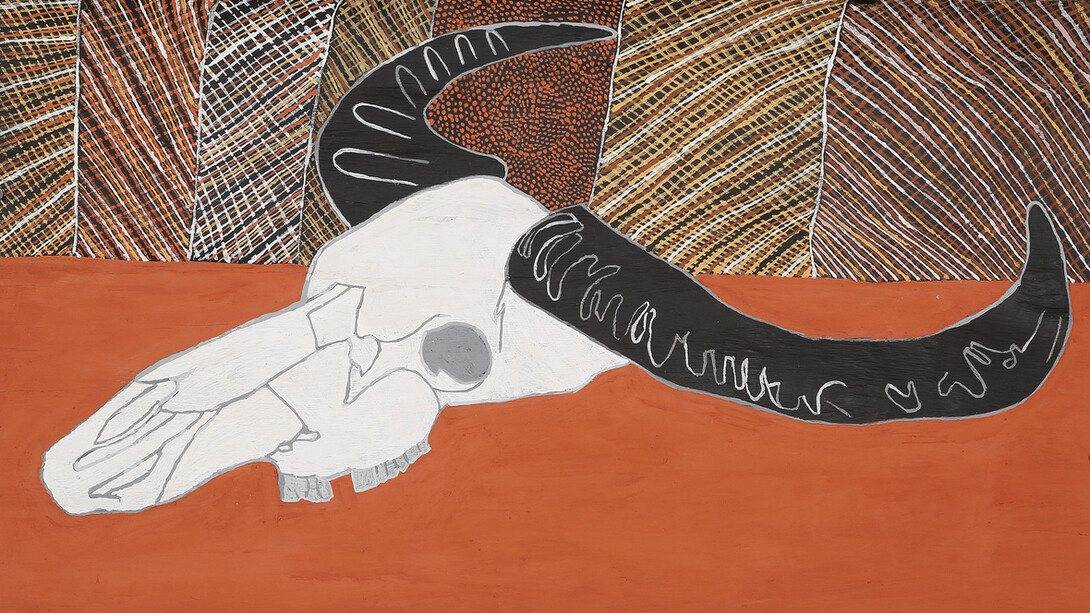
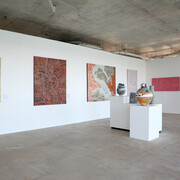
When David Tipuamantumirri and Graham Tipungwuti began discussing this exhibition, they found themselves reflecting on the messages carried through Tiwi culture, both ancient and contemporary. David works with ancestral totems and jilamara (Tiwi design) that have conveyed knowledge since the Dreamtime, while Graham combines traditional jilamara with urgent contemporary concerns. From these conversations emerged the exhibition title Pupuni Ngirramini, Jirti Ngirramini (Good News, Bad News).
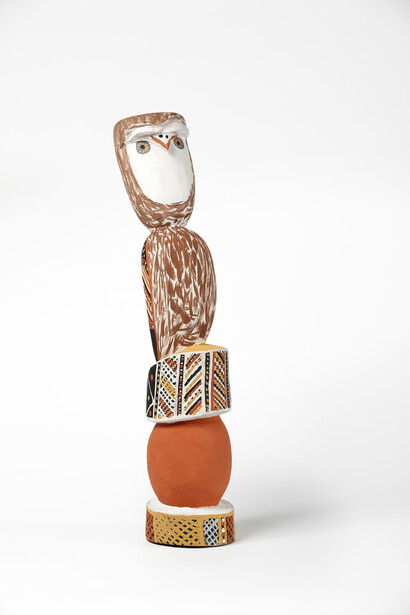
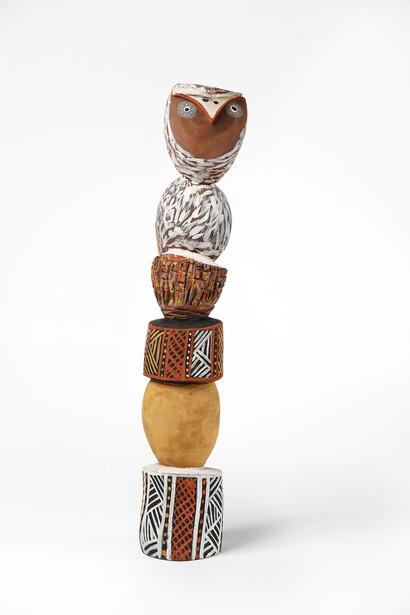
For the past two years, David has focused on carving Jurrukukuni (Owl and Owl Man). The Owl Man holds a significant place within Tiwi creation stories. According to Tiwi tradition, Jurrukukuni was the first to announce the concept of mortality. He was the ancestral being who brought news to Purukapali that his young son, Jinani, had died.
Following this tragic event, Purukapali performed the first Pukumani (burial) ceremony before walking into the sea, establishing death as a permanent cycle for humankind. Afterward, Owl Man and his wife, Pintoma (the Barn Owl), went on to perform the first Kulama ceremony, the important yam-based initiation ritual that marks the transition from boyhood to manhood.
David’s carved poles of Jurrukukuni, the boobook owl, celebrate the continuity of Tiwi stories and cultural knowledge. Through these works he has also developed a new jilamara motif based on the owl’s eye, a design he paints on both the body and tutini (poles). This new design reflects the living nature of Tiwi visual language, demonstrating that jilamara, like Tiwi culture itself, continues to evolve and grow.
Since moving from carving into painting, Graham Tipungwuti has become increasingly interested in juxtaposing traditional Tiwi visual language with contemporary realities. His recent work draws upon research into Australia’s Closing the Gap targets and the continuing inequalities experienced by First Nations communities. For Graham, it is troubling to see that many of these targets are already unlikely to be met.
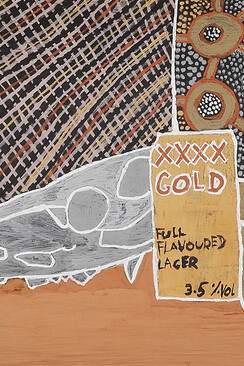
Drawing inspiration from the vanitas paintings of the European Golden Age of still life, Graham uses symbolic arrangements of food to address one of the major contributors to poor health outcomes and reduced life expectancy for Tiwi people. In place of the traditional human skull found in vanitas paintings, Graham substitutes the buffalo, his ceremonial dance and totem animal.
The buffalo depicted in these works carries its own story. It was caught while swimming across the Apsley Strait, lassoed, and brought ashore on Bathurst Island. After being shared among the community for food, its skull was later discovered by chance while collecting ironbark in the bush. Graham transforms this object into a powerful symbol linking culture, sustenance, memory, and mortality.
New foods introduced to the Tiwi Islands have increasingly replaced traditional bush foods, contributing to significant health challenges for Tiwi communities. Graham’s paintings are political works that confront these realities directly. While they speak of difficult truths, of loss, illness, and inequality, they are also intended as acts of care, using art as a way to encourage reflection, awareness, and positive change.
Together, David and Graham present two perspectives on contemporary Tiwi life. One draws strength from ancestral stories that continue to guide and shape Tiwi identity; the other examines the challenges facing Tiwi communities today. Through both approaches, ancient knowledge remains a living force, carrying messages of warning, resilience, continuity, and hope.