English
 Español
 Français
 Deutsch
 Italiano
 Português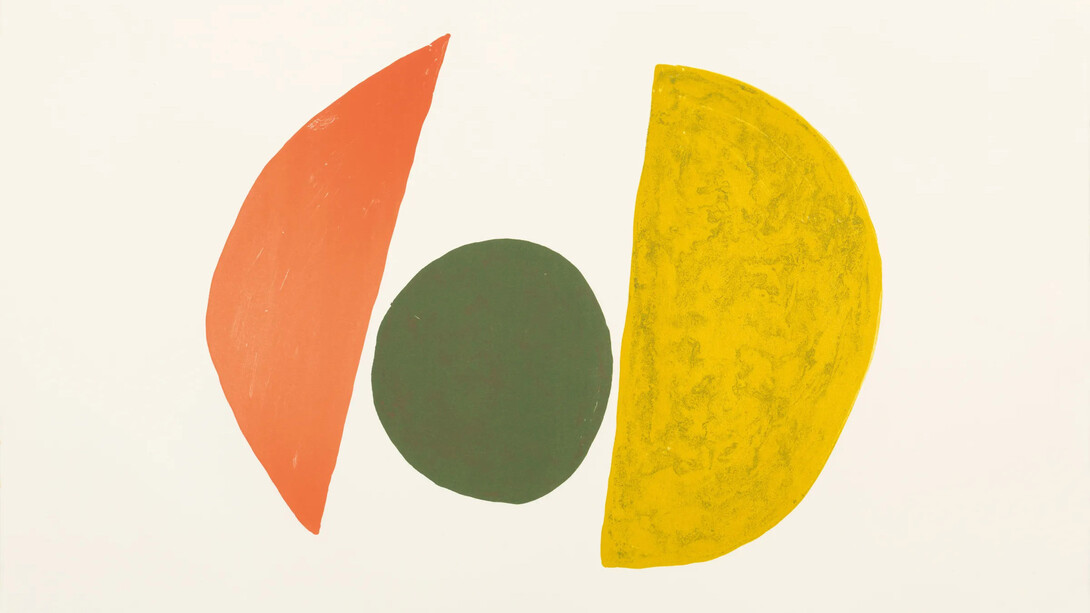
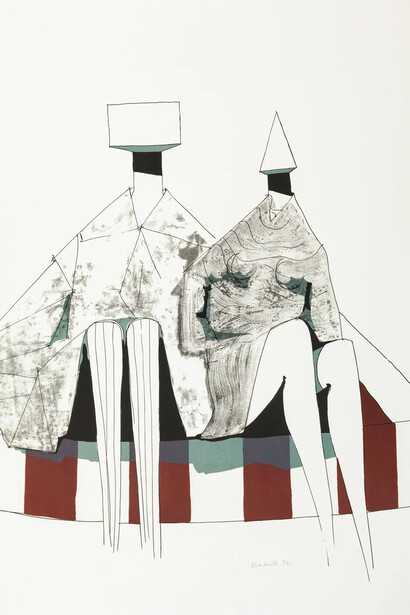
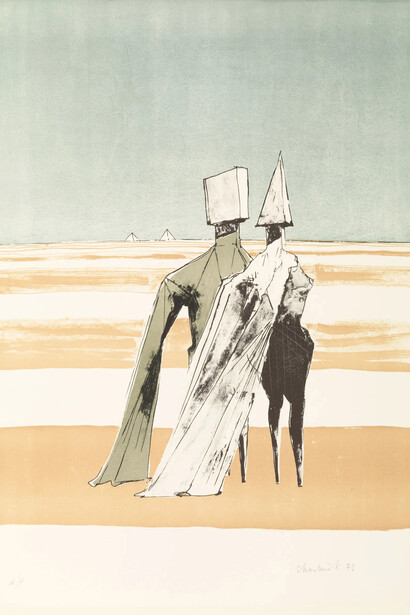
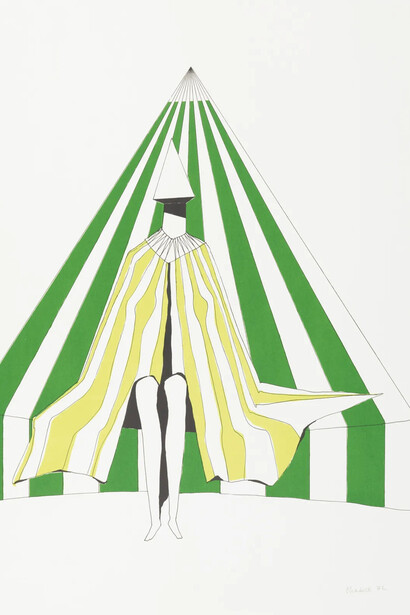
Pangolin London is delighted to present an exhibition focusing on the prints of celebrated sculptor Lynn Chadwick. Featuring screenprints and lithographs created throughout his illustrious career, the exhibition highlights Chadwick’s adept control of line and form in two dimensions and his skill at creating strong graphic images where he could experiment with colour and composition.
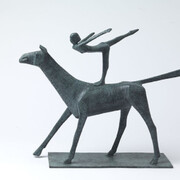
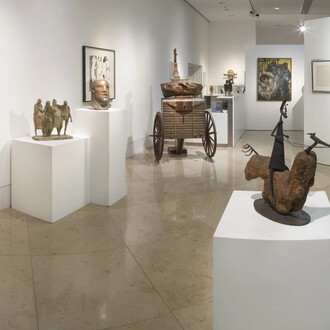
This is the first exhibition of its kind in London and explores the depth of Lynn Chadwick’s visual thinking by presenting his print oeuvre alongside related sculptures.
Throughout his career, Chadwick frequently revisited earlier themes, exploring and refining them across media. Drawing and printmaking provided him with an intimate, immediate way to continue his visual thought process, distilling sculptural ideas to their purest forms.
(Rungwe Kingdon)
In 1956, the year Lynn Chadwick represented Britain at the Venice Biennale, he chose to exhibit as many drawings as he did sculptures. This was also the year Chadwick first produced a print for sale. Created to accompany a monograph by Swiss publisher Jürg Janett, with a text by art historian Herbert Read, Chadwick produced a limited-edition lithograph, Teddy boy and girl (1956), derived from the 1955 welded sculpture of the same name. This lithograph - with its pair of angular figures in pleated coats - brings out the sculpture’s fashion-plate quality and its title references and quietly celebrates the emergence of the first distinctive postwar youth subculture of the 1950s.
Chadwick’s graphic work carries the same visual language as his sculpture with their sharp edges and triangular, spindly limbs. Figures such as Standing figure (Elektra) (1969) draw direct parallels with his sculptures, often taking the form of standing pairs, seated couples, winged figures and sentinel-like forms. In his earlier prints, the use of more muted colours and tones allowed Chadwick to soften his skeletal forms and anthropomorphic abstractions. In comparison, his later prints - such as Grand central (1972) - feature striped and wave-like compositions with use of bold colour fields which speak to the more colourful and graphic turn of the 1960s and 1970s. In most instances, the prints decidedly depart from the sculptures with his experimentation of colour and texture, moving beyond the earthy tones of iron and bronze.
Unlike many of his contemporaries, Chadwick rooted his practice in construction rather than modelling. He primarily used the process of drawing and printmaking to explore the sculpture he had made after its creation rather than to plan it in advance. The medium of print provided him with an immediate way of appraising the sculptural forms he had created, perhaps inspiring new directions in form. Looking back, it’s interesting to observe his progression of visual language running concurrently with his sculpture. He experimented with printmaking throughout his career, from personal Christmas cards to editions made for exhibitions, making some sixty-eight lithograph editions between 1950 and 1976. This reflects the nature of lithography, his most frequently used method of printmaking, where every print is individually hand-crafted ensuring small editions and typically signed by the artist in pencil.
As a result, they are now extremely desirable and offer an excellent acquisition for the first-time buyer or seasoned Chadwick collector alike. Beyond introducing his artworks to a different collector base, Chadwick appears to have learnt something from the translation of his figures from sculpture to print. Mass translated into line, volume into colour and shade and space into composition are eloquent qualities of his multiples. The complete prints offers an opportunity to encounter Chadwick’s work through the primary medium of paper, where the two-dimensional output functions not as an end in itself but as an exercise in balance, structure and kinetic possibility. This selection of prints - with their deft draughtsmanship and directness of image-making - offer valuable insights into Chadwick’s sculpture and artistic practice.