English
 Español
 Français
 Deutsch
 Italiano
 Português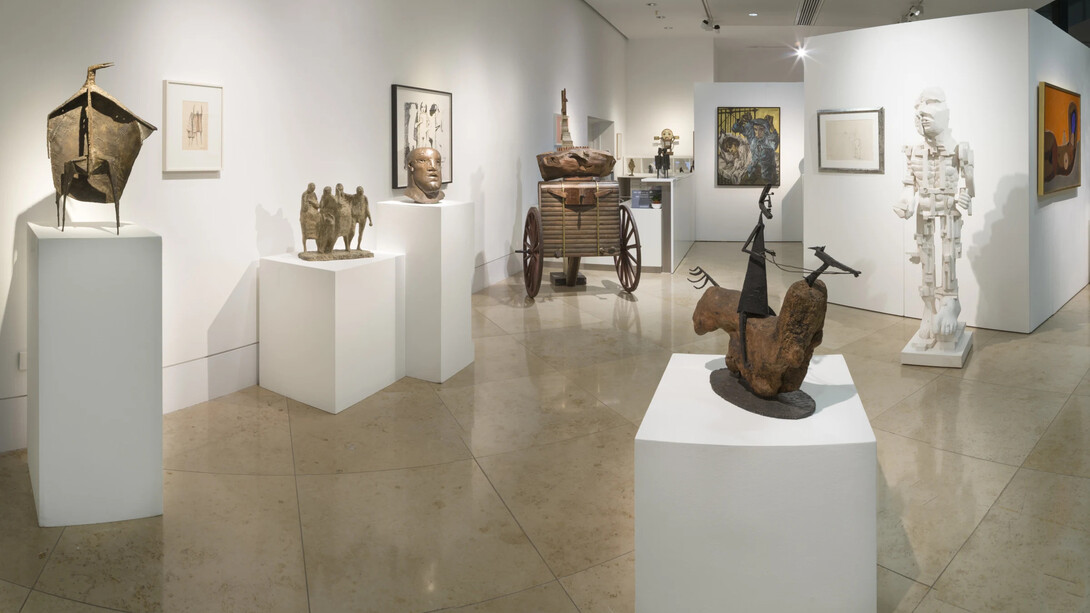
Pangolin London is delighted to announce Reconfiguring the figure, a group exhibition that takes Lynn Chadwick as a point of departure to explore the development of figurative sculpture over the past seven decades. From post-war abstraction to contemporary reinvention, the exhibition brings together Modern British masters and contemporary sculptors who challenge, fragment, and reconstruct the body in new and unexpected ways.
Lynn Chadwick’s sculpture redefined the figure in post-war Britain, replacing soft modelling with constructed, angular forms. His men and women, who are often single or paired, cloaked, winged, sitting, walking, or reclining, are recognisably human yet emotionally distant. Figures are brought to life with polished bronze faces that reflect our gaze and invite us to question our perception of the figure. As Chadwick once remarked, “No expression is an expression.”
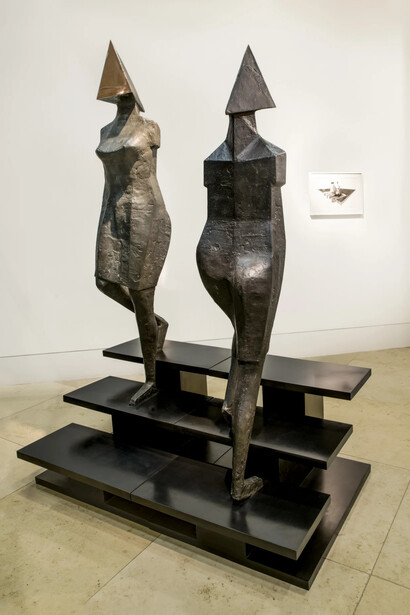
At the heart of the exhibition is Chadwick’s monumental bronze Stairs (1991), the largest works in his series of the same title. Two female figures pass one another on a simple set of steps - perhaps in greeting, perhaps in silence - embodying Chadwick’s lifelong fascination with movement and poise. His process of welding linear skeletons and building them up into solid form produced a sculptural language both architectural and alive, a blend of precision and vitality that came to define post-war British sculpture.
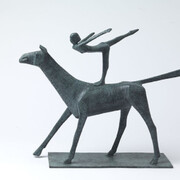
Mid-century sculptors approached the figure from multiple angles: sensual, symbolic, skeletal, and mechanical, placing Chadwick firmly within an innovative group who challenged the classical body. Among them was Geoffrey Clarke, whose Horse and rider (1951) combines forged iron with driftwood found on a beach in Normandy. This rare early work captures both fragility and strength, illustrating the experimental energy of the post-war period, when sculptors like Clarke and Chadwick were pioneering welding as a new language of making.
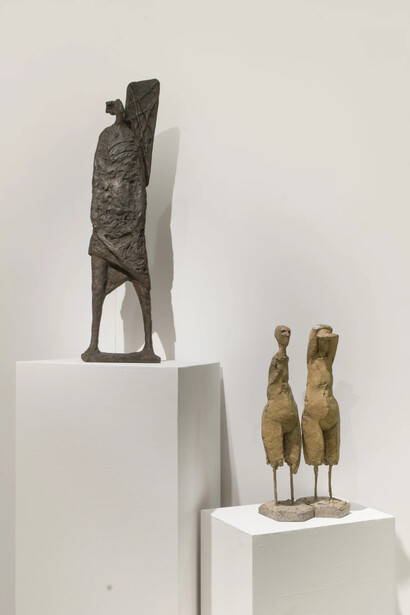
George Fullard’s The infant St George (1962–63) translates the trauma of war into sculptural form, its roughly hewn wood and metal surfaces bearing witness to the scars of experience. Similarly, Elisabeth Frink’s Soldier’s head II (1965) conveys a powerful emotional intensity: the head, scarred and defiant, stands as both a symbol of endurance and a reflection on the human condition. At a time when British sculpture was embracing pure abstraction - a period of remarkable innovation and departure - figuration persisted. Though under threat during this radical shift, artists such as Frink and Fullard continued to push the language of the human form forward. The figure remains sculpture’s most enduring subject, continually redefined to reflect each generation’s anxieties, ideals, and materials.
As the exhibition unfolds, Reconfiguring the figure moves from the post-war period into the twenty-first century, tracing how artists continue to expand the language of figuration through new materials, technologies, and ideas. Today, the figure is interpreted more broadly than ever and is no longer just confined to bodily form. Figurative sculpture has become a means of expressing human presence and emotion beyond representation.
In Zachary Eastwood-Bloom’s Human error (2022), mirrored glass busts created from AI-generated data blur the boundary between human and machine. Familiar yet uncanny, they reflect our image back at us, echoing Chadwick’s polished faces but rendered in a digital age where identity itself is mutable.
Angela Palmer’s The last frontier (2021) pushes the limits of the visible body altogether. Working with Harvard Medical School, Palmer used 1,000 micro-scans of the brain to engrave a three-dimensional image across 28 layers of glass. The result is a luminous portrait suspended in space, extending sculpture into an extraordinary fusion of art and science, making the invisible visible.
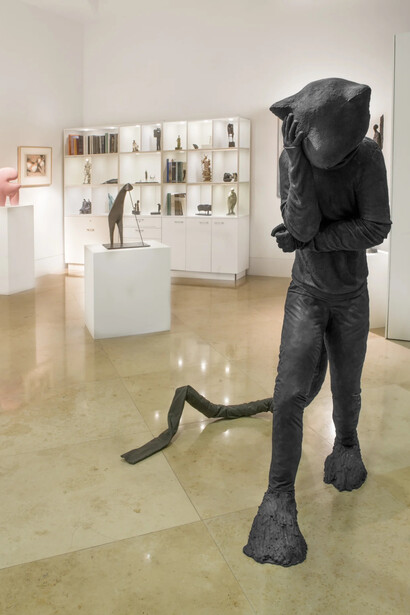
In contrast, Laura Ford’s Days of judgement - Cat 2 (2015) reimagines the human figure through animal form. Inspired by Masaccio’s The expulsion from the garden of Eden, this tall, cat-like figure paces anxiously, embodying guilt and self-reflection. Stripped of facial expression, it mirrors our own emotions. With humour and empathy, Ford captures the fragile tension between vulnerability and resilience that defines so much of contemporary life.
These contemporary works expand the language of figuration while remaining connected to Chadwick’s legacy of experimentation. Reconfiguring the figure reveals how the body, whether carved, cast, welded, or scanned, continues to serve as sculpture’s most profound and adaptable vehicle for exploring what it means to be human.