English
 Español
 Français
 Deutsch
 Italiano
 Português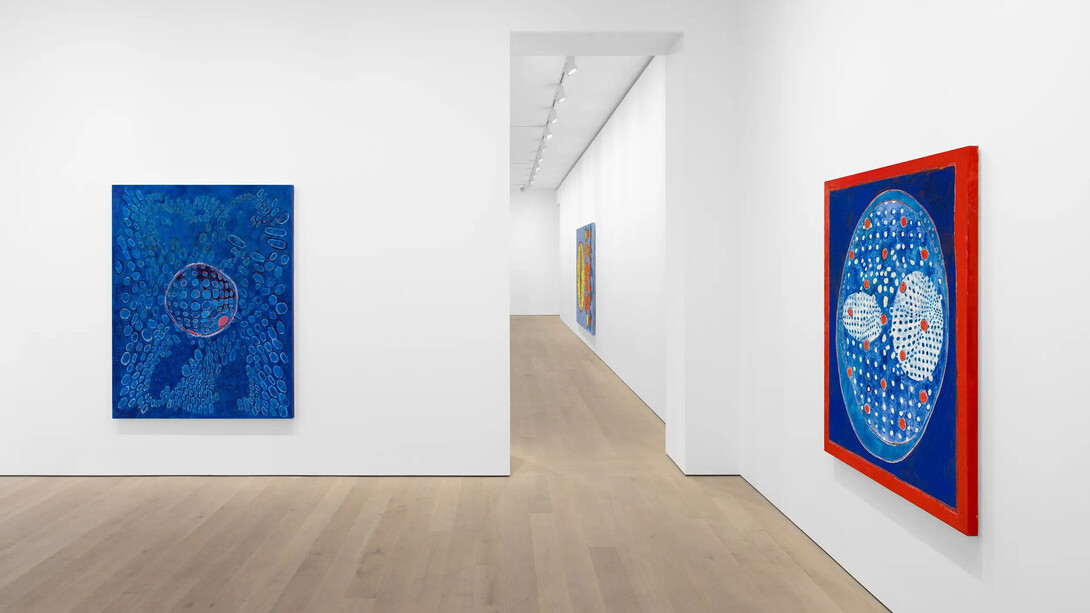
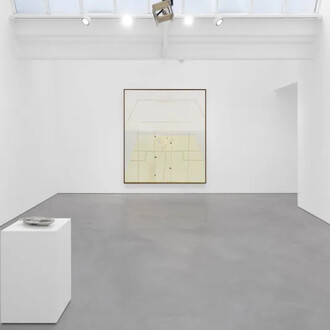
Modern Art is pleased to announce a solo exhibition by Terry Winters, Along the river, the artist’s second presentation with the gallery.
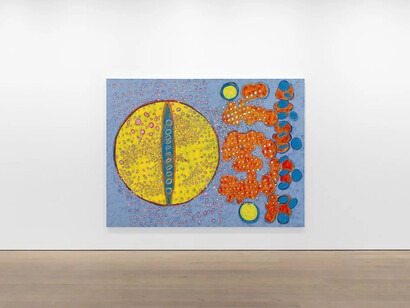
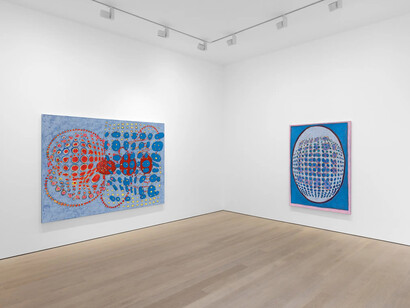
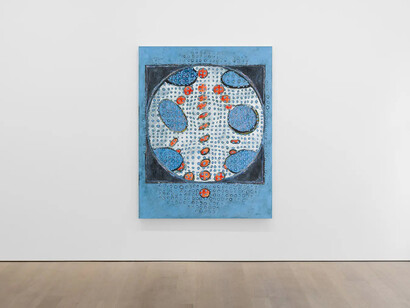
For over four decades, Terry Winters has produced a body of work that renews our optics of nature. This exhibition extends Winters’s interest in envisaging different forms of recorded observation, revealing it as inherently subjective, partial and ever shifting. Through painterly abstractions of complex, imagined structures, rotating webs and vertiginous spatial points, Winters touches upon the ungraspable that escapes our field of vision. His densely built, chromatically rich canvases appear to dart beyond our everyday realm. Winters torques and bends space to reveal perception itself as a material, manipulable form, as he observes of his work: ‘The paintings are a-signifying signs, a poetic mix of the technical and the magical’.
The title of the exhibition is taken from a 1906 letter written by Paul Cézanne in Aix, France, to his son, in which he reflects that ‘Here, along the river, the motifs multiply.’ He adds that ‘same subject, seen from another angle, offers a subject of the most compelling interest … I could work for months without changing position, but by just leaning a little to the right and then a little to the left.’ For Winters it is this minor movement of one’s position that opens the complex, transitory relation to the material world. Here one’s place along the speeding river becomes a capacious, cognitive realm in which his technical images, durational diagrams and imaginary spaces appear to both reorder and supplant unifying logics that determine perceptions of the natural world.
A native New Yorker, Winters’s thinking was shaped by the aesthetics of the 1970s where the discourse of Post Minimalism and Process Art informs his approach to traditional painting techniques. The eight new works included here, are all oil on linen, each title comprising one word – Locus, field, Scope, Point, Area, Sequence, Array and Set – were produced at his rural studio in Upstate New York. Each painting is a ‘laminated structure’, developed and transformed over time, until they reach a place of resolution. This new body of work extends his previous Point cloud pictures, referencing a term borrowed from the field of three-dimensional modelling – suggesting also, fleeting cloud formations and the studies of John Constable made in the early 1820s.
A diverse range of references are synthesised but ultimately return to the life of abstraction – on molecular, cosmic and compositional levels. His paintings take shape as a vehicle of embodiment and extension, where meaning emerges as lyrical description. Winters’s committed experimentalism lies in how form carries contingencies, as elements appearing ‘along the river’ and frees us from the flow of information as wholly nameable or knowable.