English
 Español
 Français
 Deutsch
 Italiano
 Português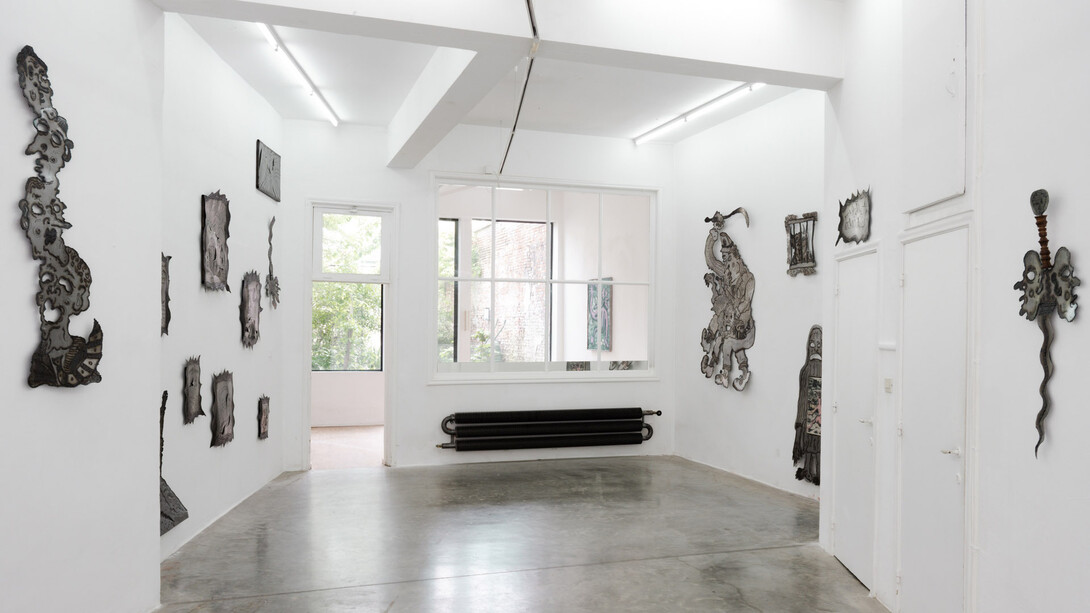
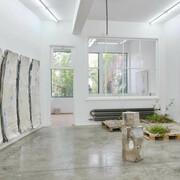
"My body is the abyss between me and myself”, wrote Fernando Pessoa, capturing the paradox of an existence where the self is always divided the observer and the observed, the bridge and the void. In the duo exhibition Siamese others, Elen Braga and William Ludwig Lutgens take up this metaphysical thread, exploring the blurred boundaries of identity through the lens of conjoined existence. If the body is a dream of a bridge, then here that bridge has become flesh, or at least a skin of latex. The body is a site of contest and fusion where the path to the other is built into the self, reflecting a world in which we are never truly alone but always entangled fused to the gazes, digital echoes and histories of the others we carry with us.
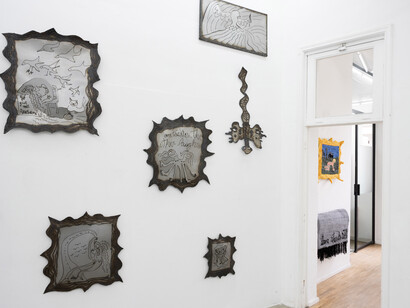
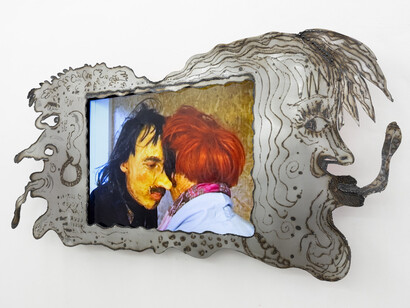
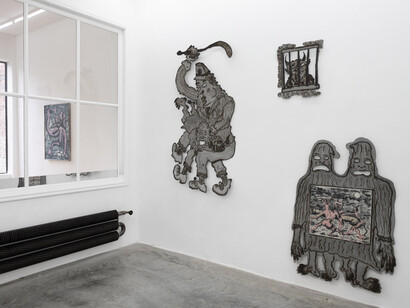
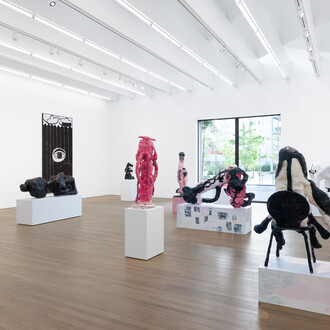
In a departure from their habitual practices, Braga and Lutgens literalize the above tension through a shared medium steel, shaped by the plasma cutter and the arc of the weld. This choice transforms the abyss into a visceral act of carving a self out of a collective mass, resulting in works that function as a physical exchange between two voices navigating a single, resistant material. These conjoined forms oscillate between the psychological and the systemic.
In Lutgens’ work A brother-thief had robbed him while he slept, and Gone ashore at some intermediate landing, a two-headed figure, part Janus, part Pan, bolts through a doorway, their shared suit straining at the seams as a faceless hand yanks them back. It is the politics of the divided self an illusion of escape where the body itself remains the primary battleground. This violence of unity shifts to a global scale in The politician from the other side of the river, where the map of the European Union is reimagined as a grotesque, singular organism. Faces representing individual nations are distorted and suffocated, merged by treaties and debt – a hostage situation where sovereignty is the first sacrifice to the collective.
Braga’s pieces One tickles, the other laughs and Crying birds extend this inquiry into the mechanics of escalation, suggesting a volatile, interconnected system where a single provocation can trigger a chain reaction across the entire body of the world. This entanglement reaches a cosmic scale in The creation myth. Recalling the original double-beings of Plato’s Symposium, Braga scales the primordial state to a universal level by depicting a many-limbed woman resting upon the Cosmic Turtle of Indigenous American mythologies. Here, the bridge expands beyond the human to connect species, myth and planet, suggesting that our existence is a collective engine supported by non-human histories and inextricably fused to the earth.
As Hilda Hilst wrote, existe sempre o mar sepultando pássaros, renovando soluços, rompendo gestos (there is always the sea burying birds, renewing sobs, breaking gestures). In Siamese others, that sea is the space between us – an abyss that Braga and Lutgens remind us we can only navigate together, acknowledging that existe sempre uma partida começando em ti (there is always a departure, an ending, that begins within the other).