English
 Español
 Français
 Deutsch
 Italiano
 Português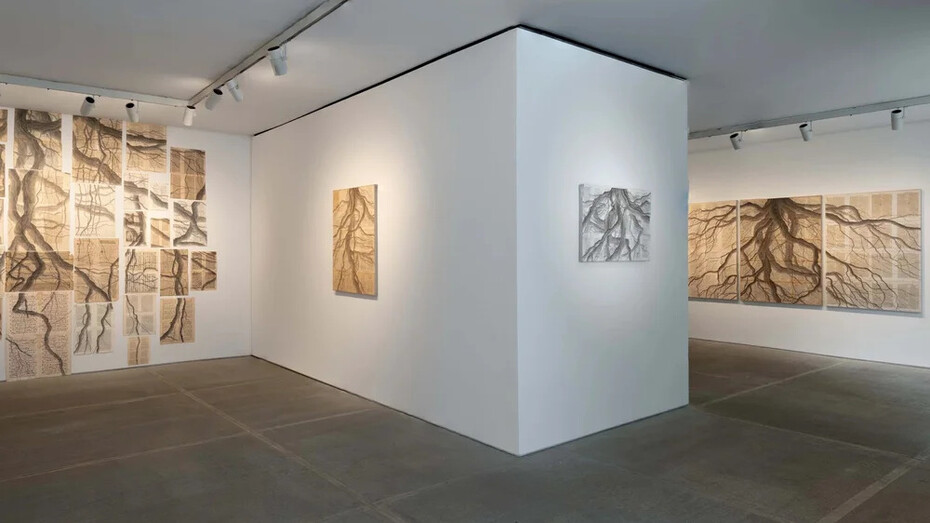
TOTAH presents The time that's left, an exhibition of works by Italian artist Tommaso Spazzini Villa. Opening May 14, 2026, this marks his first solo exhibition with the gallery, and his first in New York City.
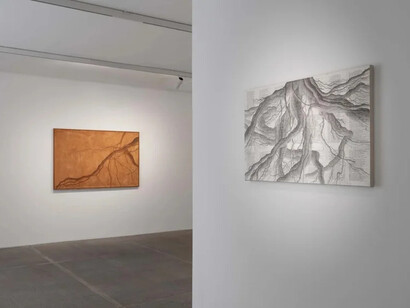
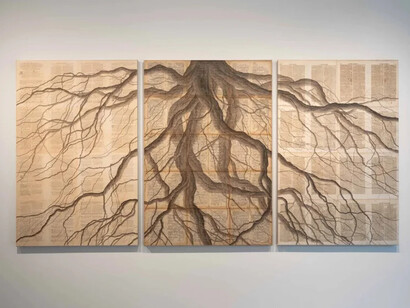
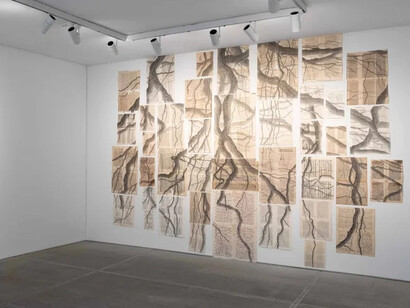
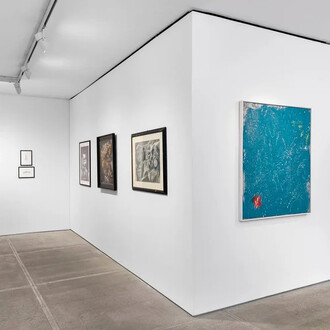
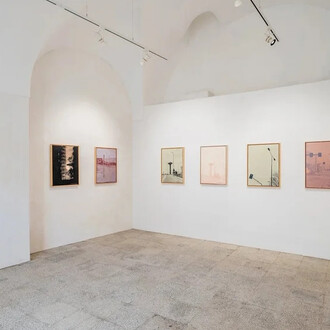
Tommaso Spazzini Villa's current exhibition expands on ideas central to his recent largescale mural work located on West 45th Street in Hell’s Kitchen. Moving from public space to the more intimate setting of the gallery, the repeated roots spread across a wall now extend into drawn interventions on the pages of antique volumes. These graphite works, meticulously traced across pages of sacred texts, epic poetry, theater, and musical scores, radiate, tangle, and proliferate over the printed surface. Set against canonical textual backdrops, these forms suggest a parallel system of growth—one that doesn’t follow the linear order of language, but branches outward, accumulating, diverging, and reconfiguring.
These root forms are not incidental. Hidden beneath the ground yet essential to all life, they operate as structures of support, transmission, memory. If print organizes knowledge into linear sequences and hierarchies, Spazzini Villa’s drawings introduce a counter-logic: one that branches, doubles back, and extends beyond the margins of the page. What emerges is a quiet tension between what can be read and what can only be intuited: between the visibility of the printed word and the submerged systems that sustain it.
This tension is carried into his sculptural works. Spazzini Villa’s metal box constructions— composed of wire, light, and unaltered dried leaves—translate perception into intimate shadow theaters. At first, these small interiors look like enclaves of light. As the eye adjusts, silhouettes begin to form: miniature dioramas that briefly cohere before dissolving back into a constellation of wire and leaves. These shadow-images emerge through a precise alignment of fragile elements, and exist only so long as that alignment holds.
Spazzini Villa’s work hovers between what is given and what must be discovered. Whether in dense networks of graphite roots or in the furtive imagery cast by light, a single gesture reveals itself: the foregrounding of systems that lie below the surface, shaping what we see without ever fully revealing themselves.