English
 Español
 Français
 Deutsch
 Italiano
 Português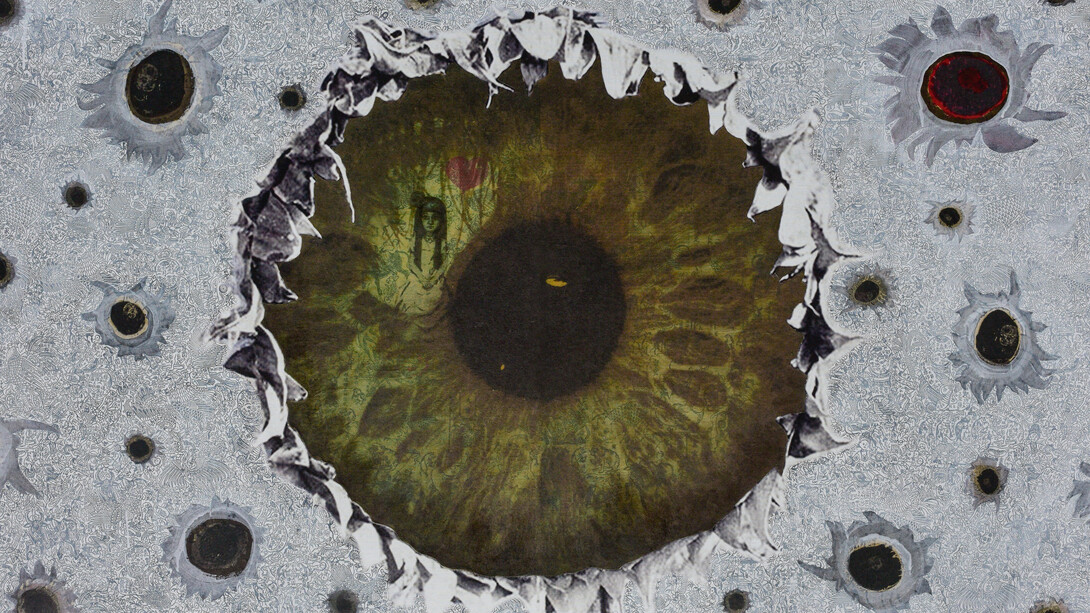
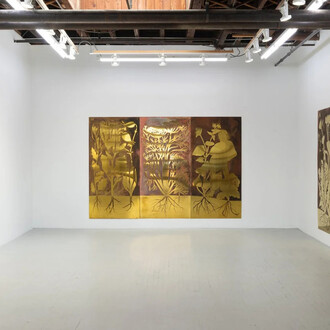
Eli Klein Gallery is honored to present Bùi Thanh Tâm: here on and after, the Hanoi-based artist's first solo exhibition in the U.S. and with the gallery, featuring 13 new and recent paintings. The title reflects the artist’s exploration of the “after” of Vietnam’s colonial history—the afterlife of war, the persistence of memory, and the continual reshaping of cultural identity. Tâm is widely regarded as one of the most important Vietnamese painters of the postwar generation. This exhibition marks a significant evolution in his visual lexicon, extending the depth and complexity of the language he has developed over decades of practice.
Through layering, collaging, recoloring, and reshaping, the artist treats Đông Hồ, Hàng Trống, and Kim Hoàng, traditional Vietnamese folk woodblock prints commonly used during Lunar New Year celebrations, as living forms of inheritance. Tâm transplants these woodblock motifs into different visual soils, where their shared genetic essence yields distinct offspring shaped by sacred and historical iconographic contexts. The result is a body of works that remains deeply rooted in tradition while taking on new forms.
If these traditional folk woodblocks operate as seeds, the sunflower emerges as their emblem of growth and renewal. Having closely studied Anselm Kiefer's scorched sunflower landscapes and Francis Bacon's existential distortion, Tâm envisions the sunflower as a symbol of resilience and rebirth. Yet its pursuit of light remains shadowed by cultural fragmentation and war's enduring scars, from French colonial invasion to Agent Orange's intergenerational trauma.
In his Searching for the sunflower series, the sunflower becomes an eye marked by rupture. Set against a densely patterned field of other watchful flowers, it reads like a pupil opening onto a fractured world. Rather than blooming outward, its eyelash-like petals peel back to reveal a dark iris, creating the sense of a gaze that is both outward-facing and inward-turning. The result is a double movement in which the flower searches for hope even as the viewer is drawn into its wounded interior.
Religion, and the promise of salvation, may be imagined as a means of healing such wounds. In the Hello. God is here series, the sunflower’s center opens into a deep blue cosmos, while a figure in front hauls a tilted cross, playfully raising a peace sign. The cross’s slanted orientation stresses its weight, transforming Christ from an icon of rebirth into a burdened body. Salvation, then, appears less as transcendence than as endurance through struggle.
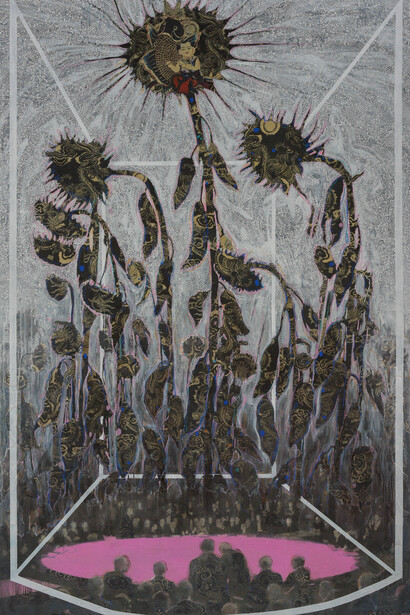
That sense of struggle intensifies in the Utopia series, where the sunflower lies within a demarcated visual space. Black blooms rise upright in narrow prism cages, while punctured forms, swirling marks, and hidden details animate the surface around them. The cages do not simply confine the flowers but make visible resilience as something that must persevere through pressure and obstruction, echoing a contemporary Vietnam shaped by the legacies of colonialism and the uneven passage of Đổi Mới reform.
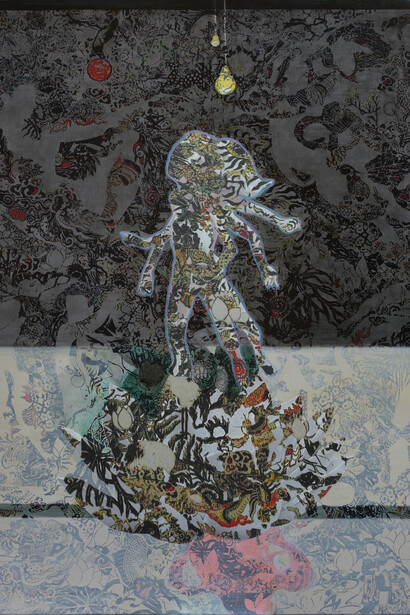
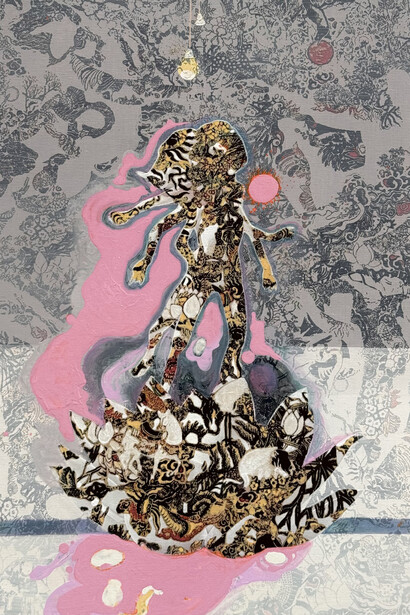
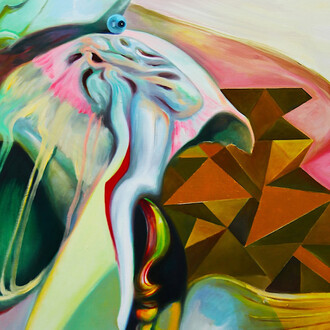
The Mutant series extends transformation into a more varied and unsettled register. Unlike the relative consistency of previous series, each work occupies its own distinct background and environment. Figures emerge as hybrid, composite bodies, layered through collage and outline rather than cleanly defined form. They seem to hover between states, as if shaped through mutation rather than natural evolution. They imply that growth is rarely seamless—it is shaped by historical violence and generational trauma, passing forward through forms fractured, then reassembled.
These works locate Tâm’s image-world within a larger field of cultural survival and reinvention. With an exceptional command of inherited form, the artist treats Vietnamese woodblock traditions, Kiefer’s charged histories, and Bacon’s distortions as living sources that he repeatedly transplants, revises, and reanimates. In Tâm’s practice, the series is not simply a grouping but a sophisticated visual strategy, allowing him to test how a shared image can renew itself under ever-changing conditions. The result is a body of work marked by a mastery of transformation, where meaning emerges not from singular originals, but from dispersed encounters within our collective consciousness, here on and after.