English
 Español
 Français
 Deutsch
 Italiano
 Português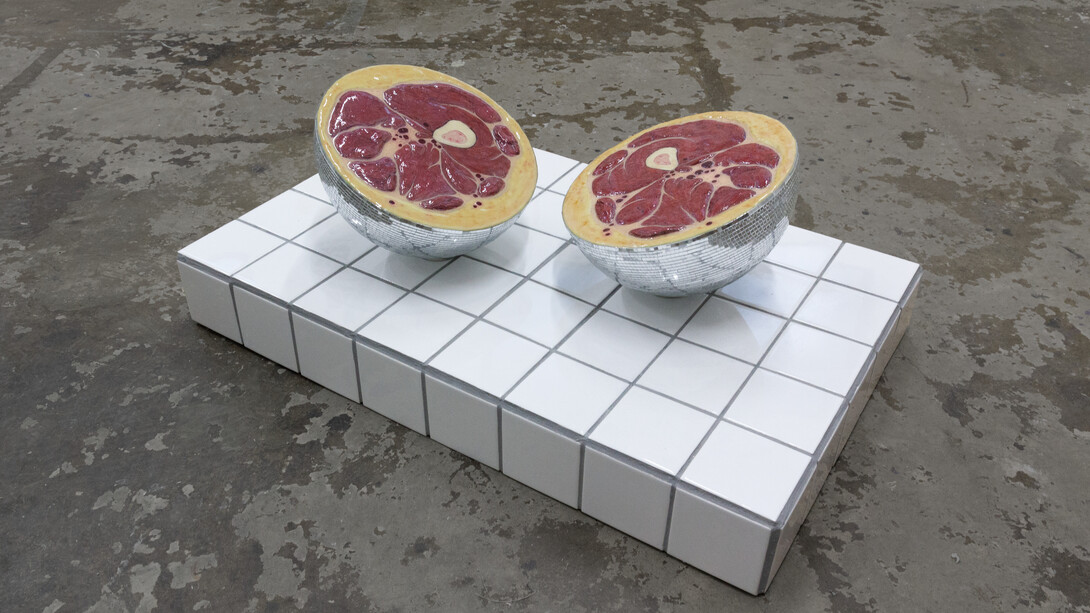
Eli Klein Gallery is honored to present Andrius Alvarez-Backus: I want to know, I need to know, the artist’s first solo exhibition with the gallery, debuting six major multimedia sculptures and a series of works on panel. Emerging from a series of health incidents experienced by the artist and his family over the past year, the exhibition examines the intersection of the artist’s primal pursuit of self-knowledge and the denial of a fully transparent answer in its process. To Alvarez-Backus, knowing begins with urgency and does not end in absolutes—ambiguity is a form of truth.
Born to a family of Filipinx medical practitioners, Alvarez-Backus’s pursuit of ancestral and family connection is not only the passing down of cultural heritage, but also a flesh-bound visceral kinship, with his contemporary art practice deeply informed by the study of surgical medicine. This brand-new body of work, created during his current residency at Smack Mellon, is driven by extrapolated and translated surgical gestures: dissection and resection, incision and excision. These decisive cuts signal a yearning to reveal the subcutaneous, even when what is revealed ultimately produces more questions.
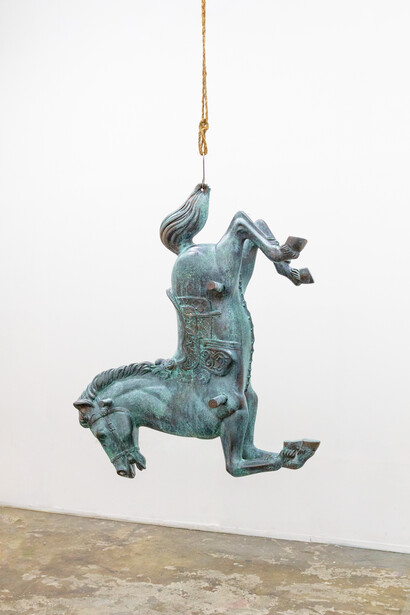
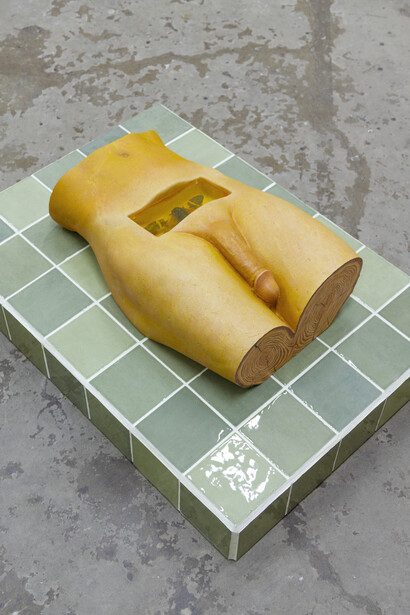
In Are you still strong enough?, a reclaimed Wonder Horse toy was deified through the application of bronze patina. A sutured wound was meticulously sculpted down the abdomen of the animal, which is hung vertically. In this work, Alvarez-Backus finds a balance between gesturing as a means to alter and sculpting as a means to create. The decisive cut becomes metaphorical in “I Was Softer Then,” where a spliced disco ball reveals its interior anatomy to resemble the cross-section of a human thigh. If surgeons cut to mend what is supposed to be there, Alvarez-Backus’s wishful cutting instead reveals the tenderness of his subconscious. For Alvarez-Backus, exposure does not equate to legibility.
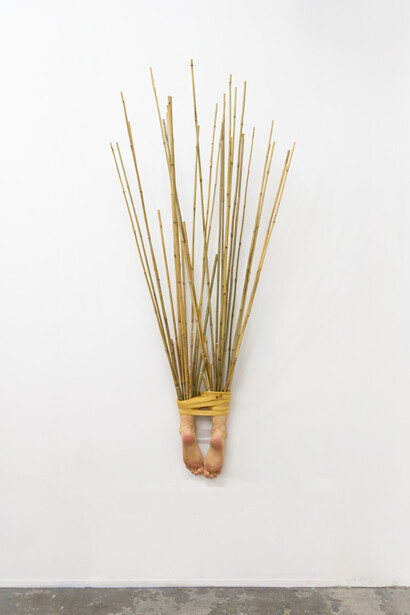
If anatomy calls for deductions, Alvarez-Backus also extends his imaginary procedures on the other side of the spectrum: extension and generation. You took your time with me witnesses shoots of bamboo growing out of a pair of feet that were displaced, rendering the new limbs fluid, resilient, and prone to arrangements. On the other hand, To whom I belong depicts a half chair precariously leaning against the wall while supporting a half phallus. The artist questions the definitive belonging of knowledge by asking whether a piece of furniture grows into a body part, or a body part materializes into an object with a utilitarian purpose. Perhaps there exists a state between absolute agency and passivity, where knowledge neither acts nor submits.
In the wall-based assemblages, reclaimed textiles act as surrogates for flesh and sources of comfort. They are stretched, torn, split apart, and held together at the seams, and in that tension reveal resilience and care. Many of these familiar forms undergo a process of slicing and splicing, which allows them to register both violence and trauma as well as the gradual progression toward healing and grafting. This duality becomes a material metaphor for rupture and repair. Installed consecutively over the long gallery wall, a series of ten flat works form a skin of sorts that is simultaneously connected and ruptured. Like individual cells sharing the same pedigree, these works, reminiscent of individuals performing collectively in a society, call for self-generation if one dares to split from their kind. Alvarez-Backus demonstrates a worldview of organic separation and re-organization, where rupture becomes a condition for kinship rather than its negation.
Turning the gallery into a subcutaneous site, I want to know, I need to know shares an epistemology that mobilizes a range of tools, artistic or surgical, such as life casting, woodworking, clay modeling, painting, drawing, cutting, re-constructing, the appropriation of found objects to inspect if the scientifically true and the artistically valid can be sutured.