English
 Español
 Français
 Deutsch
 Italiano
 Português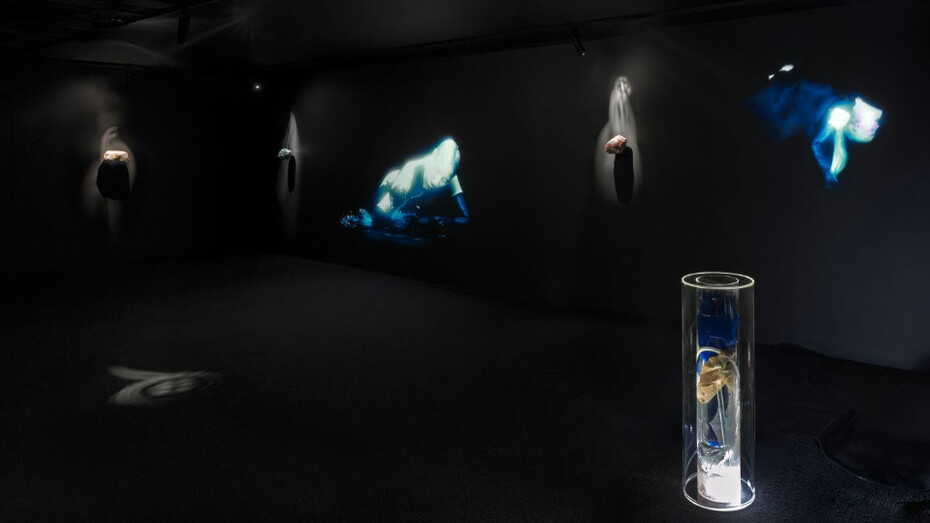
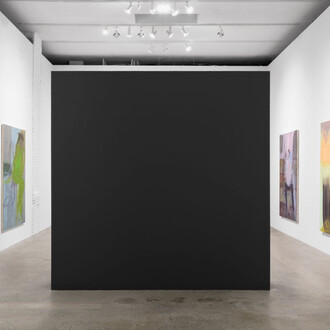
Hayden Dunham’s third solo exhibition with the gallery, Never is over, stages the cosmological tendency towards reconnection through the artist’s most recent iterations of sculpture, video, and sound.
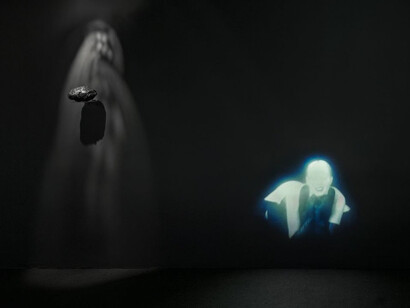
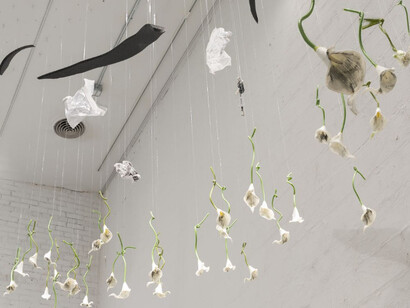
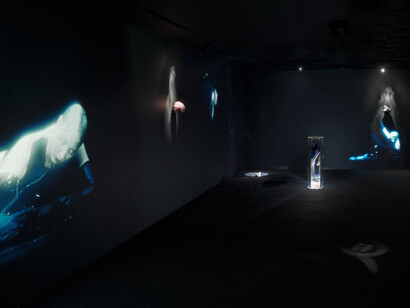
In the gallery’s central atrium, lifetimes of lilies, hand-written notes, and obsolete keys float overhead, weightless and free from gravity. A transparent ladder connects the floor and ceiling, leading down to the gallery’s lower level where a large glass battery sits, its contents leaking. Throughout the installation, a diaphanous score blends whale songs with the 526 hertz frequency of a black hole, a sonic register believed to aid cell regeneration.
Seven unassuming vessels placed throughout the lower gallery contain the recorded voices of the departed, with connections to the artist ranging from the personal to the inspirational (Octavia Butler, Pippa Garner, Radclyffe Hall, Sacha Kozlow, Sally Ride, William Winter, Sophie Xeon). These spoken messages can only be heard if the objects themselves are broken open, the light sensitive sounds inside are unlocked by the sun, and the contents set free.
What if redemption was the natural law of the universe? If redemption was not an act of salvation bestowed by a generous God, nor the fruits of willful self-improvement? What if there were no debt to be repaid, no pledge to be fulfilled, no perpetual atonement. If atoms, animals, people, and worlds always self-liberated, went upward, and returned to the heavenly matter from which they came? What if redemption was simply to rejoin?
The exhibition explores the premise that a return to oneness is the inevitable trajectory of both beings and things. Atoms, the smallest actors of the physical world, primarily organize into bonded pairs and groups. They do this because joint arrangements are simply more stable. Breakage happens but separation is temporary, as fragments recombine into new bonded pairs. This means that without the severing of bonds–without breaking open containers–there can be no subsequent joining or returning.
At the edge of separation, on the precipice of isolation, remember that letting go is necessary to come back together. Stars, too, pull in stray material, consuming solitary or free-floating matter and folding it into themselves. At every scale, matter tends toward relation and reconnection. Everything in the universe has been a star, and will be again. As the Buddhist adage goes: all beings have been your mother.
Theological notions of redemption promise wholeness through restored community or a healed self. But matter teaches us that all objects move toward more stable, connected states and that separation begets reattachment. Never is over is neither a final judgment nor a resting state. It is without beginning or end: it is iterative, a continuous cycle, and a perpetual motion of which we are already a part.