English
 Español
 Français
 Deutsch
 Italiano
 Português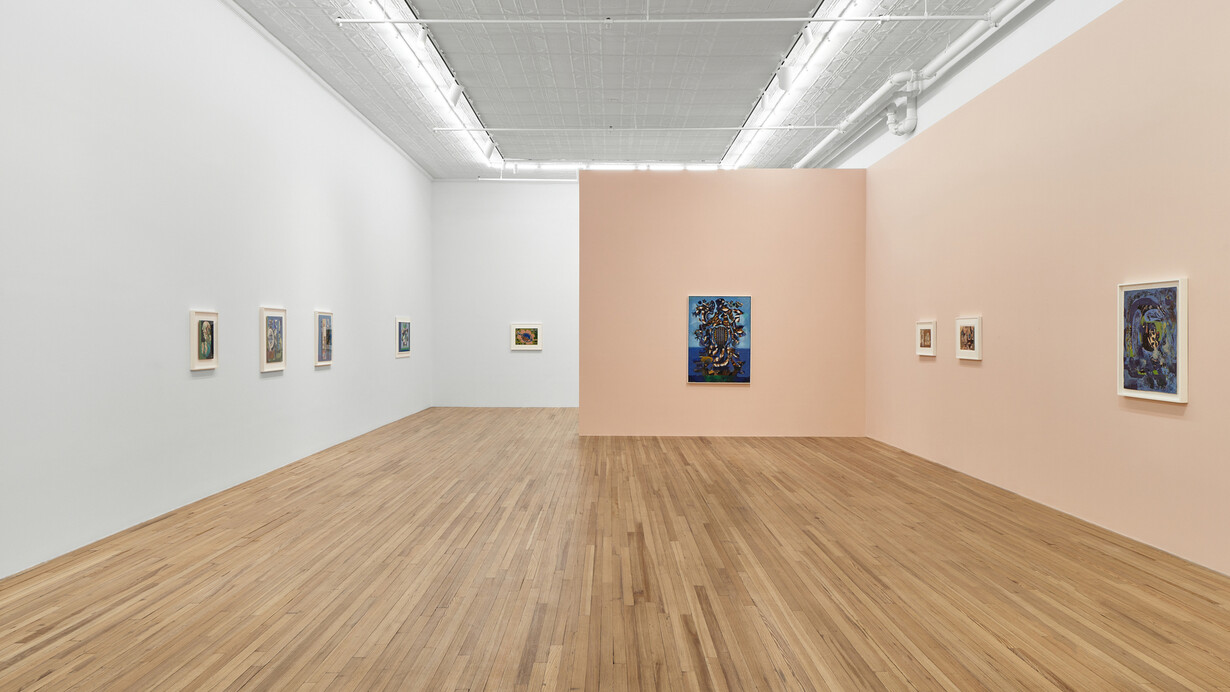
Andrew Kreps Gallery is pleased to announce Leaves of the world, an exhibition of works by Eileen Agar (b. 1899, Buenos Aires, Argentina; d. 1991, London, UK) spanning seven decades of the artist's career. A parallel exhibition of Agar’s work will open at Alison Jacques, London, this June.
My life is a collage, with time cutting and arranging the materials and laying them down, overlapping and contrasting.
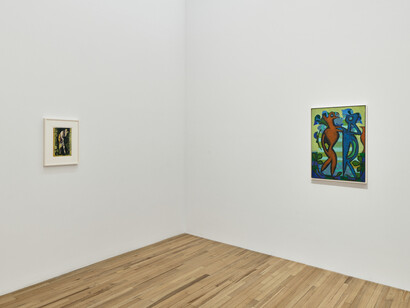
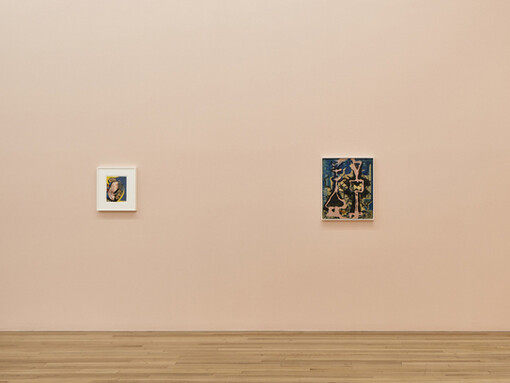
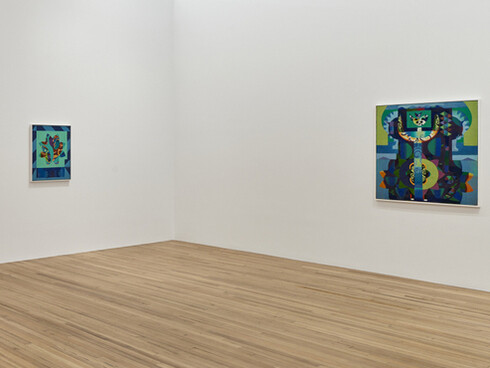
Throughout her career Eileen Agar maintained a tenuous relationship with surrealism, taking cues from concurrent movements like cubism, and abstraction, while simultaneously interjecting a consistent irreverence and wit. The result was a deeply personal artistic language that linked diverse forms and objects through both spiritual, and formal relationships, as well as her own autobiography. Including works made between 1927 and 1980, Leaves of the world underscores the enduring importance of collage to her work, not only as a technique, but a way of synthesizing the kaleidoscopic references, and ongoing conversations with artists and writers that informed her work. This includes Agar’s relationship with the painter Paul Nash, whom she met in the coastal town of Swanage in the mid-1930s, which led to life-long fascination with the found object, as well as the ecology of the sea. Rich hues of blue would begin to dominate her palette, as evidenced by Leaves of the world, c. 1940, where an interplay of transparent layers and bold swaths of paint create a vortex-like form, revealing delicate branches at its center.
While the second world war had a profound impact on Agar’s practice, devoting her energy to the war effort in spite of her pacifist stance, she approached her work with a renewed vigor at the end of the 1940s. Paint became increasingly alchemical, as she experimented with poured enamel, and introduced geometric forms that both defined figurative elements and created windows into the complex architecture of her compositions, like the torqued silhouettes of Personnage, 1949. Her move to West London in 1958 enabled Agar to translate these visual strategies to a new scale.
In both Deus ex machina, 1963-1965, and Medusa, 1965, Agar creates an array of planes within the image, interjecting a vernacular of recurring motifs of flowers, curves, and shell-like forms, and abstract references to her interest in Greek theater and mythology. This process of layering visual fields would be furthered with the introduction of acrylic paints to her practice in the late 1960s, like the zig-zagging lines, and bold swirls that comprise La fleur, 1972. Agar would continue to experiment freely with material throughout her life, but it was this persistent curiosity and sense of artistic freedom that unites her work, stating, “to play is to yield oneself to a kind of magic. In play the mind is prepared to accept the unimagined and incredible, to enter a world where different laws apply, to be free, unfettered and divine.”