English
 Español
 Français
 Deutsch
 Italiano
 Português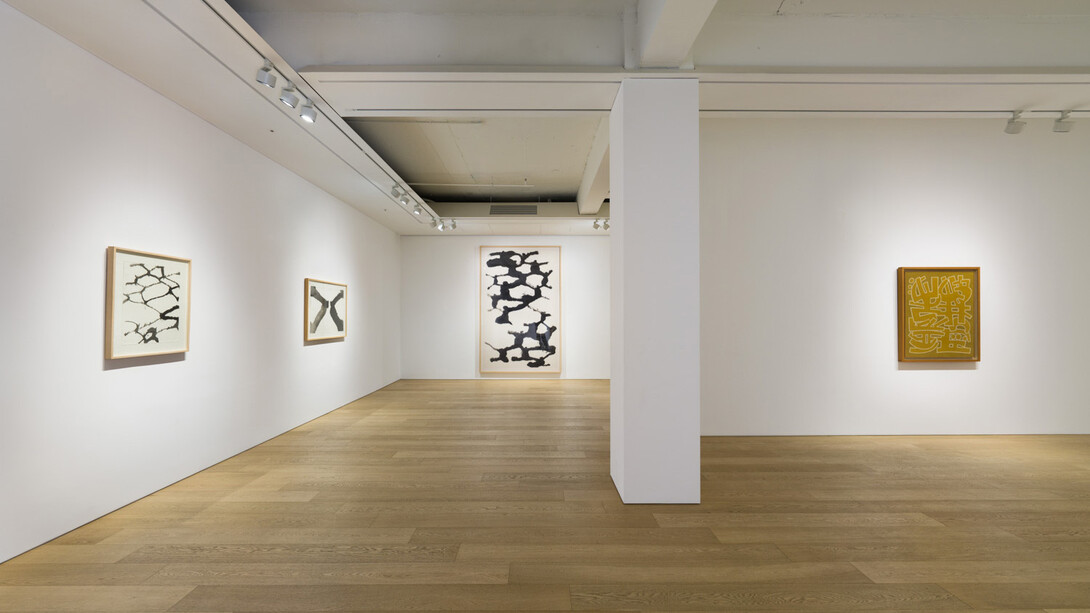
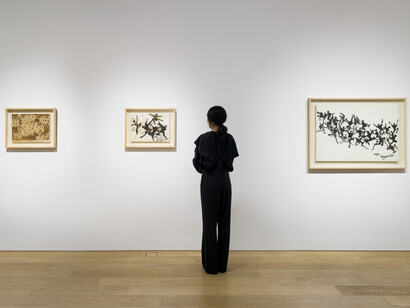
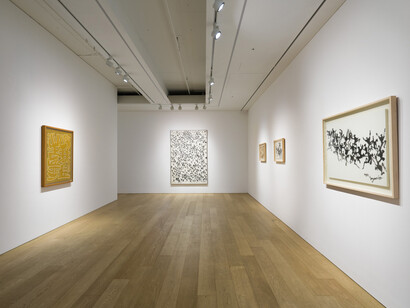
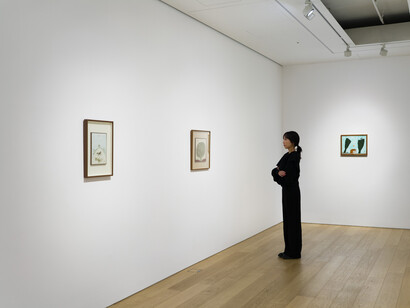
Lehmann Maupin Seoul is pleased to present an exhibition of work by Chang Ucchin, Lee Ungno, and Suh Se Ok, three pivotal masters in modern Korean art who redefined the relationship between the individual and the collective through distinct yet intersecting visual languages. The exhibition title reflects a shared concern in their practices: while each artist approaches the human figure as a singular presence, their works extend beyond the individual to consider humanity as a whole. Working across ink and oil, figuration and abstraction, they treated the brush as a structural instrument, organizing line, mass, and interval into rhythmic compositions that articulate how figures gather, disperse, and inhabit shared space.
Emerging from different artistic formations and historical circumstances, each artist engaged tradition in distinct ways. Lee and Suh approach the legacy of East Asian ink painting and calligraphy as a foundational visual framework to be expanded, abstracted, and reoriented toward modern concerns. Meanwhile, Chang—working primarily in oil and intermittently in ink—did not explicitly align himself with a continuous literati lineage. Instead, his work distills visual form to an elemental clarity that parallels ink aesthetics without claiming its inheritance. In each case, tradition becomes neither static nor purely referential, but a flexible structure through which the conditions of modern life and shared existence are examined.
*Lee Ungno’s practice traverses the embodiment of the sign and the signification of the body. As suggested by his early pen name “Juksa” (literally meaning ‘calligrapher for bamboo’), bamboo marks the point of departure for his artistic universe, gradually transforming into calligraphic script and, ultimately, into human figures. In his paintings, characters stand or dance like figures, capturing visual similarity between bodily movement and written language. In his 1970s Abstract letter works, figuration fuses with gestural brushwork within a calligraphic structure. From 1979 onward, Lee concentrated on his celebrated Crowd series, in which figures traverse the picture plane to generate a collective rhythm. Repeated strokes and modulations of ink blur the boundaries between individuals while preserving the vitality of each gesture. Lee sought to expand the resonance of these works beyond political specificity and toward a universal language of shared breath and movement. A 1987 work from the Crowd series, produced during the final decade of his life, unfolds along a dynamic diagonal composition: interwoven figures expand across the canvas with powerful momentum. Repetitive brushstrokes soften individual contours yet animate each body, while tonal gradations of black ink weave the entire surface into a single, rhythmic expanse.
Chang Ucchin’s oil paintings present a lucid and simplified world in which recurring motifs such as sun and moon, figures, dogs, calves, trees, and houses all coexist on an egalitarian pictorial plane. His career is often divided according to the locations in which he lived and worked: Myeongnyun-dong, Deokso, Suanbo, and Yongin (Singal), each marking subtle shifts in style. In Tree (1984)—which was created during his Suanbo period, distinguished by heightened formal radicality—a solitary tree anchors the center of the canvas like a rotating earth, establishing pictorial order while evoking both cosmic and quotidian cycles. Within restrained forms, luminous color fields, and unadorned imagery, Tree is a distilled meditation on the essence of life.
Around 1977, Chang also devoted himself to ink paintings that articulated a different mode of modernity through the tension and transparency of single, decisive brushstrokes. While retaining traditional materials, these works enacted a conceptual shift. Referring to them modestly as “toying around with the brush” or even “brush fun,” Chang distanced himself from institutional categories. As shown in Two men under the tree (1982), his simplified forms and flattened compositions do not reiterate traditional landscapes or bird-and-flower painting; rather, through symbolic reduction, they probe the structural conditions of existence.
Sanjeong Suh Se Ok’s works inhabit the spirit of literati painting while expanding the horizon of ink abstraction. The formation of the Mukrimhoe (Ink Forest Society) in 1960 marked a crucial turning point for the artist, who joined as the group sought to root experimental ink painting in the legacy of literati tradition. Suh subsequently pursued the essential qualities of humanity and nature through restrained brushwork, repetition, and rhythmic composition. In his seminal People series, minimal lines coalesce into clusters of figures that connect and disperse. Swift strokes and the diffusion of ink into hanji paper reveal both performative gesture and material presence, reducing the relationship between individual and collective to an abstract structure. Figures become symbolic entities; within a system of repetition and variation, the dynamics of community and individuality emerge in distilled form.
Working contemporaneously, Lee linked ink painting to international discourses of abstraction, Suh expanded the expressive possibilities of the literati tradition, and Chang suspended rigid genre distinctions in favor of essential forms. Across these distinct trajectories, modern Korean painting reimagines the human figure not as motif but as structural principle—whether gathered in rhythmic crowds, distilled into clusters, or dispersed across pictorial fields where a singular presence quietly expands into its own cosmos.