English
 Español
 Français
 Deutsch
 Italiano
 Português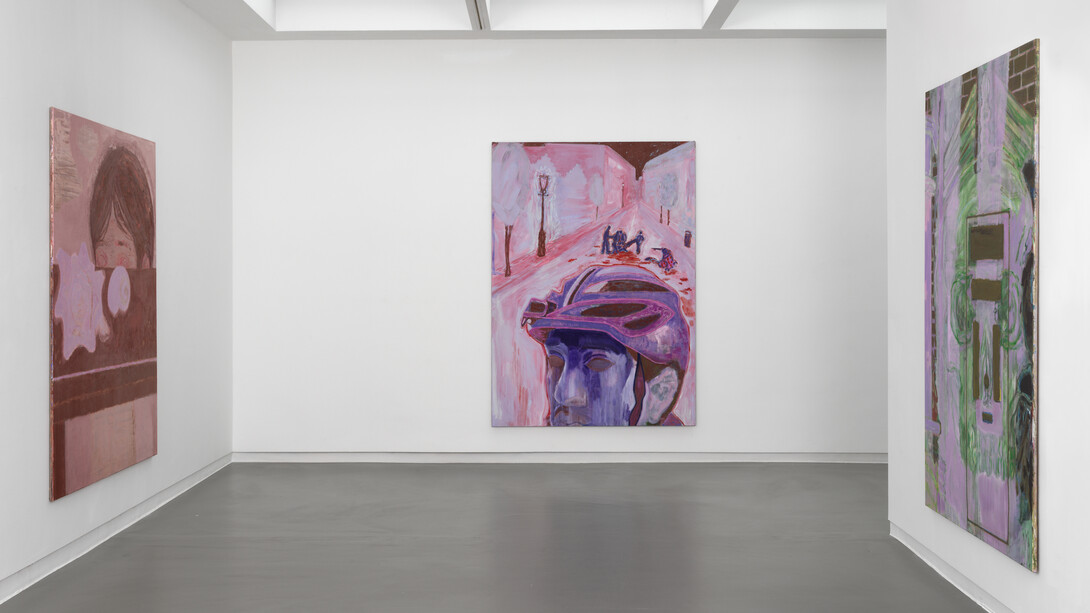
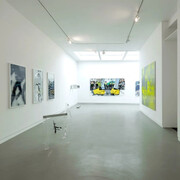
Annet Gelink Gallery is pleased to present Autumn journal, the second solo exhibition by Leo Arnold at the gallery, featuring a selection of new paintings, shown here for the first time.
In his 1938 book Autumn journal, poet Louis MacNeice described his text as “something half-way between the lyric and the didactic poem”: as much a personal reflection on love and daily life as it is political reflection on the time. Taking this as a point of departure, Arnold constructs a personal journal that hangs across the gallery: an intuitive and emotional register of his life lived in Amsterdam.
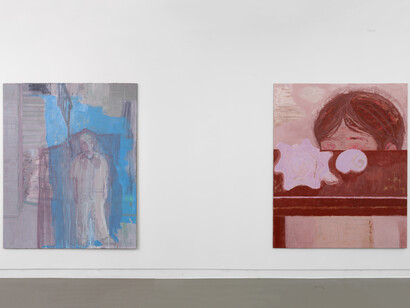
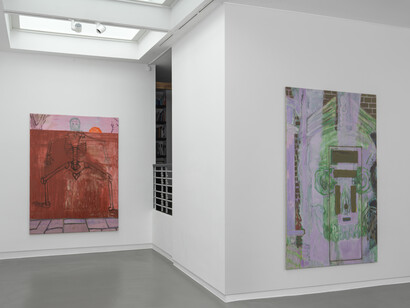
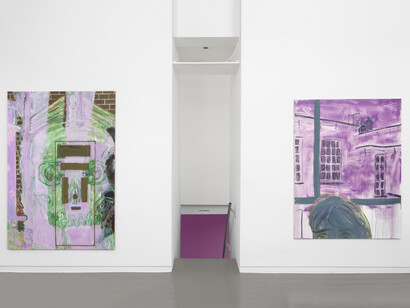
Across the exhibition an array of motifs - skeletons, shells, and horizon lines in the shape of tables, or walls - construct a record of fears and memories. Familiar locations such as a cemetery wall near his apartment and his mother’s front door are overlaid with skeletal forms, charging them with dread and rendering the ordinary unstable. The artist’s gaze here functions as something of an unreliable lens, through which the audience glimpses a world coloured by his anxieties.
Through self-portraiture, Arnold portrays himself as both emotionally charged yet hollow - cycling on an Amsterdam street or hiding behind a table topped with shells. In Blind eyes, he appears in a bike helmet - another shell. The helmet, regarded as unnecessary and faintly absurd in the Dutch context, hints at both self- concern and foolishness, casting him as a kind of pierrot.
The paintings are executed intuitively with no strict plan. Mistake, accident and doubt are fundamental aspects to their development, with Arnold prizing painterly discovery as the engine of each work. The paintings labour under their own acute awareness of other possibilities, with entire compositions often questioned and reworked. A sequence of stymied solutions and doubtful frustrations result in a highly physical surface rendering the paintings both palimpsests and records of their own making. His use of colour is guided by emotion; the palette emerging through a process of distillation.
They carry a kind of vulnerable self-parody, a hesitant, and at times awkward attempt at locating oneself within a reality that remains only partially understood: a closed door implies something behind, a wall conceals what lies beyond. This lack of clarity does not resolve, but instead shapes the works themselves: things remain fragmentary, gestures unfinished, faces blurred or withheld, forming a continuous circling around something that resists being fully grasped, and yet is still there.