English
 Español
 Français
 Deutsch
 Italiano
 Português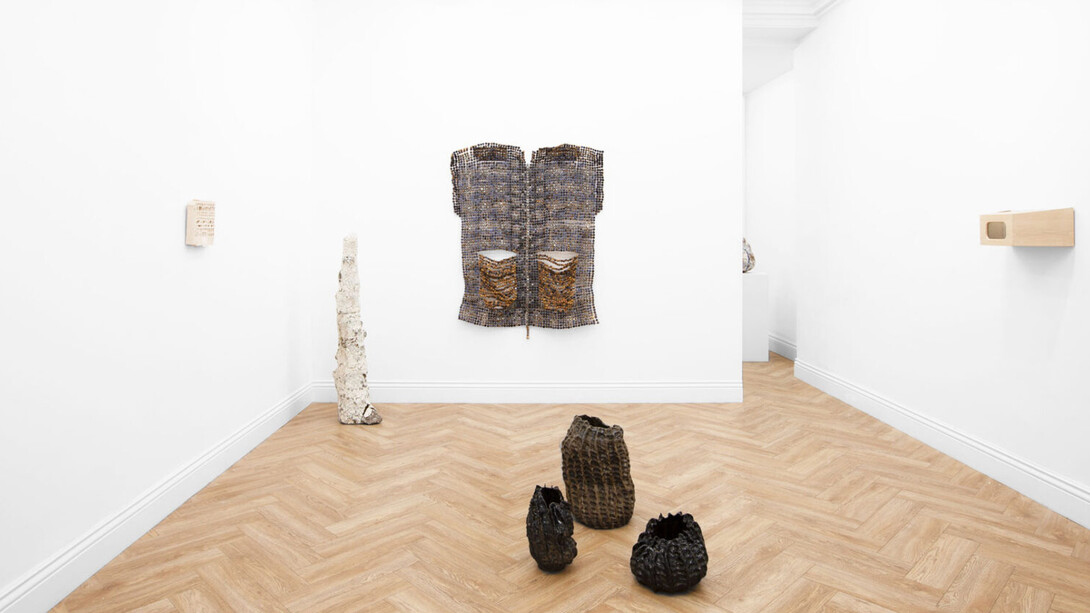
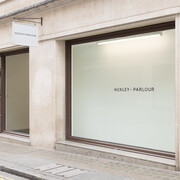
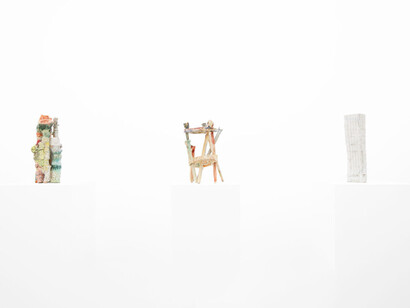
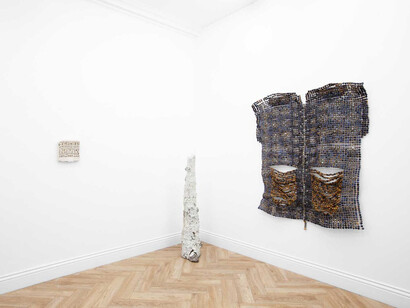
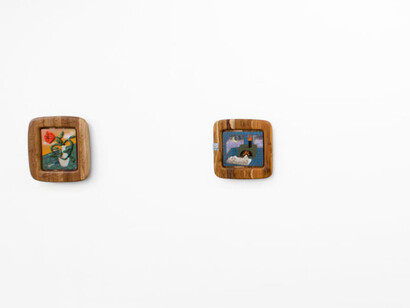
Huxley-Parlour are delighted to announce Metamorphosis: on clay, a survey exhibition of international and intergenerational artists that will examine the expanded role of clay within contemporary artistic practice. Opening at our Maddox Street gallery in March 2026, each artist navigates clay as a means to investigate diverse themes that include art historical legacies, architecture, the commodi cation of the object, collective memory, and lived experience.
Time operates across multiple registers in the exhibited works; narrative and critique are relayed through references to art history, cultural memory, and personal experiences. In particular, SaraNoa Mark and Isis Dove-Edwin collapse the boundaries between past, present, and future. Mark’s practice maps traces - both literal and intangible. Her work records accumulations and gestures, invigorating her surfaces through a repetition of carving and scoring. Employing the medium in this way, Mark’s sculptures reect the evolution of landscape and history, while simultaneously offering potentialities for the future. Dove-Edwin engages intuitively with her material to create her uid, transient forms. Drawing on traditional Nigerian ceramic techniques, textile patterns, and performed gestures, surface acts as a foundation in the artist’s ceramics, through which narrative, movement and personal histories can be explored. Incorporating tradition with contemporary life, Dove-Edwin’s works in clay negate a staticism, instead offering a continued unfolding.
Ambiguity and instability are threaded through Jessica Stoller, Lindsey Lou Howard and Shahpour Payan’s practices. Utilizing established frameworks, the artists seek to dismantle prescribed understandings and structures of power. Stoller offers a critique of her chosen medium - porcelain - with its historical association with renement, consumption, and taste, through abjection and the grotesque. Synthesizing cultural, historical, and corporeal notions of the female body, the artist complicates ideas of pleasure and desire. For Howard, consumerism and emotion are examined through the visual culture of food. Howard employs a satirical tone and the tropes of the horror genre, as a mode of critique for the proliferation of fads and commercialism within the food industrial complex. Shahpour Payan’s sculptures depict visual manifestations of power, in particular the organisation of architectural space as a mechanism for domination. Through a replication of these structures, often rendered in bright hues, Payan seeks to transform the historic and political into poetic monuments of visual form.
London-based artist Dean Hollowood similarly looks to the external, in an engagement of space he seeks to capture the ambiguity in our surroundings. His works rely on the interplay of sculptural form and its spatial situation activating the viewer in a consideration of our own relationship to object and environment. Classi catory impulses are challenged in the sculpture of Katie Spragg, who seeks to redress the categorisation and imposition of order on natural forms. Exploring overlooked and everyday ecologies, Spragg’s mixed-media practice celebrates the resistance of the biological to human-imposed structures. London-based artist Aneta Regel’s amorphous congurations also assert an agency. The artist’s work exists in a liminality between natural and manmade, and emphasizes transformation: incorporating stone into her ceramic, her sculptures exist at the border between states of matter and completeness and development.
Place is central to Ozioma Onuzulike, Gustav Hamilton, and Karla García’s practices. Onuzulike’s large scale sculptures are composed of individual ceramic beads whose material and pigments are taken from localised sites across Africa, indelibly connecting them to the site of their making. The artist’s enquiry is rooted in a probing of the materials’ aesthetic and conceptual potentials, while scrutinizing historical and sociological roots of the continent’s political and socio-economical contexts. García’s practice is informed by her experiences growing up in the borderlands between Mexico and the United States. Her works take the botanical structures of the desert as a departure point, imbuing them with an anthropomorphic quality that speaks to the movement of populations, and the transcendental and spiritual elements of local folklore. Dissolving strict parameters between mediums, Hamilton draws on landscapes of the American Midwest and familial heirlooms to create what he describes as an ‘autoctitious diary’, blending real and imagined experience.
Through these varied approaches, the exhibited artists reveal the medium’s potential, as surface, as object, and as narrative device. The works in the exhibition are each shaped by chance, historical iconographies, the vernacular, and contemporary socio political events.