English
 Español
 Français
 Deutsch
 Italiano
 Português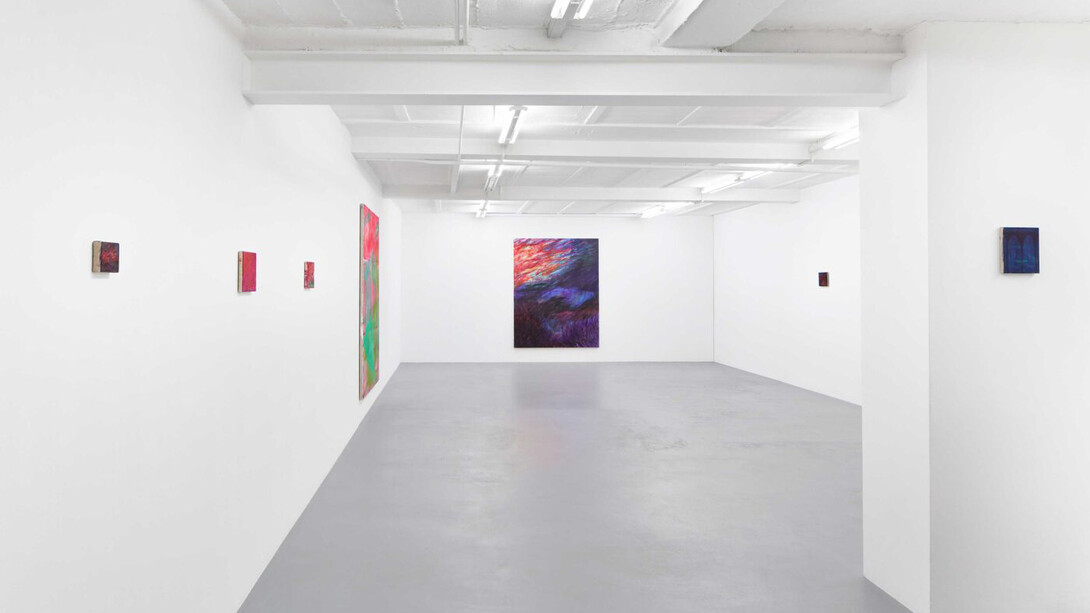
We are pleased to invite you to the opening of the solo exhibition by Augusta Lardy Micheli, Walk with me, which will take place on Thursday, March 19 at 6 pm.
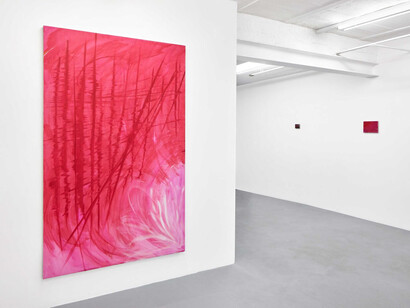
The title of the exhibition, Walk with me, takes the form of a simple invitation. A sentence that could belong to a dialogue, to a familiar gesture. It is also the name of a work that opens the exhibition and carries its breath. On this canvas, the words walk with me are inscribed directly into the paint, as if scratched into the flesh of a twilight. One passes through barriers of blackberries and ascending winds of heat, reds that burn, violets that collapse into darkness. It is a passage as much as a painting: an invitation to enter, and already a crossing.
Her paintings are the emergence of a state; their subject is not so much image as it is painting. One discovers trees, clearings, sometimes streams or detonations in the sky. These are elements recognizable enough to situate the scene, but never defined enough to confine the painting to a simple description. In Augusta’s work, landscape acts as a field of projection where feelings, tensions, and inner states take shape without passing through language.
In the way she speaks about her work, Augusta Lardy evokes the universe of David Lynch — less for what it shows than for the way it makes things felt. In Lynch’s work, the familiar imperceptibly tilts toward the strange: a gust of wind, a light that changes, a silence that thickens, as if the world were announcing an imminence. Something of this order also runs through her painting.
The place in which the artist now produces her work plays an important role in this relationship to landscape. Her studio is located in the canton of Neuchâtel, in a place surrounded by woods. The site possesses an almost cinematic quality. The trees are very present, the sounds are filtered by the vegetation, the light changes quickly over the course of the hours. The solitude is palpable, but it is not oppressive. It resembles more a form of openness. In this environment, the painting seems to develop like an extension of the place itself. The external landscape is not reproduced in the paintings, but it acts as a perceptual condition. It modifies the way of looking, of feeling light, of perceiving distances.
When Augusta lived in London, the paintings carried a particular tension, that of sensing a natural world transforming from afar, without being able to be there. Since moving to Neuchâtel, the landscape is no longer something to be missed: it is the very condition of the work, and the paintings breathe differently.
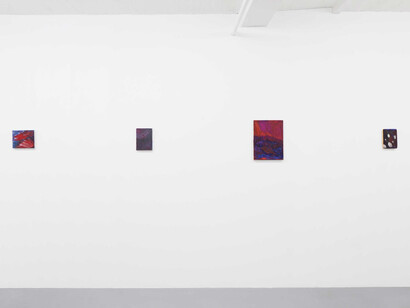
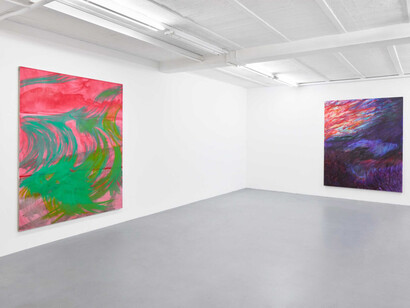
The question of color plays a central role here. At first glance, Augusta Lardy’s palette may appear surprisingly luminous. The greens are vibrant, the pinks radiate, certain surfaces seem almost irradiated by light. Yet these colors do not necessarily correspond to a state of serenity. Fear, loss, or mourning may lie at the origin of the painting. Painting then becomes a way of moving through these states; it acts as a transformation.
Within this dynamic, Augusta Lardy sometimes evokes the figure of Agent Cooper in Twin peaks. This character embodies a strange form of positivity. Faced with deeply troubling situations, he retains an almost joyful curiosity. He advances without cynicism, with a confidence that does not deny darkness but refuses to be enclosed by it. In Augusta Lardy’s painting there is a comparable attitude. The paintings do not avoid shadowy areas, but they move through them with an energy that remains luminous.
The artist’s working process also has a very particular temporality. Before painting truly begins on the canvas, the images build in her imagination for several weeks, sometimes months. The artist allows the painting to exist internally before approaching it physically. When the gesture finally arrives, it can, on the contrary, be very rapid.
Music plays a precise role in this rhythm of production. In the studio, Augusta often works while listening to the track Simple headphone mind by the group Stereolab. The duration of this piece, about twenty minutes, acts as a unit of time. A portion of the painting can be constructed within this interval. The repetitive and hypnotic character of the music creates a particular form of concentration.
The true subject always remains the pictorial surface. Each painting is constructed as a conversation between gesture, matter, and light. Augusta Lardy works in oil, and this materiality has a particular depth: the colors are not only visual signs, they possess density, thickness, a way of absorbing and reflecting clarity. It is through this very resistance that Augusta seeks to paint what escapes direct representation — the wind, places that are no longer or not yet, things that can only take form through the fluidity of the pictorial act itself.
This approach echoes certain traditions of modern painting in which the image becomes above all a space of experience. One may think of the Rothko Chapel: a space where painting represents nothing in a narrative sense, but produces a presence, an inhabited silence, an experience of the sublime that each visitor crosses in their own way. In Augusta Lardy’s work, figuration reappears, but it remains carried by this same ambition: to make the canvas not an image to decipher, but a space to inhabit.
Another possible resonance can be found in certain landscapes by Munch. In those paintings, wind, mist, or the vibration of color translate psychic states. The landscape becomes almost an extension of the body. Augusta Lardy’s painting sometimes shares this quality. The trees seem to move slightly, the light dissolves into the air, forms undo themselves at the very moment they appear.
The paintings are situated in what the Greek philosophers called the metaxu, the in-between. An intermediate space where two realities coexist without merging. Between representation and abstraction.
Walking with these paintings, as the title of the exhibition suggests, perhaps simply means accepting this intermediate space. Advancing into the landscape without seeking to possess it. Looking at what emerges, disappears, and then reappears differently.