English
 Español
 Français
 Deutsch
 Italiano
 Português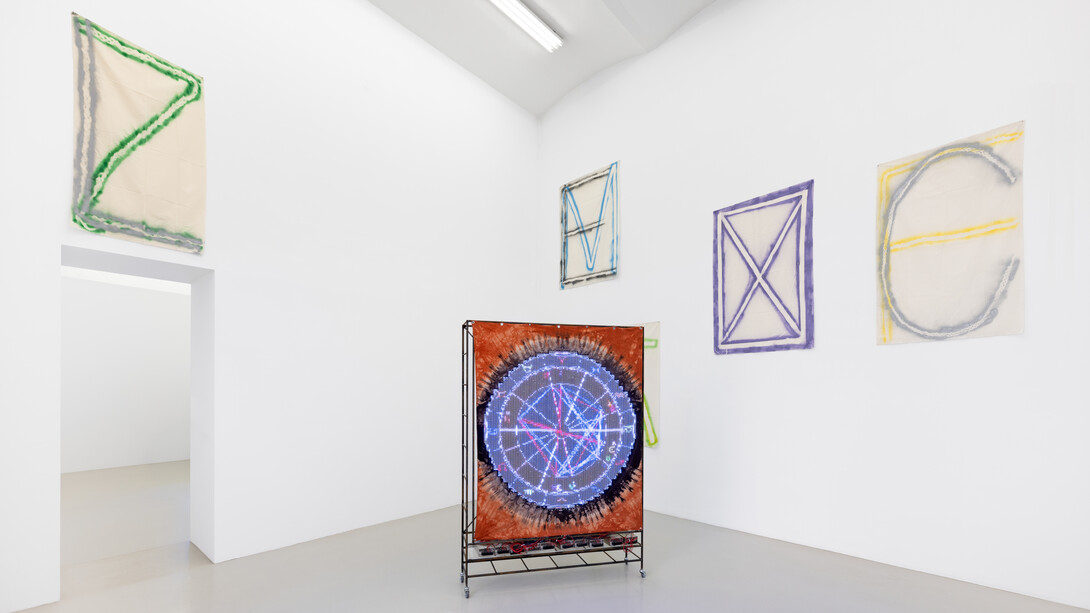
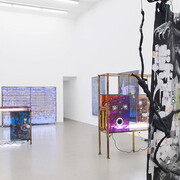
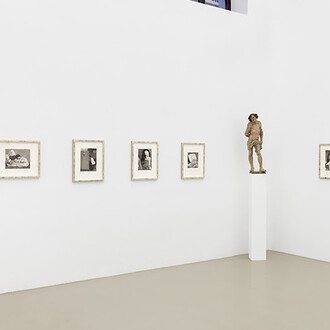
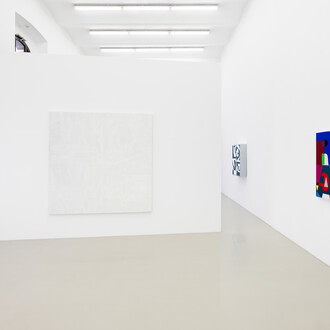
The occasion for the exhibition Splendid playground1 is the nomination of Ei Arakawa-Nash as Japan's representative at the 2026 Venice Biennale and his associated design of the Japanese Pavilion. This provides a valid reason to look back at some aspects of his sculptural work in the context of his frequent collaborators, Nora Schultz and Nikolas Gambaroff.
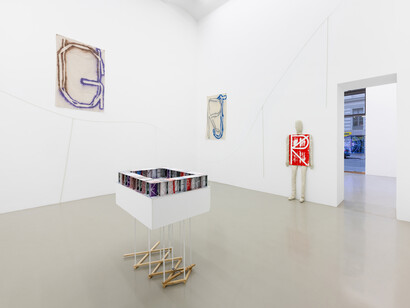
In their collaboration, which began in 2008, Ei Arakawa-Nash and Nikolas Gambaroff have regularly developed various reinterpretations of so-called Two-Alphabet Monograms. Originally created in 2009 as a dysfunctional written and spoken language, the project remains in constant development, finding various formal and material forms of existence in performances, installations, objects, and lectures: One will pat the 25 randomly drawn cards on four different parts of one’s body: Head, Heart, Gut, and Below. The result is your Two-alphabet monogram self-portrait, that is Bodycard Testimonial. With this testimonial being voiced out in different abstract modes, one can consult the cards of and on your past, present and future: any questions and concerns. Two-Alphabet Monograms are tools to ST IR UP AN IN TE RS UB JE CT IV EP OE TR YO CE AN.
The working methods and artistic approach of Ei Arakawa-Nash, Nikolas Gambaroff, and Nora Schultz are characterized by a number of similar features: they all explore the production and meaning possibilities of traditional artistic media such as painting, sculpture, plastic arts, photography, reproduction and printing processes, and installation. This is exemplified in the collaborative performance Social scarecrows printing fields by Arakawa-Nash and Schultz together with Henning Bohl at the Reena Spaulings fine art gallery in New York in 2012. The artists demarcated a large performance area in the middle of the gallery using a transparent plastic sheet laid out on the floor. Arakawa-Nash, Schultz, and Bohl poured large cans of black and white paint into a metal basin on the side and mixed the colors to create prints. The audience was spread throughout the room, but for the most part they began and ended their visit on the side from which they had entered. Several times, Arakawa-Nash broke through the supposed fourth wall and asked the audience to make room for him. As a result, the audience assumed various constellations throughout the performance, making it impossible to establish a single, definitive point of view.
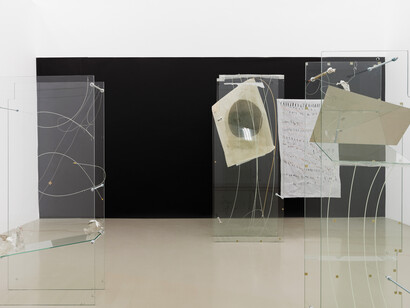
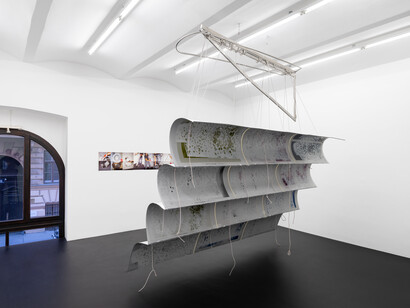
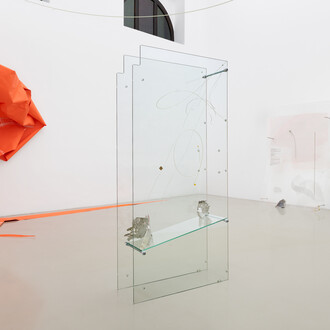
Starting with an open idea of printing, Arakawa Nash and Schultz activate a series of bodily and mechanical gestures, sculptural objects, materials and images. Here, printing is considered as a way of engaging reality, of making contact with the world by inserting oneself into its spaces and economies. Both Arakawa-Nash and Schultz, as well as Gambaroff and Bohl, raise questions about process, institutional context, and performativity in their conscious use with their respective media. For example, in her 2012 exhibition Portikus printing plant and portikus sounds, Nora Schultz presented a live performance of a printmaking workshop, suggesting that the press itself should be understood as a sculptural link between people and the images they produce. The sculpture Bird singing in the reality rain, 2012, reflects this approach. Schultz allows the process to speak for itself, often leaving the artworks in a reconstructable or modifiable heap. In the case of In out press, a work also composed of two sculptures, large rectangular panels set on hinges with the word “In” cut into one and the word “Out” cut into the other create large book-shaped printing presses producing prints with diametrically opposed meaning.
Michelle Cotton: The work employs a language that formally asserts the authority of a definitive, autonomous statement, only to undermine it. Elements will not be fixed, preferring to cancel each other out. The standard physical and conceptual frameworks for an exhibition appear corrupt by the work or an act of duplication. (…) Amongst this archaeology of systems in language and architecture there’s an idea of continuity, multiplication and renewal that quietly wins out over the schematic inevitability – Schultz teases out the possibility of accounting for a structure, its origins and effects and finding new ways to transform it.2
Ei Arakawa-Nash does not produce paintings himself and is therefore always dependent on the works of other artists, which leads to a kind of doubling of the artist within his work. It’s because I am constantly shifting toward another identity in my work. But I did a performance („Colgne of the Maghreb“) last year [2016] at Museum Ludwig which centered on the Cologne-based painter, Michael Buthe (1944-1994), who was part of the same generation as Sigmar Polke but is a little forgotten these days. He was obsessed with Morocco and had several Moroccan boyfriends. His works were also heavily influenced by Moroccan culture, so to some people he could be considered an Orientalist, whereas others could say that he showed a commitment that goes way beyond Orientalism. I felt there’s a conceptual relationship in his relationships with his Moroccan lovers, like he was literally able to internalize the culture of the other, so I made an installation with singing LED paintings speculating about that, although maybe the body politics was a bit obscured because of the LED installation. (...) Technology has always been part of art – think about Jikken Kobo, EAT, Fujiko Nakaya, Nam June Paik. But I think the situation with technology is going through another big transformation right now, so I want to focus on it or engage it through history. My friend Nikolas Gambaroff says that because of the Internet we are able to simultaneously access numerous historical references at the same instant. The use of history is really different under these conditions.3
Arakawa-Nash's continued his strategy of questioning the performative potential of painting in Harsh citation – Harsh pastoral – Harsh münster, head of installation, 2017, an audiovisual installation for the Skulptur Projekte Münster 2017 exhibition, as well as in the exhibition Performance peope at the Kunstverein Düsseldorf in 2018. In both cases, Ei Arakawa-Nash expored the performative potential of LED paintings and proposed an alternative interpretation of performance art. The eight LED works presented at the Kunstverein Düsseldorf, for example, were then subjected to astrological analyses by the American artist Sarah Chow in relation to their respective times and places of births. In this way, performances such as Tony Conrad's 7360 Sukiyaki (1973) and May I help you? by Andrea Fraser (1991), or Lee Lozano's Untitled (Boycott women) from 1971 are literally addressed as “persons” in Arakawa-Nash's multimedia LED works—including their respective psychological idiosyncrasies, their fateful destinies, and the power of their interpersonal desires. How do performances think and feel?
Notes
1 Splendid playground was the title of an exhibition of the same name by the Gutai art collective (founded in 1954 by
Yoshihara Jirō) at the Guggenheim Museum in 2013.
2 Cotton, Michelle, Conversations, in: Texte zur kunst, No. 67, 2007.
3 Maerkle, Andrew, Ei Arakawa: Pt I and Pt II, in: Art iT, June 9 and 16, 2017.