English
 Español
 Français
 Deutsch
 Italiano
 Português
Ice skating is a sport that requires discipline, which is a beautiful combination of being a high-performance athlete and showing fine arts. Well, it appears effortless to spectators, but the act of smoothly gliding on the ice with the help of a steel blade that is only a few millimeters thick requires a sophisticated command over physics, biomechanics, and psychological determination. To come at the most efficiency and be elite in it, the athlete must learn to balance the explosive power with flexibility and grace, all while maintaining absolute control over their cognition under pressure.
Physical requirements and biomechanical foundations
The physical profile of any elite skater is highly specialized. Unlike many sports, skating demands a high strength-to-waist ratio.
Core stability and lower body power
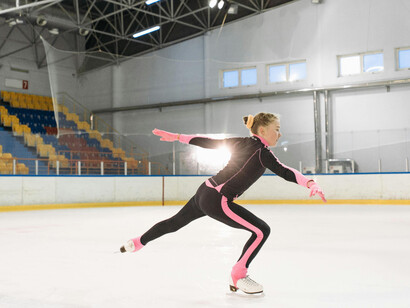
The “skating stroke” is not a walking motion; it is a lateral push that converts muscular force into forward glide. This requires immense strength in the quadriceps, hamstrings, and gluteal muscles. However, the strength is in the core. The entire workout while skating is the core of the athlete’s body. A stable torso allows the efficient and smooth transfer of energy from the legs and the upper body, which is important for initiating rotations. Without a rigid core, the centrifugal force generated while performing a triple or quadruple jump would end up causing the athlete’s form to collapse.
Flexibility and joint mobility
Efficiency in skating is often measured by “depth of edge.” To achieve deep, curving lines, a skater must have exceptional mobility in the ankles and hips. Flexibility is not just a part of the aesthetic but a functional and important skill requirement. To give an example, for a spin like a Biellmann, athletes have to pull their leg above their head while rotating at a high speed. This requires a level of spinal and hip flexibility that can go against rhythmic gymnastics.
Anaerobic and aerobic capacity
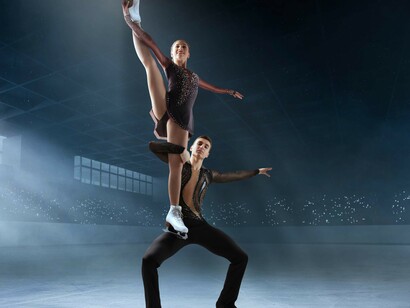
A competitive program lasts for four minutes. During this time, the skater performs high-intensity bursts like jumps and throws, followed by active recovery periods with the help of footwork and transitions. This uses both the anaerobic system—explosive power—and the aerobic system—sustained endurance. An efficient athlete is one whose body can clear lactic acid as quickly as possible, preventing “heavy legs” during the final crucial movements of the performance.
The efficiency of the athlete: the physics of the blade
The ability to maintain speed with minimal visible effort is what defines efficiency in skating. This is achieved through the mastery of something called the blade’s edges.
Ice skating relies on the fact that ice is slippery under pressure and friction, creating a thin film of water where the blade can glide. An efficient skater understands that a blade has two edges: internal and external. By learning to lean into these edges, skaters use the geometry of the blade to create “flow.”
Minimizing friction: inefficient skaters “scratch” the ice. They either use the toe pick or a flat blade to push off. Efficient skaters use the curvature of the edge to generate momentum, a technique known as “power pulling.”
Rotational efficiency: in jumps, efficiency is governed by the Law of Conservation of Angular Momentum. To rotate faster, an athlete must bring their limbs as close to the axis of rotation as possible. A “tight” air position reduces the moment of inertia, allowing four full revolutions in less than a second.
The mental frontier: psychological requirements
The mental demands of ice skating are more taxing than the physical. It is one of the few sports where a 0.5-second error can invalidate months of preparation.
Spatial awareness and proprioception
Proprioception is the brain’s ability to know where the body is in space without looking. Skaters must possess an elite sense of proprioception. When rotating four times in midair, the “spotting” techniques used by dancers are impossible. Skaters rely on the vestibular system to maintain balance and timing. Efficiency means the brain processes these signals so rapidly that the landing becomes an instinct rather than a conscious choice.
Emotional regulation and “The flow state”
The environment of a skating rink is inherently “cold” and clinical, yet the performance must be “warm” and expressive. Athletes must manage extreme “ice nerves.” If a skater is too tense, their muscles become rigid, killing the natural glide of the blade. If they are too relaxed, they lack the “snap” needed for jumps. Achieving the flow state—a zone of energized focus—is the hallmark of an efficient mental game.
Resilience and cognitive reframing
Skating is a sport of falling. An elite skater may fall dozens of times in a single practice session. Mental efficiency involves the ability to “reset” instantly. If a skater falls on the first jump of a program, they must cognitively dismiss the error within seconds to ensure the remaining elements are performed perfectly. There is no room for “rumination” during a performance.
Integration: the holistic athlete
True efficiency in ice skating is found when the physical and mental aspects become indistinguishable. When a skater has reached peak physical conditioning, they no longer have to think about the jump; the body executes the muscle memory, freeing the mind to focus on artistry and musicality.
Ice skating remains one of the most demanding sports. It requires the heart of a runner, the legs of a powerlifter, and the nerves of a tightrope walker. Efficiency in those sports is about speed; it is about the elegant conservation of energy and the mental clarity to perform at the edge of physical possibility. For the elite athlete, the ice is a partner to be understood through the laws of physics and the discipline of mind.