English
 Español
 Français
 Deutsch
 Italiano
 Português
![Nicole Gravier, Non risponde [He doesn’t respond], 1976-78. Courtesy of the artist / Ermes Ermes, Roma / Les
Douches la Galerie, Paris © Nicole Gravier](/attachments/f13e511064feebed8dd5a43162e0dc528e2c7d26/store/fill/1230/692/eb6e0a0476f215502ce59645be11d64265d8fdb8432c951d6374a339f3fe/Nicole-Gravier-Non-risponde-He-doesnt-respond-1976-78-Courtesy-of-the-artist-slash-Ermes-Ermes.jpg)
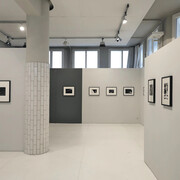
Les Douches la Galerie is pleased to present Jeux de mots, a new group exhibition curated by Éric Rémy, featuring works by Berenice Abbott, Tom Arndt, Pierre Boucher, Sophie Calle, Roger Catherineau, Stéphane Couturier, Joël Ducorroy, Henri Foucault, Jean-Claude Gautrand, Nicole Gravier, Hervé Guibert, Ernst Haas, Anneliese Hager, Raymond Hains, Frank Horvat, Bogdan Konopka, François Kollar, Barbara Kruger, Yvan Le Bozec, Vivian Maier, Ray K. Metzker, Duane Michals, Jean Moral, Marvin E. Newman, Roger Parry, Denis Roche, Man Ray, Joost Schmidt, Maurice Tabard, Patrick Tosani, Moï Ver, Sabine Weiss and Klaus Wittkugel.
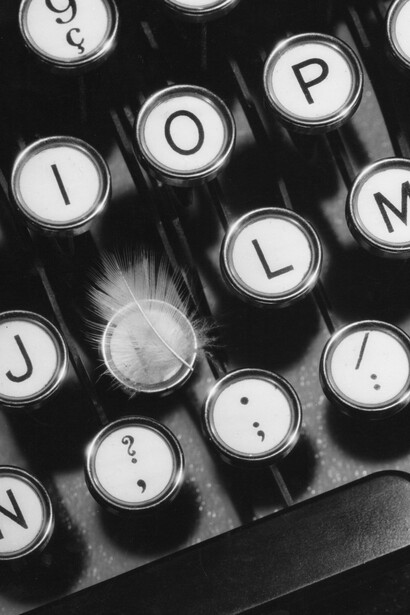
Following Dans ma cuisine, last year’s group exhibition devoted to domestic space and the modest arrangement of everyday objects as seen through the lens of the 20th-century photographers, this new project extends a similar curatorial gesture: an exploration of the relationship between text and photography. This time, language itself—words, letters, typographic signs—enters the photographic field. Omnipresent in our visual environment, text is approached here not merely as an accompaniment to the image, but as an active material capable of altering its reading, disrupting its apparent clarity, and expanding its poetic and conceptual resonance.
Jeux de mots thus affirms a continuity: that of a photography which interrogates the most familiar signs, explores their formal potential, and reveals—through subtle shifts—the image’s capacity to transform the ordinary into a sensory and critical experience. Until the 1920s, text and photography maintained a hierarchical and orderly relationship: photography illustrated the text, or text captioned the image. These two “writings of the world” coexisted for decades before truly converging.
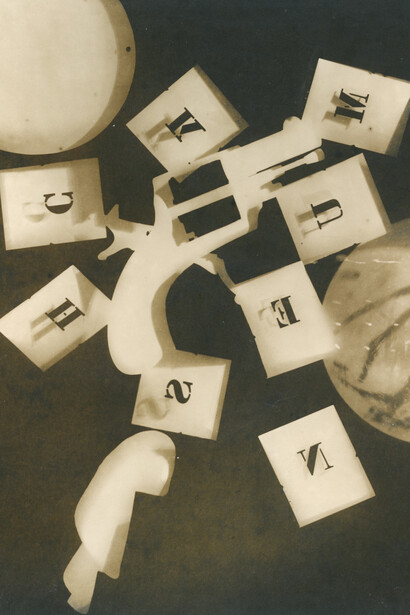
The first deliberate integrations of typography into photography emerged in the early 1920s: at the Bauhaus under the impetus of László Moholy-Nagy; among the Russian Constructivists, notably El Lissitzky; within the Dada movement; and, decisively, through the rise of modern advertising. In France, the magazine VU, founded in 1928, placed photography at the heart of information for the first time. The image made a spectacular entrance into the illus-trated press and began to rival the authority of text.
Throughout the 20th century, photographers worked toward a form of reconciliation. Photography incorporated letters into its compositions, played with the meaning of words, illustrated alphabets, and interwove narrative and image. Text and photography sought to coexist in a renewed alliance in which each asserts its own necessity.
At the Bauhaus, under the direction of Walter Gropius, interdisciplinarity lay at the core of teaching. Joost Schmidt, first a painter and later a typographer, became a professor of typography after studying there, producing refined compositions in which photography integrates the letter much like an illuminated initial. The Lithuanian artist Moï Ver, trained at the Bauhaus in Dessau under Kandinsky and Klee, also turned to photography and demonstrated in the rare study Adhesol his mastery of the interplay between image and typography. Klaus Wittkugel, who studied in Germany with painter-typographer-photographer Max Burchartz, created compositions in which text itself became the photographic subject, notably in promotional imagery for companies and institutions in 1930s Berlin.
In Paris, in 1927, Charles Peignot, director of the Deberny & Peignot type foundry, founded the journal Arts & métiers graphiques, which became a major vehicle for this visual revolution. On March 15, 1930, a special issue was devoted to photography; its success led to the publication of an annual volume dedicated to the medium. Around Deberny & Peignot, Pierre Boucher, Maurice Tabard, and Roger Parry developed an advertising language grounded in photomontage, photograms, and collage, where text and image became inseparable.
Commissioned by Horizons de France, François Kollar produced La France travaille (1931– 1934), a vast undertaking that established him as one of the leading industrial photographers of his time. In one volume devoted to the book trades, a typographic printing plate becomes, through his lens, a metallic landscape—a city seen from above.
The encounter between photography and typography extends beyond the printed page. Posters invade urban walls; neon signage saturates cityscapes; buildings are covered in slogans, brand names, and graphic structures. Berenice Abbott, Pierre Verger, Ernst Haas, and Louis Faurer made these elements central subjects of their work. In one photograph by Sabine Weiss, two workers perched before the luminous expanse of Times Square become, al-most inadvertently, typographic signs themselves. This textual proliferation also permeated painting, as seen in Fernand Léger’s Nature morte ABC (1927).
Later, Stéphane Couturier revisited this dialogue in his series Les nouveaux constructeurs. His image ABC does not introduce an alphabet primer, but rather refers to À blaise cendrars, the writer and friend of Léger, a fervent advocate of advertising, which he described as “the most beautiful expression of its time.”
Before making torn posters his signature material, Raymond Hains experimented in the 1950s with hypnagogic photography, distorting reality through ribbed glass. His work is fundamentally centered on language: words and letters become matter—distorted, fragmented—as in Hépérile, Camille Bryen’s poem shattered by the image.
In a related spirit, decades later Henri Foucault dispersed the letters of Baudelaire’s Les fleurs du mal into clouds, constellations, and recomposed skies.
In the 1950s, Roger Catherineau, an active figure in the Rencontres de lure, devoted much of his research to “photographism” and to the interaction between writing and photography. The first professor of photography at the École Estienne, he created the first photographic alphabet as well as a series of “printed portraits” superimposing faces and torn newspapers.
During the same period, Anneliese Hager produced intimate photograms in her apartment, sometimes incorporating fragments of newspapers. Some were published in the poetry collection Weiße schatten (White shadows), an oxymoron that encapsulates the very mystery of photography: light and shadow, black and white, revealed and concealed.
If the first photo-novel—La folle d’Itteville (1931), conceived by Germaine Krull and Georges Simenon—proved unsuccessful, the genre found its audience in women’s magazines from the 1950s to the 1970s. In the 1980s, Nicole Gravier offered a playful critique, staging herself in stereotypical poses accompanied by ironic captions.
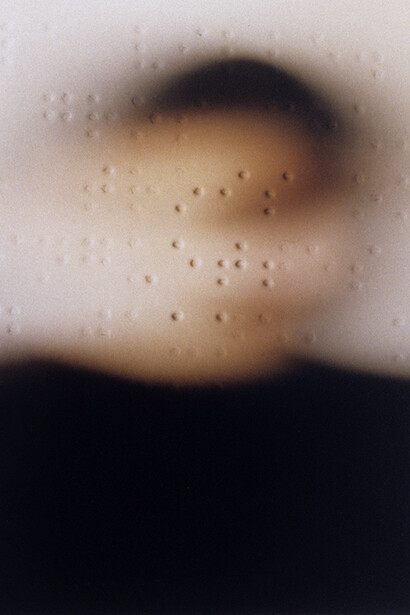
In 1984, Patrick Tosani invoked another form of writing—Braille—in a series of blurred portraits projected onto embossed pages. He brings sight and touch into dialogue while subverting their functions: Braille becomes image, stripped of its haptic quality, while photography relinquishes its identificatory power.
In the 1990s, Sophie Calle’s work drew attention for its intimate and programmatic narra-tives, in which photography documents experiences articulated in words, granting text and image equal status. The American artist Duane Michals, through handwritten texts inscribed at the edge of his prints, adds narrative depth to the visual poetry of his photographs.
Denis Roche, both writer and photographer, printed certain works with generous white margins, creating additional space in which writing and image could coexist.
Words are not only those of advertising; they are also the language of political protest plastered across city walls. During May 1968, Jean-Claude Gautrand roamed the streets, recording ephemeral slogans later published in Les murs de mai. From the 1980s onward, Barbara Kruger denounced consumer society by overlaying her images with monumental typographic injunctions: text eclipses the image, at times nearly effacing it.
The American photographer Tom Arndt likewise bears witness to civic engagement by photographing political leaflets, posters, and slogans, appropriating them through the camera’s frame.
Today, prompts—the textual instructions addressed to artificial intelligence to generate images—seem to close the loop: text indirectly regains authority in a century in which the im-age had once contested it.
(Text by Éric Rémy)


![Mary Cassatt, Fillette dans un fauteuil bleu [Enfant dans le salon bleu] (detail), 1878. Courtesy of Musée d’Orsay](/attachments/3ddcf3630b2e6b21d055a8488350d949784be8fa/store/fill/330/330/9b97dc5b17cad42577b6453f0968e961b1231ceb2b8b5ceb2c09057b2695/Mary-Cassatt-Fillette-dans-un-fauteuil-bleu-Enfant-dans-le-salon-bleu-detail-1878-Courtesy-of.jpg)