English
 Español
 Français
 Deutsch
 Italiano
 Português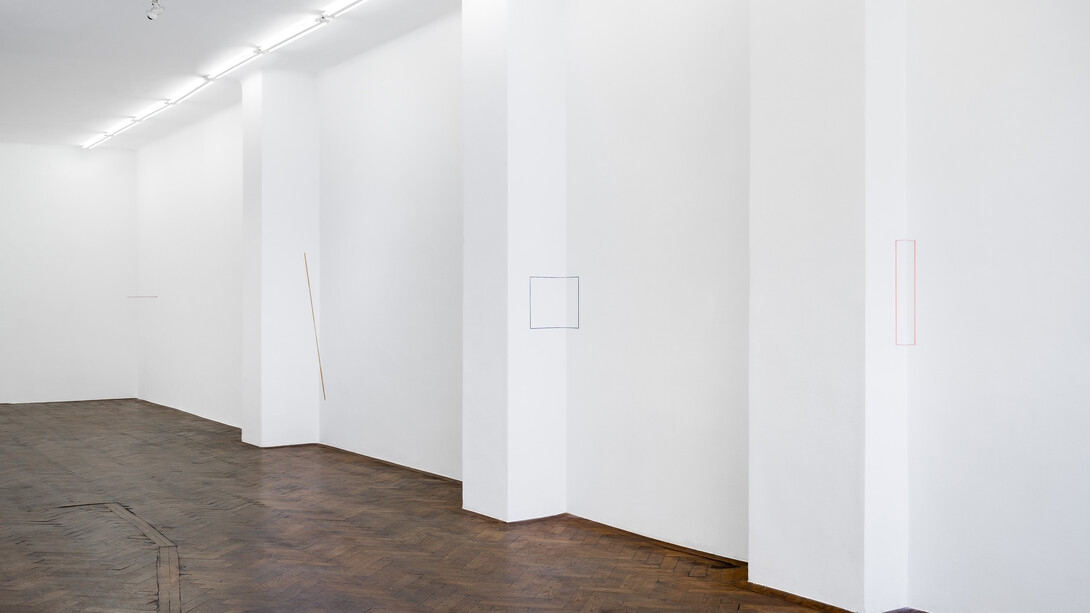
Ich hoffe, du kannst uns dort bald mal besuchen. Im Augenblick haben wir ein paar
Sonnenuntergänge einzufangen.
Immer dein bester Kumpel,
Skeet(Die letzten Zeilen. In: Thomas Pynchon. Schattennummer. Roman. Dt. v. N. Stingl und D. van Gunsteren. Hamburg, Rowohlt, 2025)
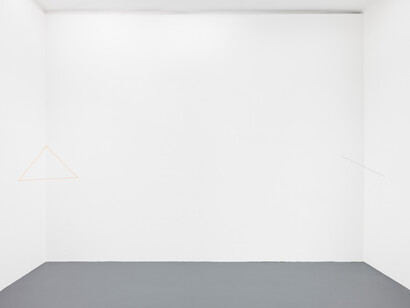
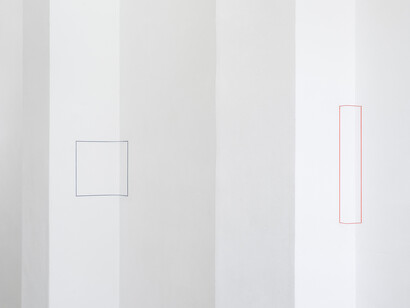
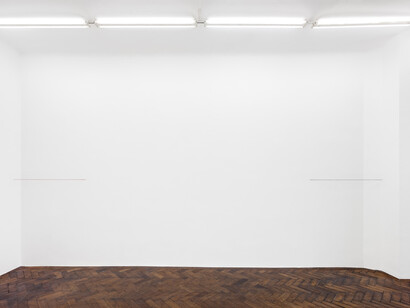
Galerie Hubert Winter is pleased to present the 11th solo exhibition of renowned artist Fred Sandback (1943–2003, New York) at the gallery. On view is the complete body of multiples that were conceived by the artist between 1968 and 1994. These comparatively small format works made from steel, elastic cord and acrylic yarn employ different colors, forms and materials to inhabit the walls and corners of a space, thereby transforming it fundamentally. This is the first time all of the multiples are brought together in an exhibition which is made possible thanks to close collaboration with the Fred Sandback Estate. The artist made the following remarks about his work in 1975.
My work isn’t environmental. It’s present in pedestrian space, but is not so strong or elaborate that it obscures its context. It doesn’t take over a space, but rather coexists with it. Environmental art makes a new environment and obscures the old one, and that’s as far from what I want as realistic painting is.
Most paintings and environmental art are aesthetically discontinuous with ordinary space, which is a quality I don’t want in my work.
My work is not illusionistic in the normal sense of the word. It doesn’t refer away from itself to something that isn’t present. Its illusions are simply present aspects of it. Illusions are just as real as facts, and facts just as ephemeral as illusions. Illusionism is making a picture of something. Possibly the trapezoids and rectangles I made were pictures of something, but the open pieces aren’t.
I’d rather be in the middle of a situation than over on one side either looking in or looking out. Surfaces seem to imply that what’s interesting is either in front of them or behind them.
Interiors are elusive. You can’t ever see an interior. Like eating an artichoke, you keep peeling away exteriors until there’s nothing left, looking for the essence of something. The interior is something you can only believe in, which holds all the parts together as a whole, you hope.
There’s an inherent transience to my work. Many larger pieces may only exist for a few days in a particular place, before being put away indefinitely. They are in principle always able to come into existence again at a future time, but will then be part of a new situation. If I remake a piece in a new place, it’s a different piece. If I remake a piece in the same place, it’s still bound to be a different piece than before.
The line is a whole, an identity, for a particular place and time. I assume that this identity can be sensed by others.
What I object to in a lot of art is its illustrative quality, the quality of being an execution of an idea. I don’t have an idea first and then find a way to express it. That happens all at once. That notion of executing an idea is the same as giving form to material, and it’s a confusion of terms. Ideas are executions. I don’t make “dematerialized art.” I complicate actual situations, and this is as material as anything else. It’s the same false distinction of paring away the matter to get at the idea which allows people to talk of something getting “dematerialized.” […]
My work always exists in an interior space. This two-part being in a place is a given condition of all my work. Pieces are conditioned by and bound to a particular place. Still, they are not commentary—they don’t tell a story about a place—they are just there. There’s finally no reason for a piece being here or there. They are limited by the structure of a place, but not deduced from it.
The scale I work on is large enough, but it’s particular, too. Large pieces can’t be transferred from place to place without being re-done. That’s a reduction in scale from a lot of sculpture in that it precludes, to an extent, a piece being uprooted from its point of origin without my being involved in it.
More and more, working seems to be like performance; not in the sense of presenting a process, but in the conditions required to complete a piece. Some things are done and complete in my studio, but others are ambiguous until done in a particular place. A studio is necessarily vague and hypothetical for pieces like that. I like the connectedness of that kind of piece—you can’t stick it under your arm and carry it home. It has its own place and lifespan.
(Fred Sandback, Notes, 1975)