English
 Español
 Français
 Deutsch
 Italiano
 Português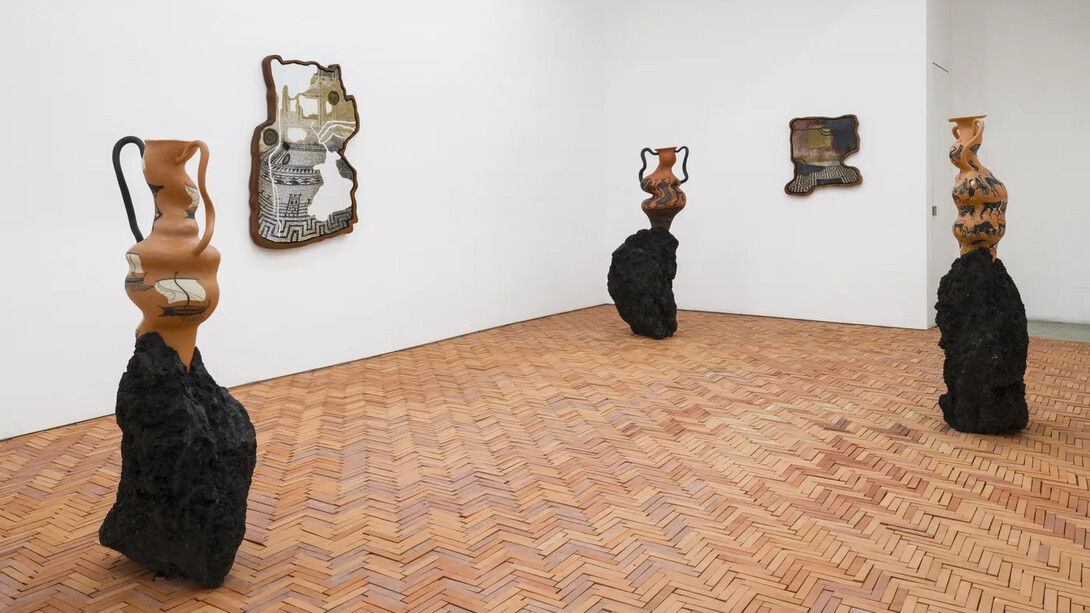
Nazarian / Curcio is pleased to present Pompeii, an installation of new sculptures by Los Angeles-based artist Cammie Staros. For her fourth solo exhibition with the gallery, Staros invokes the ancient city’s destruction as a lens through which to view our contemporary moment—one marked by environmental precarity, sudden disruption, and shifting historical narratives. Created in the year following the 2025 wildfires in Los Angeles, Pompeii examines how fragility and endurance intertwine, using the language of archaeology and classical craft to consider collapse, preservation, and the traces that remain.
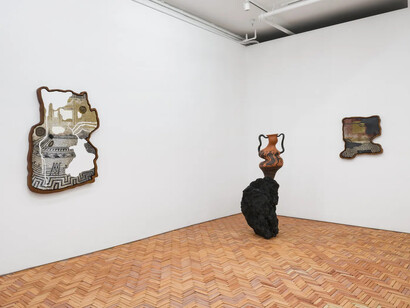
Central to the exhibition is a hand-made ceramic floor of fired earthenware tiles Staros has been making and accumulating for over a decade. Fired to varying degrees of maturity, the tiles are intentionally unstable, cracking underfoot as visitors move through the space. Over time, the path worn into the floor becomes an evolving record of those who have come before.
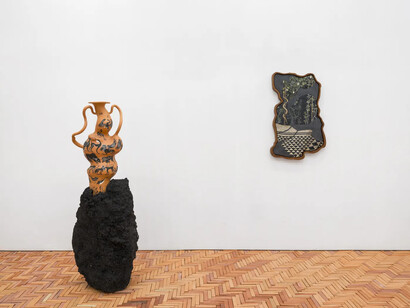
On the walls, Staros debuts her first mosaics, organically shaped works composed of dozens of varieties of hand-cut stone framed in mahogany. These pieces reference archaeological sites in Pompeii, themselves adorned with mosaics, such as the House of the Tragic Poet and the House of the Orchard. Aqua resin forms interrupt Staros’s stone surfaces, introducing moments of modern abstraction while alluding to the processes through which ancient works have been excised, repaired, and relocated. Preservation emerges here as an ambivalent act—one simultaneously of care, disruption, and displacement.
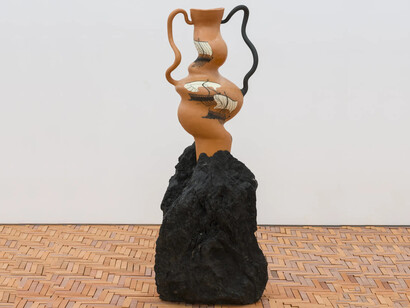
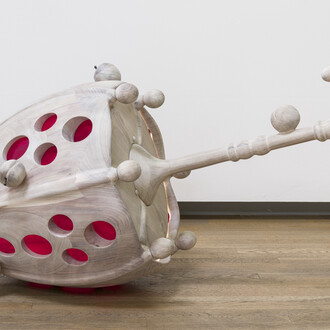
At the core of the installation, new ceramic vessels stand partially encased in volcanic stone, their forms warped as if in the midst of melting. These hybrid objects evoke the eruption of Mount Vesuvius, which annihilated Pompeii while preserving it for posterity—freezing a moment of daily life in time. Staros treats this paradox as a metaphor for the entwined forces of loss and endurance. The vessels’ painted surfaces draw on recurring motifs from Pompeian frescoes and mosaics, while the boulders shaped around them suspended the ceramics between emergence and dissolution, becoming and erasure.
Long attuned to classical antiquity as a means of probing how material, myth, and fragment construct historical memory and contemporary perspective, Staros uses Pompeii to connect ancient ruins with present-day vulnerabilities. Here, the vestiges of a once-thriving city serve as a mirror for today’s concerns: the suddenness of ecological and social upheaval, the illusions of permanence that precede them, and the ways history is continually rewritten in their wake. Rather than dramatizing disaster, Pompeii invites a quieter, more reflective encounter—one that lingers on the tenuous relationship between past and present, ruin and resilience.