English
 Español
 Français
 Deutsch
 Italiano
 Português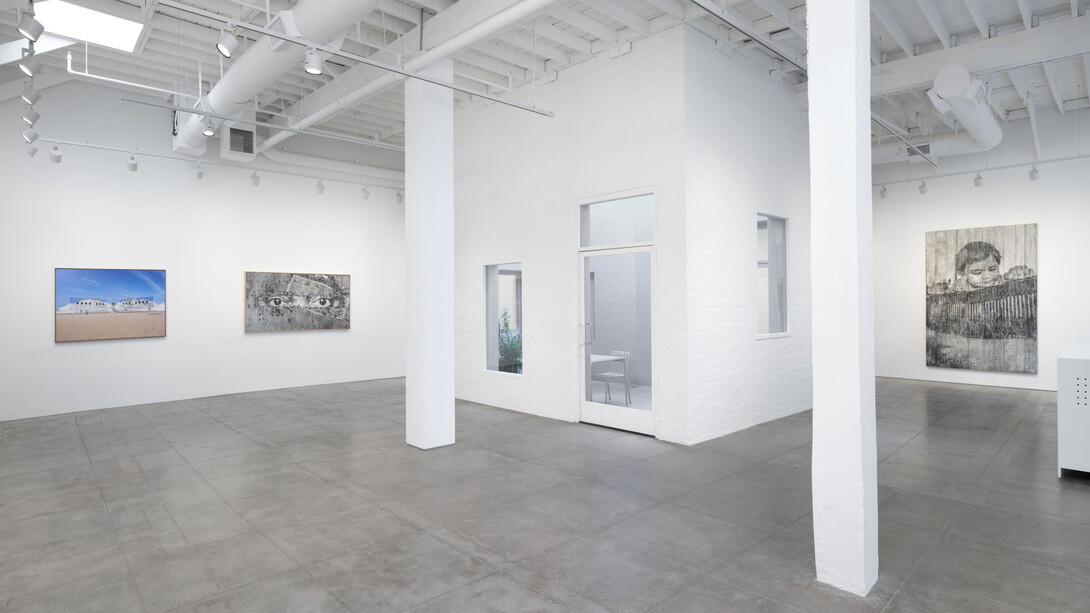
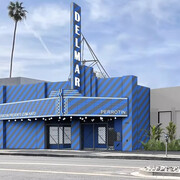
Perrotin Los Angeles is pleased to present Horizons, JR’s first solo exhibition at Perrotin Los Angeles, which brings together a selection of works realized across California that underscore the artist’s enduring engagement with visibility, memory, and community.
The horizon cannot be reached or possessed; it recedes as we approach and is a boundary that invites encounter. It is social as much as spatial, shaped by the farthest edge of vision that keeps us moving. Our spatial understanding of the horizon points to the notion of perspective, what appears to be and what is. This is a core motif throughout JR’s work, where vanishing points and converging lines expand, compress, and distort spatial perception, and in turn change our perspective both conceptually and materially.
This exhibition brings together four bodies of work that JR created across California: in San Francisco, Los Angeles, Tehachapi, and along the U.S.–Mexico border near Tecate. Since 2011, he has repeatedly returned to the state, installing large-scale photographic interventions across its varied terrains, from the facades of buildings to prison yards and border infrastructure. In each instance his work turns built environments into places of encounter, empathy, and shared understanding. California, long imagined as the western edge of the continent, here becomes a shifting horizon, a place where questions of belonging, visibility, and possibility are continually coming in and out of focus.
JR’s practice operates at massive scale in both its scope and presentation, yet it often begins with individual encounters, captured through portraits of people and communities. These images of people coming from all walks of life are enlarged and sited in ways that render them visible, often in places where they can be made to feel invisible. The effect is not simply about scale, it is relational for both the viewer and the participant. Curiosity and recognition become a part of the encounter. A border wall becomes a site for gathering. A prison yard becomes a place of collective portraiture and collaborative creation. A city’s architecture is animated by the presence of those who inhabit it. In all these approaches, the use of perspective and its transformation of space allows for the conceptual collapse of distance, offering us a way to more clearly see the complexity of people and places.
In this way, the horizon in JR’s California projects is not a line we look toward but a social space we enter together. It is produced by participation, by what is removed, by who stands within the frame, and what is revealed that was once invisible. The works inhabit the structures of cities, prisons, and border zones, momentarily reorganizing how those spaces are experienced. They ask what becomes possible when the faraway is brought close, and when visibility itself becomes a shared act.
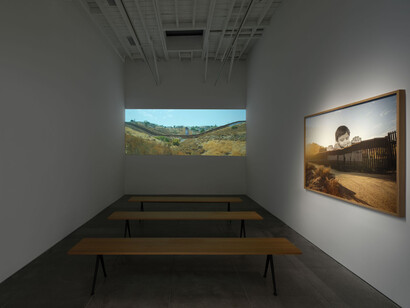
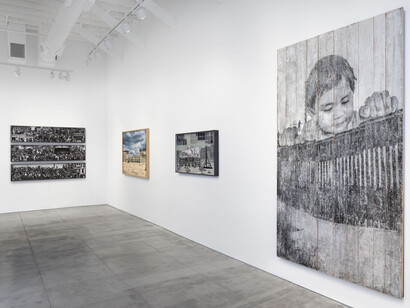
The exhibition includes three images from the artist’s project known as Kikito. In 2017, JR and his team visited the border wall in Tecate, Mexico and installed a giant image of a toddler, peering curiously over the border wall, his small hands gripping its steel slats. The image is a portrait of Kikito, a toddler JR photographed after meeting the child’s family while scouting for a site for the project.
The gesture disrupts the horizon of the border itself; the enormous scale and yet intimate expression of the child is juxtaposed against the heavy architecture of the border barrier. Here the wall is made strange: the innocence of a child without an understanding of borders, of states, and citizenship reveals the absurdity of the barrier itself.
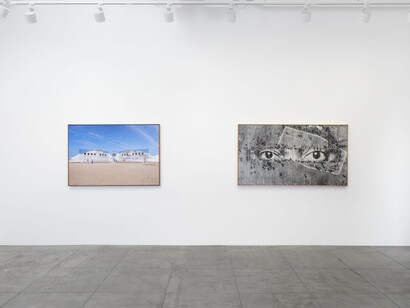
After the installation was complete, JR and his team invited local communities on either side of the border to gather together for a picnic. The event was unsanctioned on the US side of the wall, and openly legal on the Mexican side of the wall. Documented in this exhibition in Giants, Kikito, October 7, 2017, 7.43 a.m., Tecate, Mexico – U.S.A. (2017) the tablecloth spread across the border wall features the eyes of Mayra, a Dreamer living in the United States. The image Migrants, Mayra, picnic across the border, general view, Tecate, Mexico – U.S.A. (2017), is taken from a drone above the space. Like many of JR’s projects, it shows us what can be made possible with listening and collaboration, here creating a new temporary social space through the act of sharing food, time, and space.
JR’s creation of temporary communities is a throughline throughout his work. In 2011, enormous close-up images of faces gesturing with smiles, deep thoughts, and loud expressions began to appear on the facades of buildings throughout Los Angeles. In The wrinkles of the city, Los Angeles – Jim Budman, Venice – USA (2011), clear eyes and a furrowed brow appear across the street, while in The wrinkles of the city, Los Angeles – Robert Upside Down, Downtown, USA (2011), the top edge of the building becomes the horizon line from which a pursed mouth seems to almost kiss the ground. Throughout this series, the city’s walls and skyscrapers reveal the character of the city in the expressions of each superimposed face, bringing visibility to LA’s elderly community across the cityscape. The series of images presented here are part of a larger body of work that has transformed cities around the world: in Cartagena, Spain (2008), Shanghai, China (2010), La Habana, Cuba (2012, in collaboration with US artist José Parlá), Berlin (2013), and Istanbul (2015). In each of these cities, the notion of the city’s horizon becomes an accumulation of lived experience.
One of the most recent projects to be featured in the exhibition is Tehachapi, a series of images documenting the artistic actions that JR and his team have facilitated in the California Correctional Institution, known colloquially as Tehachapi for its location, just two hours outside of Los Angeles. In 2018, a friend secured permission for JR to visit Tehachapi and meet with some of the inmates. JR arrived without expectations and began with listening, spending time with the inmates to hear their stories. He began to photograph each person and invited them to record their stories, offering voice and visibility to an often-hidden part of American reality.
JR and his team worked with the warden and prison staff, as well as former inmates and victims of violent crime to create a composite image of the inmates’ portraits and returned to Tehachapi to install the work in the basketball courtyard of the prison. They worked collaboratively with the inmates, staff, guards, and a group of formerly incarcerated individuals, together with victims of violent crime who are justice reform activists. For a brief period, the prison yard became a place of collective labor and sharing that built bridges between people and offered a way to see one another anew.
This exhibition includes two images from return visits and activations at Tehachapi. In Tehachapi, The road, anamorphosis, #1, USA (2022), JR and his team collaborated with the inmates to wheat paste the architecture of a new housing unit with a trompe l’œil image of a road leading out of the prison. As if projecting forward movement without escape, the image also features easels aligned with the windows of each cell, where inmates can become a part of their own artworks in the landscape.
Gathering to share food often appears in JR’s work. In Tehachapi, Picnic, Ruett Foster, USA (2022), JR organized a closing picnic for all the participants in the project, this time gathering around an image of the eyes of one of the victims of violent crime, a participant in the project who chose forgiveness and became an activist to support collective healing between victims and inmates.
Another recent project featured in the exhibition is The chronicles of San Francisco, from 2018. Inspired by the work of the Mexican muralist Diego Rivera (1886–1957), JR began to develop a series of monumentally scaled participatory murals, composing collective portraits in different communities. To create his own San Francisco mural, JR and his team staged a photo booth inside a large truck and visited 21 different locations around the city, inviting passersby, groups, and individuals to have their portraits taken and share their stories in an adjacent makeshift audio booth. Each person’s image was meticulously collaged to create a massive composite image of over 1,200 project participants. A portrait of a city, the project also created a temporary community of people known and unknown to one another. The work was exhibited in the galleries at SFMOMA in 2019 with each participant invited to the opening to share their stories and connections. JR has created similar monumental murals of place in Kyoto, New York City, Miami, and Napoli.
In each of these California projects, the horizon is never a fixed boundary but a condition of encounter. What recedes in the distance is brought forward. What was invisible is made present. Throughout his work, JR’s interventions do not simply document people and communities, they temporarily reorganize the way we see the world around us. In shifting our perspective both conceptually and physically, the artist offers us the potential to see beyond the horizon, a way to imagine a future where we can all flourish.