English
 Español
 Français
 Deutsch
 Italiano
 Português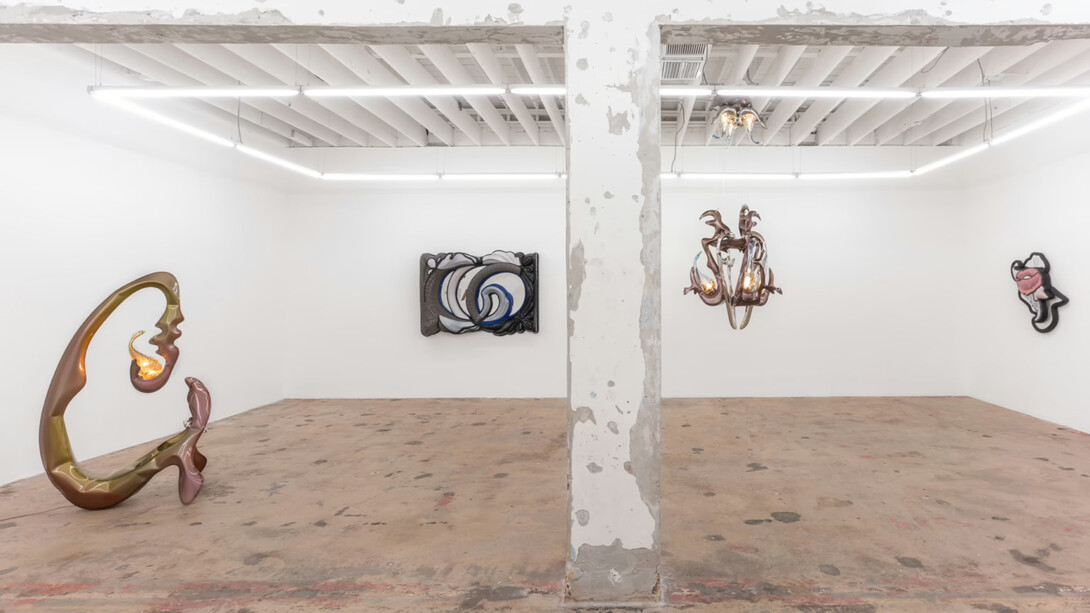
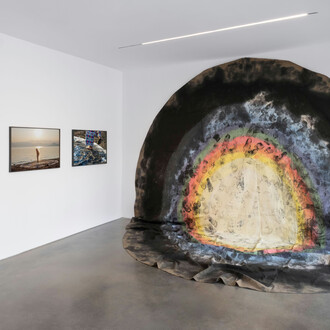
Nina Johnson presents Dripped, a group exhibition featuring the artist collective made by Astronauts, Hilliary Gabryel, and Oh de Laval. Bringing together sculpture, design, painting, and altered domestic forms, the exhibition considers water, mythology, and aspirational luxury as material, symbolic, and psychological forces—fluid systems through which desire, power, and identity circulate.
At the center of the exhibition is the work of made by Astronauts, an Athens-based collective founded by Greek artist Danae Dasyra and British artist Joe Bradford. Developed around the broad theme of water, this presentation marks the collective’s most expansive and cohesive body of work to date. Rather than functioning as discrete objects, the works operate as a constellation—each piece representing a member of a mythological family drawn loosely from ancient Greek lore. Together, they narrate both the artists’ collaborative process and an unfolding fictional universe, inviting viewers to step into a space where mythology serves as an open-ended framework rather than a fixed narrative.
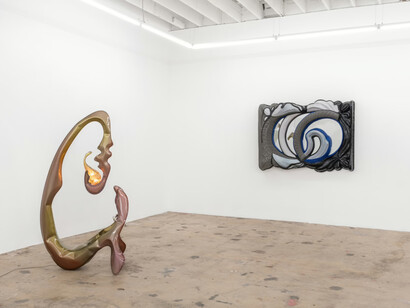
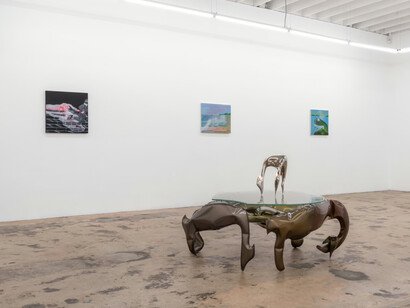
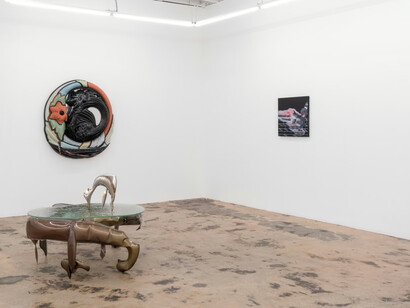
Made by Astronauts presents a range of sculptural and functional works, including a chandelier, low table, floor lamp, wall-mounted mirror, and oil lamp. The collection is unified through a shared material language rooted in their signature hydroforming technique—an industrial process that uses high-pressure water to expand and manipulate metal, allowing steel and stainless steel to assume fluid, organic forms. Each work is finished with a multilayered powder coating system developed in the studio, designed to protect the surface while preserving the visible traces of fabrication, including welds and irregularities. For this exhibition, made by Astronauts collaborated for the first time with Athens-based glass specialists: hand-blown glass elements appear in the lighting works, while kiln-formed glass features in the tabletop pieces. These collaborations deepen the material vocabulary of the exhibition while reinforcing its emphasis on process, locality, and craft.
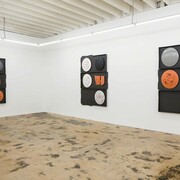
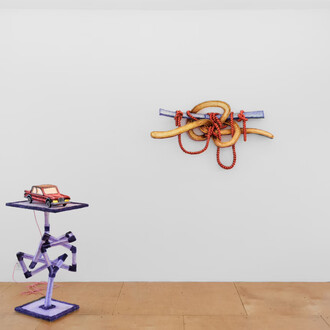
Hilliary Gabryel contributes three new wall-mounted sculptures from her ongoing Bedroom eyes series. Working with salvaged furniture—headboards and vanity mirrors sourced from resale markets or found on the street—Gabryel transforms objects associated with intimacy, femininity, and aspiration into hybrid sculptural forms. The works combine found furniture and casts upholstered in slick, shiny rubber, etched mirrors, and lacquered papier-mâché inspired by traditional Eastern lacquerware and its later Western reinterpretations. The objects read like bodies encased in a second skin—seductive, protective, and uncanny.
Gabryel’s practice frequently engages with the visual language of aspirational luxury, a theme she connects to Miami’s cultural landscape. Many of the furniture forms she works with can be traced to Franco Cozzo, the Italian-Australian entrepreneur whose flamboyant, Baroque- and Art Nouveau-inspired bedroom sets once promised accessible grandeur to mass audiences. In Gabryel’s hands, these hollow, vacuum-formed objects—rendered in jewel tones and punctuated with steel tacks—become sites where class aspiration, consumer desire, and gendered objecthood converge. By encasing her works in hypersexualized rubbers, Gabryel reclaims these mass-produced forms, transforming them from their original domestic function and exposing the fantasies they were built to sustain.
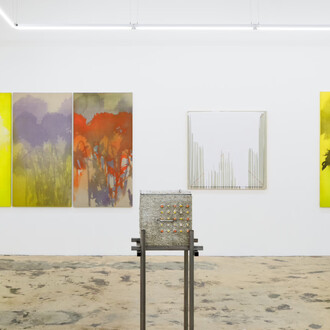
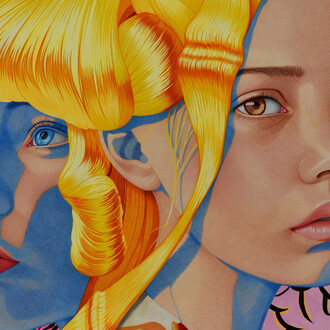
Oh de Laval presents two new acrylic paintings on canvas, continuing her exploration of self-portraiture, narrative ambiguity, and mythological reference. Born in Warsaw, with formative years in London and now based in Paris, de Laval paints herself in scenes that blend lived experience with imagination. Her works operate on multiple registers: what appears on the surface is often accompanied by a secondary, allegorical narrative—lessons embedded like fables. For this exhibition, both paintings draw from tales of water and Greek mythology, extending the exhibition’s broader mythic and symbolic framework.
In Poseidon spit by the sea on Island of Virgins, de Laval reimagines the god not as conqueror but as vulnerable, surrounded by women who have never seen a man. Separated on the surface but connected in the deep reflects on human relationships—fleeting, pleasurable, and intense— suggesting that impermanence need not be tragic but can instead register as adventure. Across her work, de Laval’s aim is insistently life-affirming: each painting pulses with excitement and desire, urging viewers toward presence and immediacy.
Together, the works in Dripped move between solidity and liquidity, ornament and structure, myth and material. Whether through hydroformed metal, latex-skinned furniture, or painterly allegory, the exhibition considers how objects absorb and reflect cultural longing—what we desire, what we inherit, and what we carry forward.