English
 Español
 Français
 Deutsch
 Italiano
 Português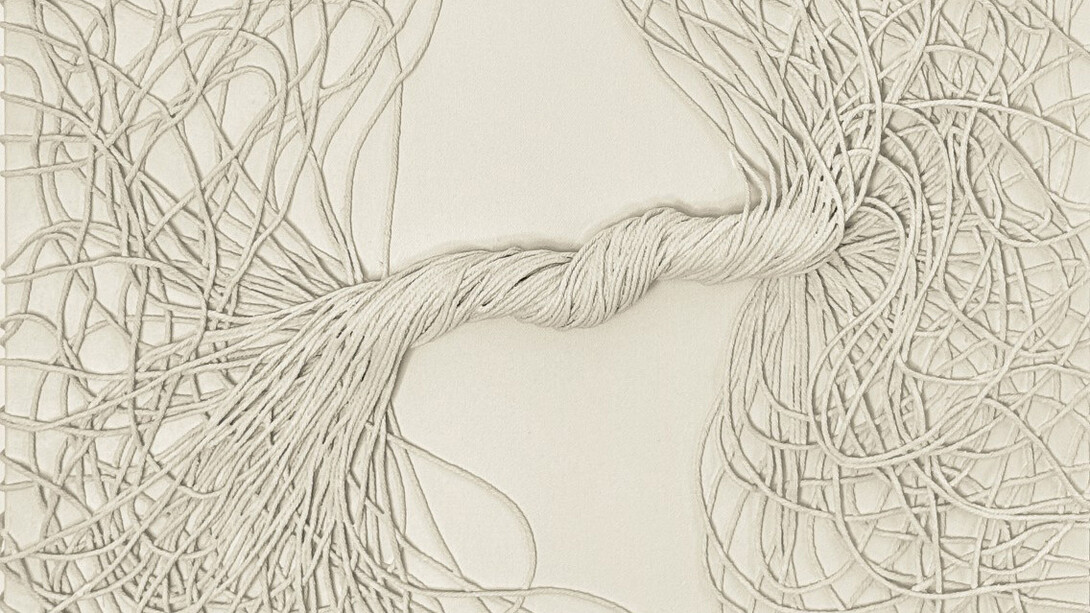
Modernism is pleased to present Veins of sorrow, a new body of work by Iranian-American artist Sameh Khalatbari. Across three interconnected bodies of work (veiled canvases, unveiled canvases, and intricate works on paper), Khalatbari examines sorrow not as a singular emotion but as a sustained condition shaped by personal history, cultural inheritance and the pressures of contemporary life.
For the artist, sorrow is not only internal. Born and raised in a religious Middle Eastern society, Khalatbari has experienced grief as both a personal emotion and an imposed condition formed in part by cultural constraints placed on women. Her work acknowledges how such structures can normalize silence and concealment, embedding suffering within the fabric of daily existence. It also responds to contemporary political realities, including the recent protests in Iran. These events, which reverberated globally, inform the urgency of the work.
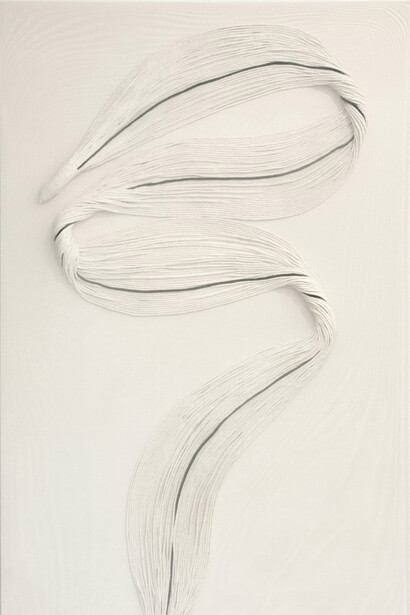
Central to the exhibition are the fiber-based canvases. Composed of bundled strands affixed to the surface, suspended configurations bend, gather and taper under their own weight. These accumulations evoke bodily systems like veins, nerves or tendons, rendered externally and exposed. The dimensional mixed-media canvases extend a material language first established in Khalatbari’s earlier body of work 1401 N/m² resistance, in which strands referenced the hair of Iranian women mandated to remain covered. Here, the strands mimic emotional fluctuation—rising, falling and looping in continuous lines that suggest the uneven rhythms of lived experience.
In many of the canvases, a translucent fabric is permanently fixed in front of the surface. The veil functions as both a physical and a symbolic barrier, evoking the guise of composure we don in daily life. From a distance, the works appear muted, their tensions softened. The veil simulates this concept of mediation, suggesting how sorrow is often regulated and rendered socially invisible.
A distinct group of canvases, collectively titled Veins of sorrow – The rupture, removes this mediating layer. Materially identical in construction, these works expose the bundled strands directly to the viewer. The absence of the veil signals a conceptual shift within the series: a point at which accumulated grief exceeds containment and becomes visible without filter. The title underscores this shift, not as a change in medium but as a change in condition. In light of the recent unrest and mass mourning in Iran, these unveiled works carry particular resonance, embodying the moment when private sorrow becomes collective outcry.
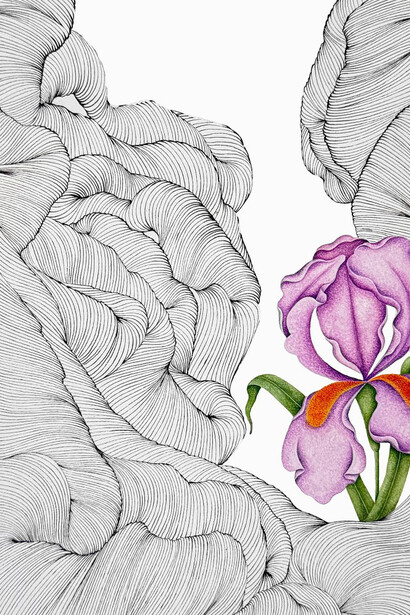
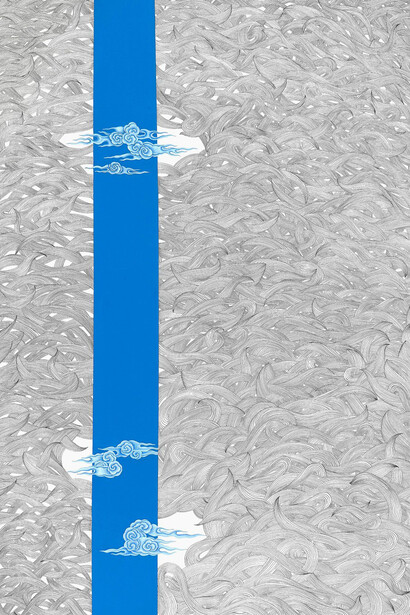
The works on paper operate on a different plane. Built from dense, repetitive ink lines, the drawings accumulate into intricate, wave-like fields that appear both meditative and overwhelming. Within these largely off-white expanses, small, vividly colored birds and blossoms emerge with heightened clarity. Drawing on Persian literary symbolism, these motifs signify longing, love, and endurance—moments of tenderness within shifting emotional terrain. Khalatbari’s restrained tonal palette reinforces her conception of sorrow as subtle and permeable—shared in presence, yet personal in meaning.
Across all three bodies of work, Khalatbari treats material and color as expressive structures. Her explorations recall the experimental ethos of Eva Hesse, while her sensitivity to color and symbolism resonates with Johannes Itten and Wassily Kandinsky, for whom color functioned as an emotional and, at times, a spiritual register. Yet Khalatbari’s practice remains grounded in lived experience, particularly in relation to gender, geography and political constraint.