English
 Español
 Français
 Deutsch
 Italiano
 Português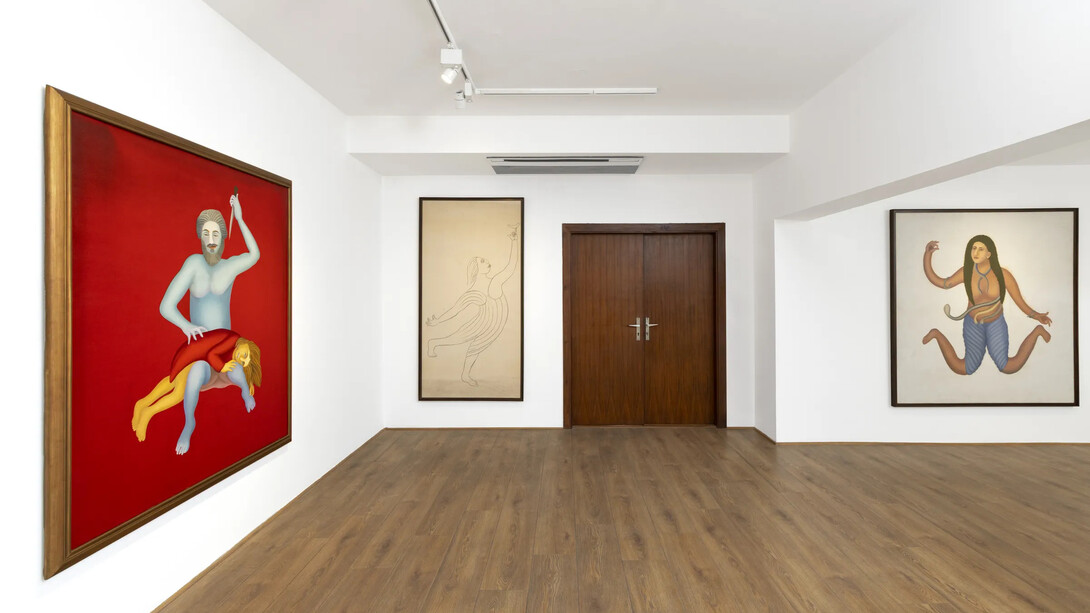
Manjit Bawa was a great traveler of the plains of north India especially the Punjab. He would watch local theatre, see the art and talk to people about their oral tradition. The stories of mythology that they related changed slightly from area to area, occasionally moving away from the traditional in some way or the other.
Manjit too, had a similar sensibility linked with storytelling. He used to often say that even though the basic storyline of any given myth followed the established norm, an artist had the freedom to play around with the imagery whenever he was inspired to do so. In other words, the urge to bring forth a change in an image or in a story was justified even while the myth remained the same.
There is a common mythology the entire country shares when it comes to epics and myths but which change from region to environment. Our people therefore can identify a performance or a visual representation even though it has undergone a change. Contemporary artists such as Manjit have been inspired by popular culture and mythology to make their own language. Manjit has redefined the narrative, has figures with a form that deviate from the traditional, and used colours that are occasionally symbolic.
As a case in point is Manjit’s painting of Narasimha slaying Hiranyakashipu witnessed by Prahlada. Narasimha’s tearing apart of Hiranyakashipu’s is not shown through any blood and gore. Instead, Manjit has symbolized it through a red background, while also suggesting Narasimha’s red-hot fury through that colour. We recognize the story while also perceiving the difference because of the sameness of culture that the country shares. Reinforcing the many interpretations that are found all over India, some versions of this story show Lakshmi witnessing the event while others do not. Manjit’s work has no Lakshmi.
In the painting of Siva on the tiger skin, what is important are the stylistic changes that Manjit brings to the work. Early traditional representations of Siva show him both with a moustache and a beard, though later images often depict him clean-shaven. Everything seems to be possible! It is all a matter of creative license that artists have taken down the centuries. What is extraordinary about Manjit’s work is the perspective given to the tiger skin. It rises behind Siva, eye-catchingly appealing against the green tinged with yellow background, and is effortlessly the central part of the painting.
Manjit was always aware of the manner in which the foreground of a painting shaped against the background; in his words, it was the interaction between the ‘positive’ and ‘negative’ aspects of a painting. In this painting, Siva’s crossed legs (positive) shape the curved yellow stripe of the tiger skin, the negative space. Viewers are unaware of why the arresting quality of the yellow-striped skin occupying the negative space is so striking. A successful painting has to be viewed carefully to understand the devices that make it a worthwhile work – such as this one. Manjit’s positive and negative principle operates in every painting.
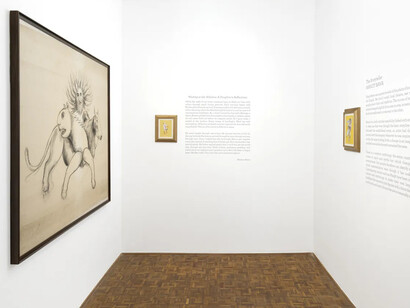
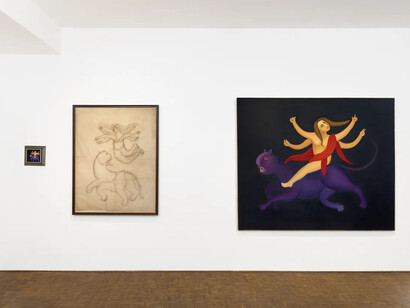
Manjit has repeated a particular theme in more than one canvas with changes in the composition. Durga riding on her tiger/lion is a case in point. Moreover, whether Manjit chose a tiger or a lion is debatable. Pan-Indian mythology has used one or the other animal as Durga’s vehicle. There is nothing of the traditional in Manjit’s Durga or tiger, yet we recognize them for what they are because of the folklore or written texts we are familiar with. Such is the enchantment of mythology and the magic it weaves around us.
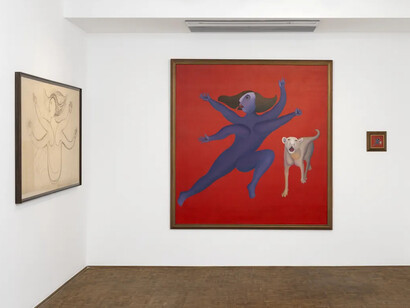
The freedom mythology leaves for interpretation is apparent in Manjit’s Kali and the dog (my title of the work since Manjit had not given one). A dog was never linked with Kali, even though it was associated with Bhairav, another form of Siva. But here the dog, seen as a loyal protector, backs away while Kali swirls in her dance of construction/destruction. The red background is true to her fiery nature. Kali, denoting time and colour, has a dark skin. She need not be black as the word kali suggests but be possessive of a blackish tinge. This is a principle that works through Indian aesthetics, where black appears as a dark blue, jet purple or greenish black. Manjit the storyteller had great knowledge of both past and present history and aesthetics and used them in appropriate places.
(Text by Rupika Chawla, New Delhi, January 2026)