English
 Español
 Français
 Deutsch
 Italiano
 Português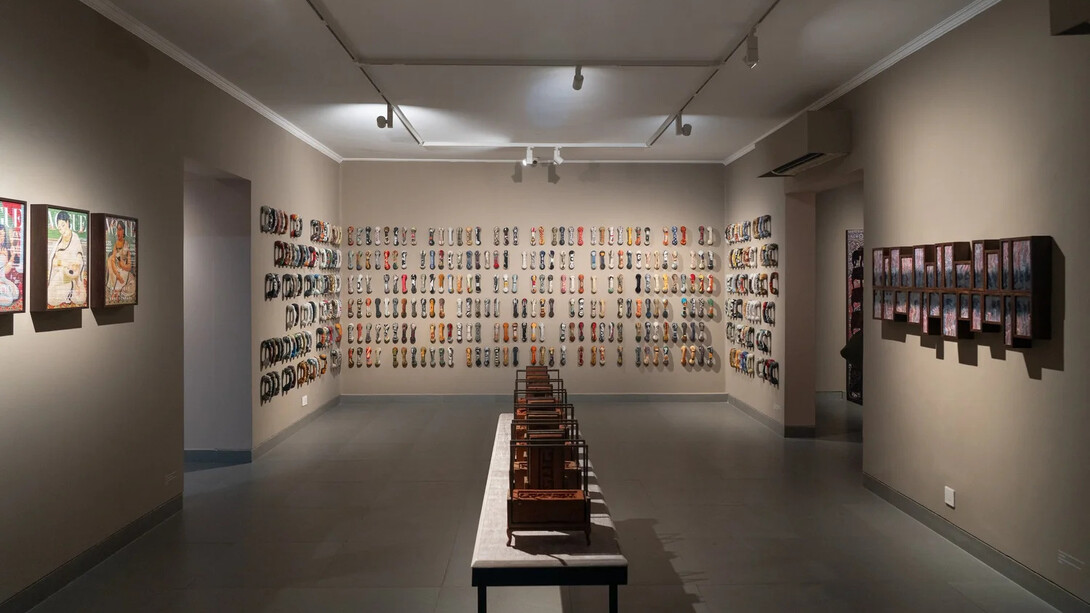
Memory takes many and often startling forms in the work of Debasish Mukherjee.
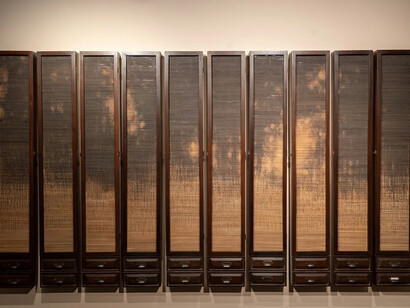
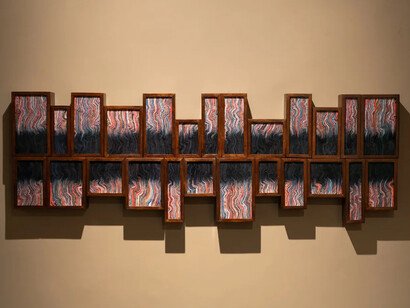
Consider his ensemble of receivers from nearly extinct rotary-dial or push-button telephones, each one painted or embroidered with lines from literary works or headlines from the newspapers: silent relics of a superseded technology that still retain their power to carry epiphanic and compelling messages. Or the staircase of chairs, their upholstery bearing a thumbprint, marker of identity and enslavement: an intriguing symbol conveying both the precarious ascent to power and the human costs it exacts. Or the river woven from varicoloured fabric, bearing the freight of exalted myth as well as toxic effluent. Or the lines of text printed on the fore-edge of a stack of newspapers, which oscillate between clear legibility and dense opacity, challenging our ability to distinguish between noise and signal.
What is the unnamed ache that draws Mukherjee back to an encyclopaedic archive of sources that include experiences of burning earth and poisoned rivers, as well as images drawn from long-defunct chromolithograph studios and transposed into the domain of contemporary lifestyle magazines? In the ghazal that opens with the immortal line Dil-e nādān tujhe huā kyā hai? (‘Fool heart, what’s the matter with you?’), the great Urdu poet Ghalib asks, Ākhir is dard ki davā kyā hai? (‘Isn’t there a drug to ease this agony?’). Later in the ghazal, having lamented the vagaries of the loved one and finding himself in retreat from the natural world, the poet asks, Abr kyā chīz hai, havā kyā hai? (‘What really is a cloud, what is the wind?’).
A similar mood informs Mukherjee’s practice, which shuttles between the compelling residuality of the past and the dynamic impulse of vitality. This mood impels him to look beyond the seductive surfaces of the present. Instead, he bears witness to the larger cultural, political and material histories that underwrite the present; and, always, these histories are relayed through the subtle and intimate weave of autobiography.
Debasish Mukherjee’s work gains its distinctive gravity from his consistent meditative focus on the past as it continues to shape the present, whether through traces of family lore, verses that resonate across the centuries, or narratives of trauma, displacement and commerce that imprint their persistence on everyday objects. In the spirit of a time-traveller, the artist compresses many layers of private and public inheritance into his practice, crafting for himself a sense of belonging that connects him expansively to multiple geographies – Chapra, Banaras, Kolkata, Delhi – rather than a singular time, place and identity. In this, he speaks for the plural, restless, fissiparous cultural self that resists the narrow impositions of the modern nation-state, and is the true agent of creative accomplishment.
(Text by Ranjit Hoskote)