English
 Español
 Français
 Deutsch
 Italiano
 Português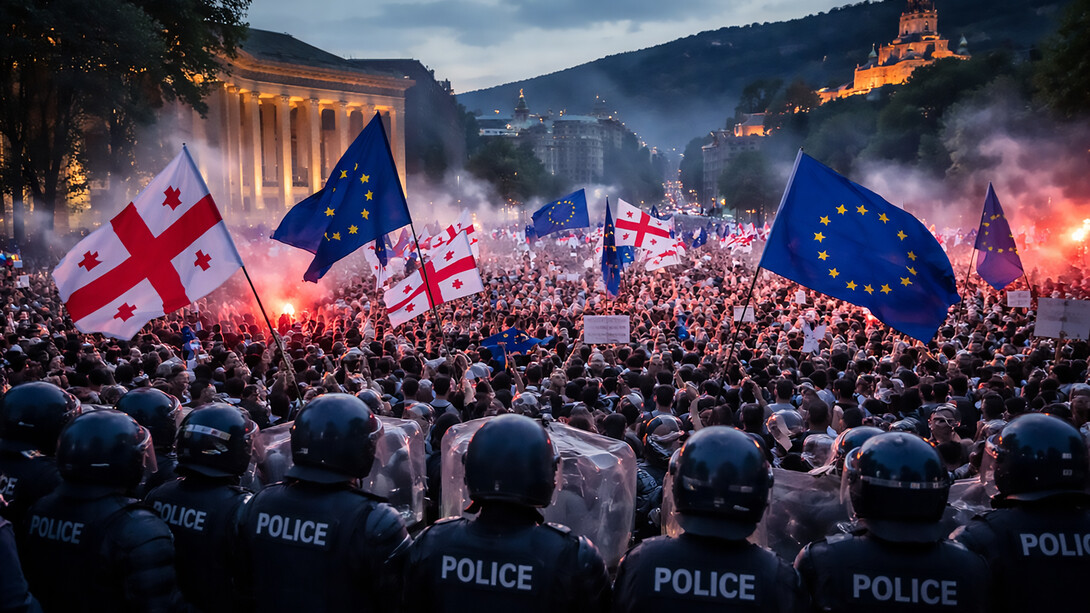
In Eastern Europe, there is a small country where the values of freedom, democracy and hope for a European future clash with the autocracy of the Kremlin: Georgia. After parliamentary elections marred by fraud, this small, unyielding country is challenging the expansion of Russian puppets, hoping that one day they will be able to join the European Union and choose their own future. But are these ambitions possible?
In July 2025, a bombshell statement1 from many Western heads of government called attention to what is happening in Georgia today. Tragically, Georgian democracy is in serious jeopardy. In order to truly understand what is going on, it is necessary to look back in time to Georgia’s recent history.
Since the dissolution of the Soviet Union in 1991, Georgia has been beset by Russian aggression, initially taking the form of Kremlin-backed guerrilla warfare in the regions of South Ossetia and Abkhazia. However, the real decline in relations between Georgia and Russia took place after Vladimir Putin's election in 2000 and the election of a pro-Western government in Georgia in 2003, leading to armed conflict in 2008. During this conflict, Georgians in the separatist regions were subjected to ethnic cleansing, leading to the deaths of at least 20,000 individuals.
Since coming to power in 2012, Georgian Dream has been moving away from the pro-European path, gradually promoting policies that weaken democratic values, reduce the influence of opposition parties and promote division within Georgia.
This authoritarian drift became more pronounced in 2023, when Georgian Dream announced the ‘Foreign Agents’ law, dubbed by its opponents as the ‘Russian Law’ due to its similarity to the law previously applied by Moscow. This law designates non-governmental organisations that receive international funding as ‘foreign agents’, affecting more than 26,000 organisations in a country where more than 90% of the funds contributing to civil society organisations come from international sources. However, due to determined resistance from the Georgian people and opposition parties, the law was fortunately withdrawn.
Unfortunately, this triumph was to be short-lived, as in April 2024, the law was reintroduced in the Georgian parliament and forced through despite a presidential veto, as a result of a vote without the opposition parties present. Given the dubious nature of this law, an assessment of its legality was demanded, which dismissed any responsibility and seriousness in its function, approving the law after a session lasting a mere 67 seconds!
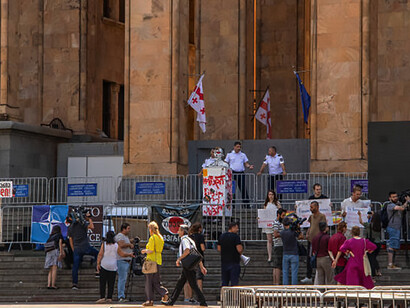
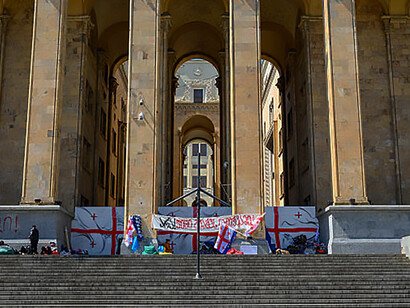
Since that infamous day, hundreds of non-governmental organisations have openly challenged the ‘Russian Law’, becoming targets of attacks at their workplaces, while their members were arrested without justification and assaulted by state forces. Despite this situation, hope remained in Georgia: the parliamentary elections in October 2024.
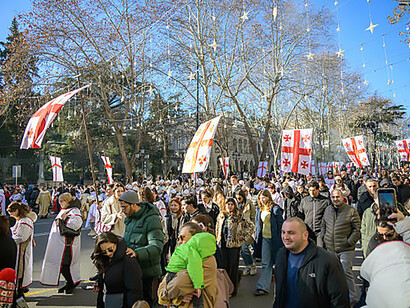
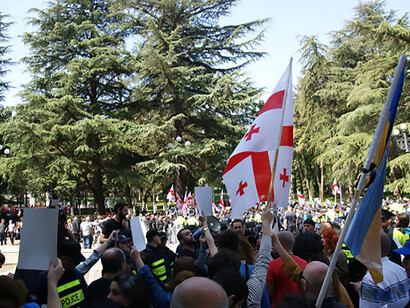
The run-up to these elections was marked by massive protests, persecution of individuals and organisations considered antagonistic to the will of Georgian Dream, and heavy-handed police repression. These actions bode ill for the upcoming electoral process.
On the eve of the elections, organisations seeking to promote voter turnout in light of the serious state of the nation, especially in rural and remote areas, encountered entire villages whose inhabitants had had their identification cards taken away by third parties who, through bribery or threats of force, ensured that they would vote in their place. This situation proved to be a harbinger of the events that would unfold on polling day.
On election day itself, members of the Georgian Dream party were campaigning illegally at the entrance to polling stations, party flags were displayed at the stations, and voters were approached at the polling stations themselves and persuaded or threatened to vote for Georgian Dream. During the day, videos circulated on social media showing ballot boxes being filled with illegal votes and journalists being assaulted while covering the electoral process.
The result was, predictably, a victory for Georgian Dream, condemned by international observers, opposition parties and the Georgian president herself. Since then, Georgians have been fighting against a tyrannical government that uses force and terror as weapons of suppression.
To remove the last political hope of the pro-European faction, the Georgian Dream party forced a presidential election in which the votes would be cast not by the Georgian people but by parliament.
The results of the presidential election, won by Mikheil Kavelashvili, the only candidate allowed by the government to run, whose far-right anti-Western ideas are supported by Georgian Dream, stand out as yet another act against the free, democratic, and European future desired by the majority of Georgians.
Georgia is currently fighting desperately against a government that wants to regress the country to a neo-Soviet state, resisting the fearful shadow of the Kremlin and its puppets. The task that these brave men and women face on a daily basis is overwhelming, so it is not enough to demand economic and political sanctions from our representatives; we must remember and support those who are fighting against tyranny, because we, the Portuguese people, also know the weight of autocratic shackles and the desire for a better future.
This article was written by Ricardo Filipe, a Portuguese writer and campaigner.