English
 Español
 Français
 Deutsch
 Italiano
 Português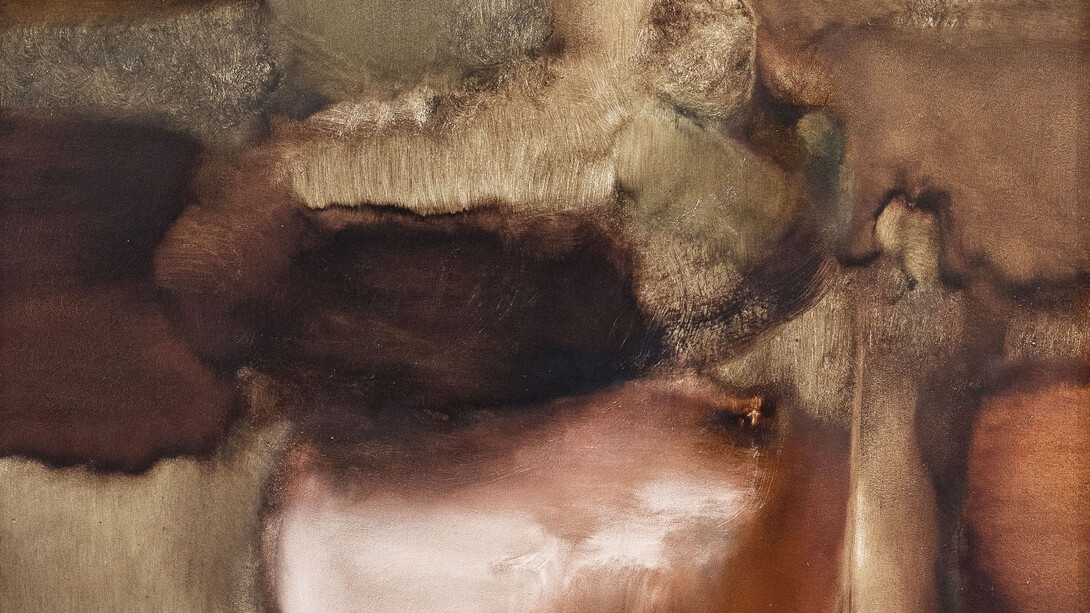
There are as many lived worlds as there are consciousnesses to inhabit them. Reality never exists in a single form. It is constantly shifting, transforming according to individuals, eras, and cultures. Yet, at the heart of these infinite possibilities, certain recurrences emerge: inevitable crossroads, recurring patterns that appear again and again. They shape our intimate stories as much as our collective narratives, and for as long as humanity has existed, they have nourished mythologies, religions, sciences, and the arts. They act as guides, reminding us that the world obeys laws greater than ourselves: those of nature itself.
In his new exhibition at Galerie Prima, Anide (born 1994, lives and works in Paris) takes hold of one of these fundamental motifs: the image of the Swallowed sun. It appears in ancient myths, where the sun descends each night into the underworld before being reborn at dawn: devoured by a monster, veiled by an eclipse, sacrificed so that the cycle may continue. Symbolically, this image refers, in Carl Gustav Jung’s writings, to a withdrawal of consciousness: a descent of the ego into the unconscious, necessary for the process of individuation. In alchemical philosophy, it is the Green Lion devouring the Sun: raw matter absorbing light in order to transmute it. Contemporary physics, in turn, reveals that stars must die to generate the elements of life, that light is born from collapse, and that engulfment is never emptiness but an extreme form of transformation. Through thinkers such as Kondratiev, Van Gennep, or Turner, the social and economic sciences also describe cycles of destruction and recomposition, in which every new order emerges from the ruin of the former. In this sense, The swallowed sun is more than an image: it names a universal structure of transformation, where no creation occurs without loss, no birth without a passage through shadow.
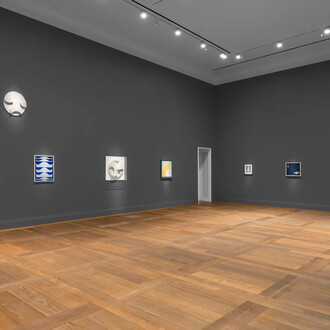
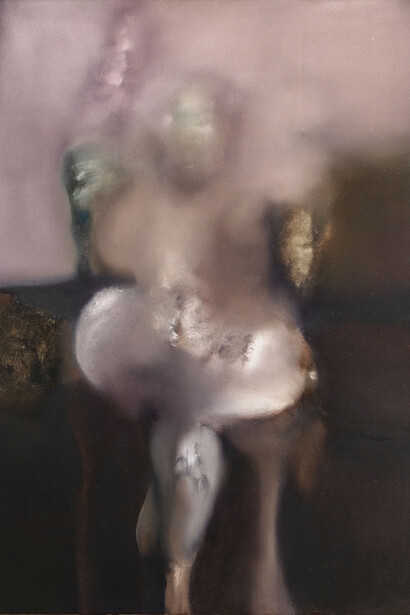
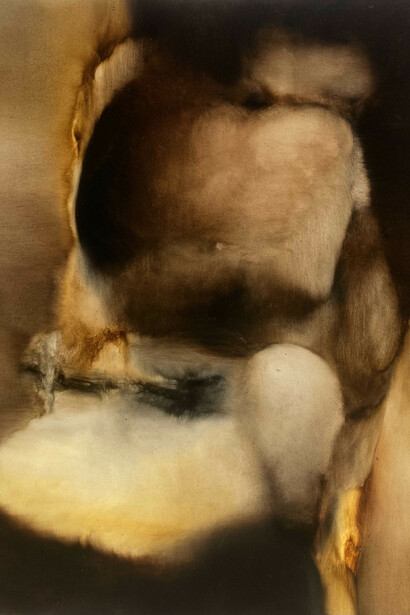
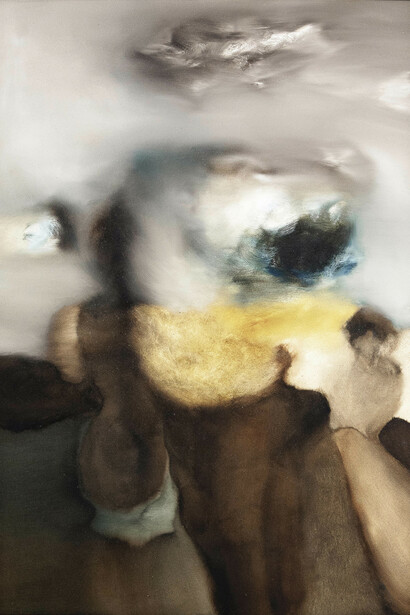
Through painting, Anide explores this moment of tipping point, this fragile and suspended in-between, where landmarks waver. Neither day nor night. Neither death nor rebirth. A time of waiting, of silence, of density. Each painting is born from intuition, without preliminary sketches. Here, colors become atmospheres, dilutions turn into plays of light, and erasures invite us to probe the depths of matter. Forms emerge only to dissolve again, and painting becomes a liminal space. With this work, the artist invites us to inhabit this state between two worlds. For is this not the most honest place of the human condition? The place where we accept not knowing what comes next, where we consent to transformation without controlling its outcome.
For this exhibition, the artist extends his approach beyond the walls. The space itself becomes something to be crossed. The darkened floor on which visitors walk heightens the sensation of entering an inner zone, almost initiatory. For the opening, a soundscape composed by the artist accompanies the arrival into the exhibition, establishing a meditative atmosphere, as if one were entering a nocturnal phase before a possible return of dawn.
Beyond its formal and philosophical dimensions, the exhibition opens a reflection on our time. Where ancient worldviews integrated the idea of cycles, our contemporary imagination tends to resist dissolution. Transhumanist narratives, in their most radical forms, conceive of death as a bug to be fixed, finitude as a technical flaw, and the body as an upgradeable prototype. This shift marks a profound change: from a world structured by alternating phases to a model of continuous growth. But what would a society without decline look like? What would our lives be without fear, drama, and doubt? What would a world be where the sun never sets?
Anide’s paintings invite us to embrace uncertainty. They allow unstable forms to surface, never fully fixed. Nothing here is definitive. Each image seems held in a state of transition, like a sun still veiled yet already preparing its return. With The swallowed sun, Anide proposes both an inner journey and a traversal of a universal archetype, reminding us that what disappears is not always a loss, but often the very condition of what comes into being.



![Mohsin Taasha Tappa-e Shuhada Roshnaaie [Hill of martyrs of enlightenment] from Rebirth of the Reds series, 2022. Courtesy of Galerie Eric Mouchet](http://media.meer.com/attachments/88a9b99d56257bd44c1e6e68377f280e3350a066/store/fill/330/330/e9d8f49d377be692a716e38249550040d715c57af996eabbdb47f1967679/Mohsin-Taasha-Tappa-e-Shuhada-Roshnaaie-Hill-of-martyrs-of-enlightenment-from-Rebirth-of-the.jpg)