English
 Español
 Français
 Deutsch
 Italiano
 Português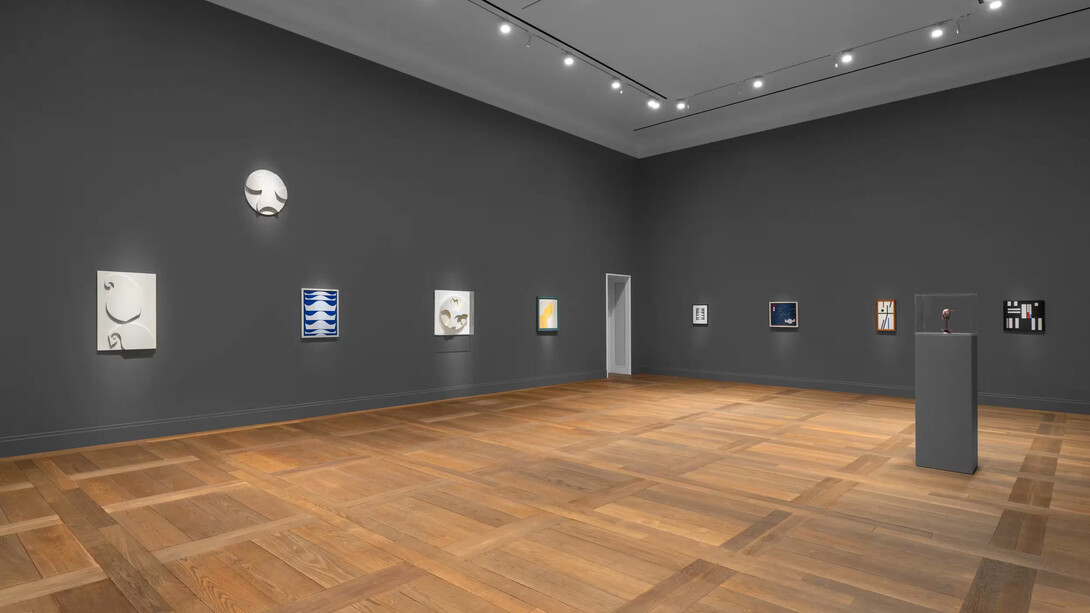
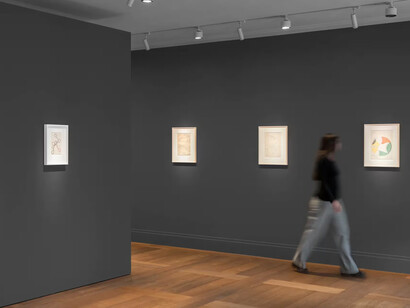
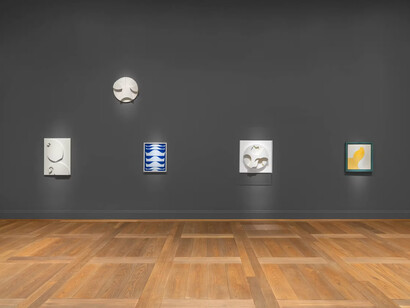
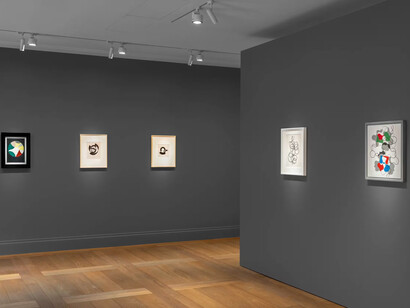
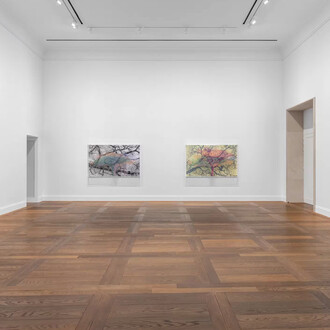
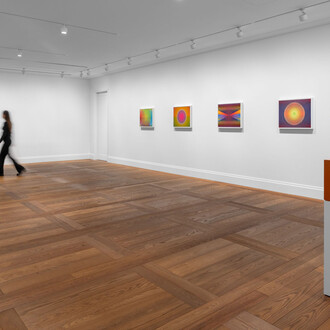
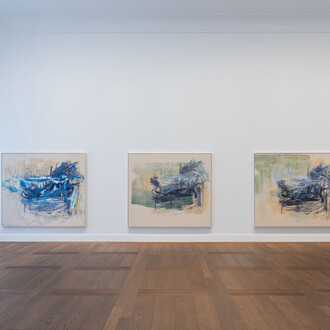
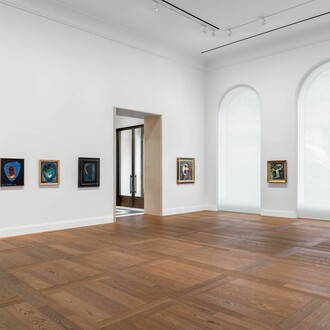
This sharply focused historical exhibition, Sophie Taeuber-Arp. La règle des courbes (The rule of curves) is curated by Briony Fer and is the gallery’s first solo display of Taeuber-Arp’s work, featuring over 45 artworks that span a four-decade period from 1916 – 1942. Coming from the German Arp Foundation (Stiftung Hans Arp und Sophie-Taeuber-Arp e.V.) and important private and public collections, the show includes paintings, drawings, gouaches, wooden reliefs and an iconic Dada head. The exhibition draws attention to the artist’s formal vocabulary of the curve, which she used in innovative ways to stretch, bend and warp the language of geometric abstraction.
Sophie Taeuber-Arp is one of the most important artists of the 20th-century avant-garde. Dismantling conventional oppositions between Dada and geometric abstraction, fine art and utilitarian objects, ‘La règle des courbes’ shows how Taeuber-Arp boldly engaged with the cultural context of international modernism.
The exhibition will be accompanied by a bilingual publication, Sophie Taeuber-Arp: La règle des courbes /The rule of curves, from Hauser & Wirth Publishers, featuring new critical texts by Briony Fer and Jenny Nachtigall that shed new light on Taeuber-Arp’s artistic output.
Taeuber-Arp’s training in the applied arts, with an emphasis on textiles rather than painting and sculpture, meant that multiple interests came together and were enmeshed with other visual and cultural forms prevalent at the time. Her work moved between art and design, the diagrammatic and the decorative, destruction and construction, positive and negative fields, parts and wholes. She amalgamated languages of decoration and technology, as well as those of Dada and Constructivism, and ignored the stricter protocols being laid down by others. This resulted in a body of work that was both playful and speculative, where curves and circles offered an alternative measure to calibrate the space between work and world. Taeuber-Arp set curves and circles against the structure of the modernist grid, a dominant trope of abstract painting in the first decades of the 20th Century. The exhibition reveals the radical possibilities of Taeuber-Arp’s earliest experiments, such as Composition à forme “U” (1918), right through to the broken circles of her so-called ‘last’ drawings such as Construction géométrique (Geometric construction) (1942).
At the height of interest in the Constructivist movement, characterised by its rigorous geometry at the time, she was making some of her most curvilinear work, translating decorative scrolls and arabesques into simple shapes. The distinctive methods she developed are arguably a continuation of a model of Dadaist abstraction, an always incomplete project, even when the component parts look as if they belong to a Constructivist tool kit. The reasons for this have much to do with the techniques she used, rooted in her formation as a designer and dominated by drafting tools of all kinds.
The title of the exhibition refers both to a rule as an organising principle and to an instrument used to measure lengths and distances like a ruler. Taeuber-Arp used a wide range of drawing tools as an extension of the hand, including French curves and other templates, as well as flexible and straight rulers. Works on display from the 1930s show her work becoming increasingly organic, containing curved shapes that suggest—as in the Coquille series—a preoccupation with natural forms and structures. This gives rise to a central paradox of the work: the more it becomes organic, the more she employs drawing templates to plot out her drawing.
One of the most compelling series that exemplifies Taeuber-Arp’s language of curvature is the small subset within the Curve paintings called Echelonnements (Gradations), which she began in 1934. These works champion both curved edges and straight lines, revealing the cumulative effects of the toppling stack of irregular forms. The ‘shapes’ in Echelonnement (1934) are white, suggesting they have been cut out of the blue ground, as negatives rather than positives.
Also on display are what came to be some of Taeuber-Arp’s final works made in 1942, which are generally termed ‘geometric constructions.’ This set of drawings all comprise black ink on paper, made using a ruler and compass. Taeuber-Arp would paint over small sections in white paint, as well as cutting and rotating certain sections, the cuts acting as horizontals or diagonals, so creating a circular movement out of the fragments. Although the forms she works with are always simple, her own methods of layering and amalgamation make them endlessly variable.
![Mary Cassatt, Fillette dans un fauteuil bleu [Enfant dans le salon bleu] (detail), 1878. Courtesy of Musée d’Orsay](/attachments/3ddcf3630b2e6b21d055a8488350d949784be8fa/store/fill/330/330/9b97dc5b17cad42577b6453f0968e961b1231ceb2b8b5ceb2c09057b2695/Mary-Cassatt-Fillette-dans-un-fauteuil-bleu-Enfant-dans-le-salon-bleu-detail-1878-Courtesy-of.jpg)