English
 Español
 Français
 Deutsch
 Italiano
 Português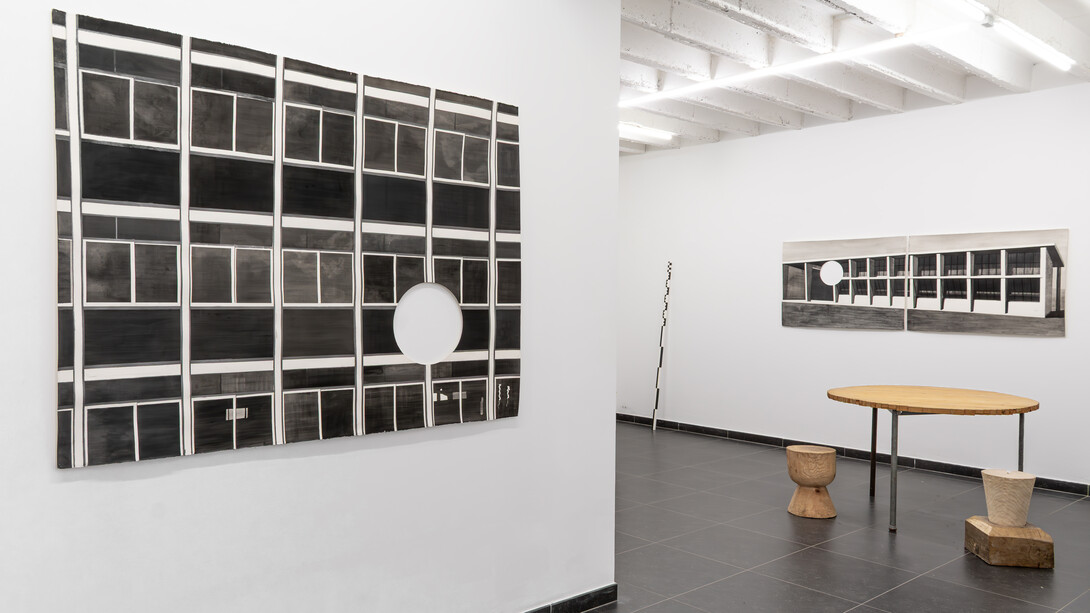
Julia Cottin presents a series of drawings inspired by school architecture in France after 1945.
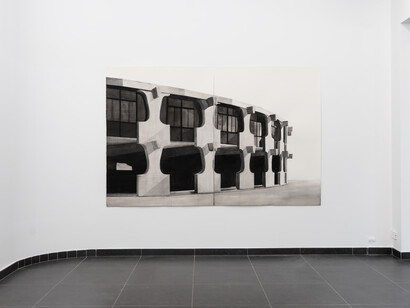
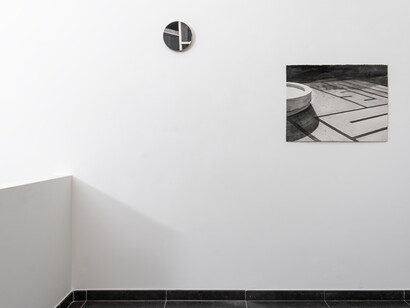
The theme of education is central to this proposal. As a social process of bringing individuals into conformity, and as an artist and teacher, it interests her greatly. In order to understand it, Cottin focuses on the places where this process is embodied. She is particularly interested in post-war school architecture and therefore modular and prefabricated architecture, since we are its direct heirs. Using archive images from various sources (the internet, specialist documentation, etc.), she creates drawings whose light materials (Indian ink and pigments mixed with water) contrast with the subject matter and the massive forms of the buildings that occupy the entire space of the sheet, as if they were portraits. In some drawings, she sometimes introduces missing areas, holes, circles — gaps in memory. These voids represent what memory cannot always restore, areas of shadow or silence. For Julia Cottin, study drawings are a way of appropriating these architectural forms in order to better divert their meaning.
This diversion serves her critical view of the standardisation of architecture and its political expression, while questioning: What pre-fabricates us? How do school walls, building plans and construction logic influence the way we learn, think and live together?
From the 1950s onwards, the massification of schooling in the West imposed rapid and standardised construction of school buildings. In France, between 1966 and 1975, 3,500 secondary schools were built, often according to centralised Technical Construction Programmes (PTC). This standardisation, although necessary, sometimes led to architectural poverty, reflecting a utilitarian vision of education. How do these spaces, designed for education, also shape our memories and our freedoms? Today, these buildings, often still in use, raise the question of their suitability for current educational challenges.
Standardisation is not neutral: it carries with it a vision of humanity and its education.
(Excerpt from the archives of the National Institute for Educational Research [INRP], 1972)
Faire le mur is a French expression that literally means ‘to make the wall’, but figuratively refers to running away, escaping (often from an institution such as a boarding school, school, or even a prison) or leaving “secretly”, similar to ‘sneaking off’ in English.