English
 Español
 Français
 Deutsch
 Italiano
 Português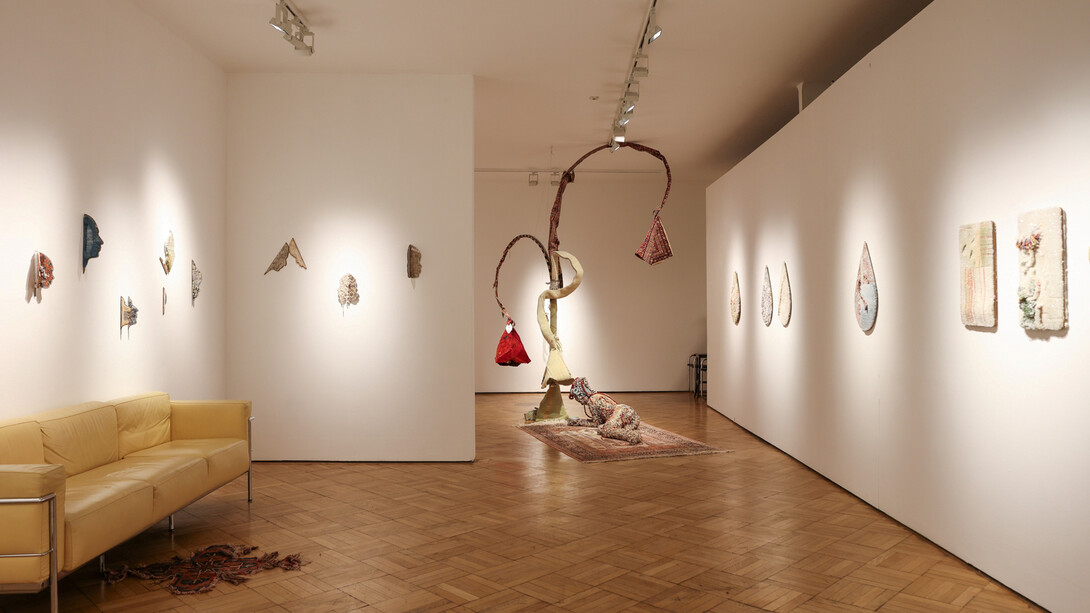
With tree of life, Noushin Redjaian shares with us a new, fantastical moment from her body of work: a landscape presented to us of carpets, crystals, forms, and figures, in which myth, psyche, and soma, mneme and memoria intertwine as symbols of cultural and ecosystemic responsibility, forming a finely woven network of perception and contemplation.
Entrée:
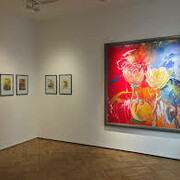
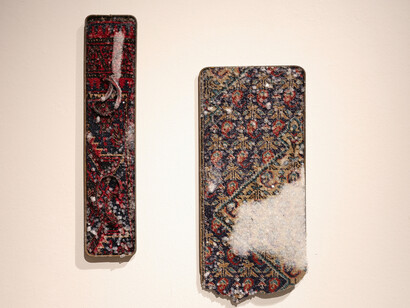
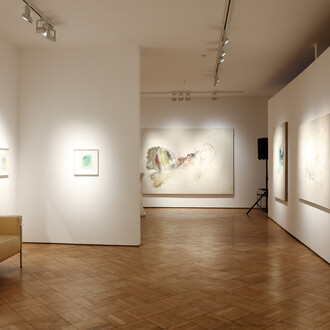
At the very beginning, one encounters pairs of carpets—arranged on the floor in the form of shoes; above them floats a bust, with two eggs embedded within it, all enclosed by soft lines that evoke life cycles, buds, and blossoms. On the right wall appear orthogons from the cycle Form and soul that have outgrown two-dimensionality: abstract forms, processes of growth, connections aimed at making inscribed imprints visible. Countless crystals on the works reflect and amplify memories of moments that are in fact fleeting, yet preserved for eternity, chemically bound to the here and now.
Salon:
At eye level, the rectangular works speak of balance through lines that appear as snakes and dragons. Beside them rests a childlike face. Each exaggerated and abstract countenance seeks to make visible how we engage with our unconscious aspects — which parts of ourselves we protect and which we overlook. From this awareness, a space may emerge in which affection, observation, curiosity, and delineation become a tangible experience.
Arboretum:
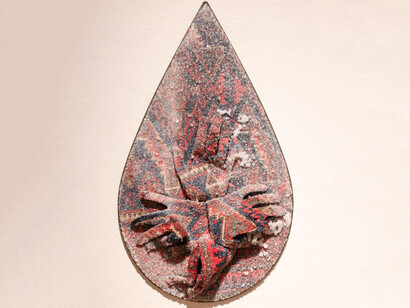
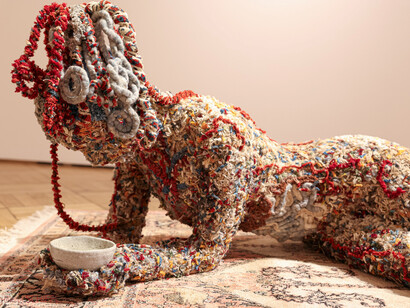
The central room is occupied by an abstracted tree whose crown reaches up to the ceiling. The representation brings together the mythologies of the Western Tree of Life, traditions of Kabbalah, and universal motifs of the Tree of life. As a living tree manifesting the Sefirot, it does not receive through language, but through breath and resonance. Beneath the tree rests a reclining figure, Mneme, who reveals heart, intestines, and veins and holds a bowl of water in her hands. She refers to the poem Tree of life installed as a wall text and symbolizes memory, inner care, and the connection between body and mind across generations. The figure is surrounded by objects in the form of hands and drops, whose meanings oscillate between giving and taking, observing and sharing. Behind Sefirot, two hands appear with a floating heart made from a more than one-hundred-year-old Persian Ghom carpet, facing one another.
The bowl, the water, the drops, and the hands point to Tikkun—healing through remembrance and transmission. The tree evokes mythological parallels—from Yggdrasil, the world ash, to the tree of Eve and Mesopotamian trees of life—as bearers of secrets, places of connection between worlds, intimacy, and knowledge. Above and below the tree unfolds a dialogue between body, nature, and myth—one that is not to be conquered, but to be cared for.Carpets as a medium refer to a millennia-old cultural history and Indo-Persian traditions, including the Miribota (paisley pattern), protective symbols such as the “salty eye,” and floral motifs as signs of the infinity of life. Historical iconography inspired by cave paintings such as those found in the Cueva de las Manos appears alongside crystal imprints on carpets as part of nonverbal communication. The crystallization of the works seals fleeting moments of human experience, much as cuneiform script preserved ephemeral thoughts on mineral tablets over 4,000 years ago. What of this will endure?