English
 Español
 Français
 Deutsch
 Italiano
 Português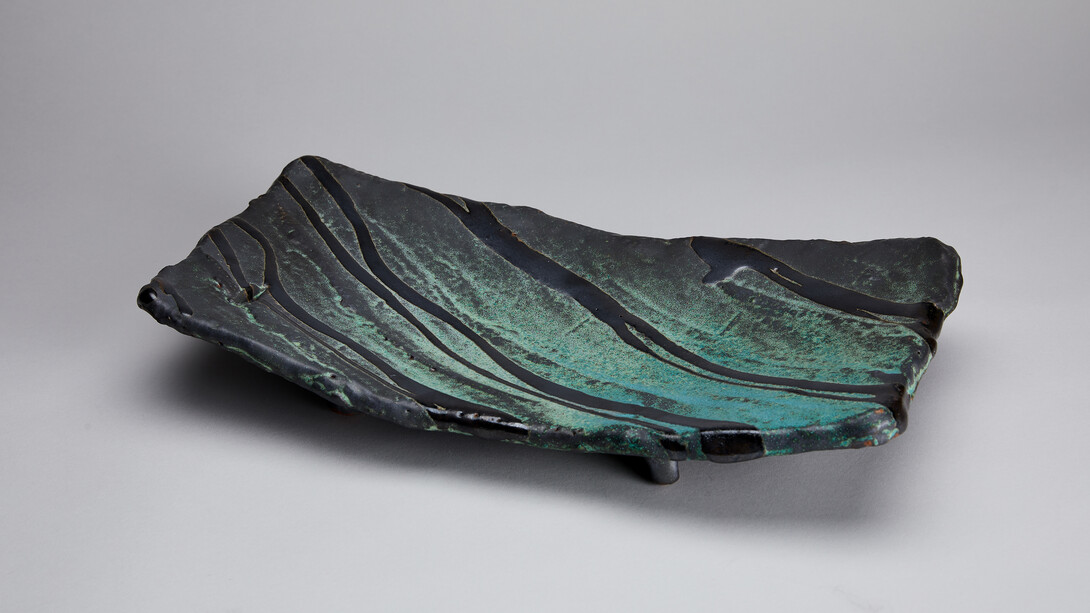
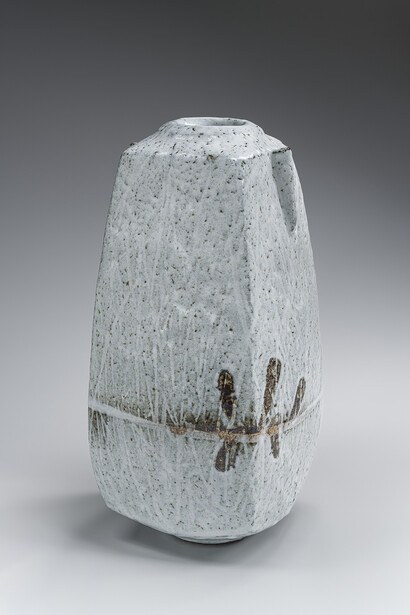
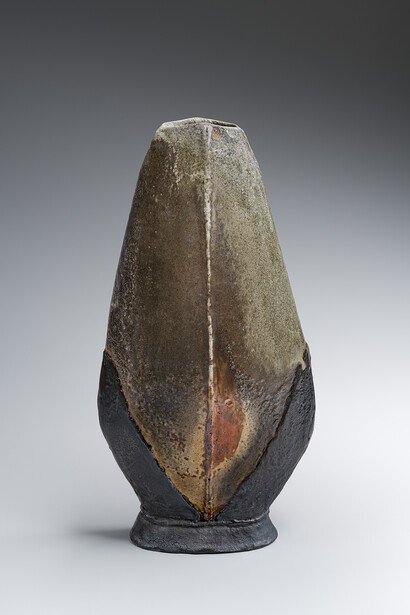
Interviewed in 1965, Saul Bellow, the Nobel Prize winning author said “that art has something to do with the achievement of stillness in the midst of chaos.”* Randy Johnston’s recent work has such an inherent quality of stillness. His work allows our attention to dwell on the heft, volume, and surface of objects that subtly yet deftly reference historical ceramics and sculpture. For all ceramic artists stillness can become evident in the frozen movement of a wet, malleable material. Clay retains touch or stretch marks, evidence of the initial plastic state, softness turning to hardness as it shrinks and dries, ultimately being fired to become a contemplative, usable object. Johnston’s choices for this exhibit record the scrape of his hand, subtle embellishments of form, the wet moments of the brushstroke, the heat of the fire. Johnston pays close attention to nuances of form and how minimally processed materials amplify gestures in both making and firing.
As contemporary potters we all work within an ecosystem of art and craft. When we endeavor to make a new object, we carry the weight of, and the potential access to, images of everything else that has ever been made. One can no longer work in isolation. In Johnston’s case, the progression of ingesting historical influences and modern artistic trends is mixed with a commitment to a utilitarian potential. His work is evocative—physically, tactilely, and of course, functionally once food, flowers, or ceremony are added.
For us, the cycle of a studio potter’s work, especially when firing a large wood kiln, is partially analogous to being a consummate gardener. The objects being made are creative seedlings, orchestrations of revisited personal standards as well as fresh varieties of form. There is a honed, almost seasonal rhythm of imagining, making, drying, perhaps glazing, loading, and ultimately firing. Harvesting expected as well as fortuitous results, failures and successes, means Johnston has to identify those pieces that carry forth his initial inspiration through the guided collaboration of material, form, texture, glaze, ash, and the kiln’s defining heat. Such objects record Johnston’s touch, vulnerability, strength, and vision.
We personally love seeing evidence of the hand and the friction that happens between the artist’s concept and the material’s resistance. For Johnston, a potter of fifty plus years, one essential question is how to sustain his own enthusiasm? How can he continue to make inanimate objects that deftly transmit emotions? How can his work evolve should he decide to simplify his process, potentially foreseeing and perhaps exploring alternatives to firing a large kiln that requires lots of wood and many helpers? How does he adjust his practice to make exemplary works that continue to breathe, to create stillness by their very presence. Johnston aims to move beyond the formal question of how does something occupy space. What are the mysterious components that give a piece bones, a supportive skeleton? There are deft allusions to the contemplative postures of Cycladic objects. There are echoes of Modigliani in a feeling of inherited line.
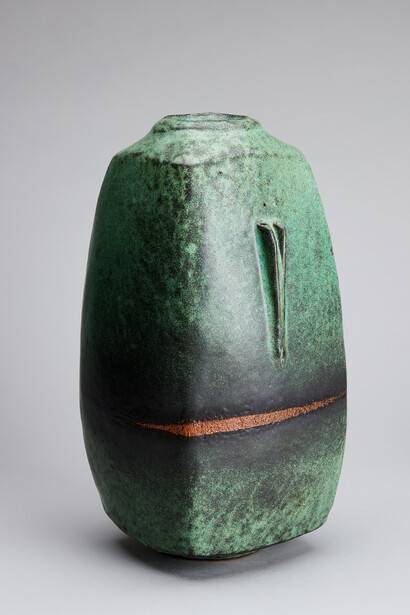
Johnston’s bounded layers of texture, glaze, and ash allow for evolving sculptural stances. The sculptural references have become more subtle yet pronounced without losing the potential of use. The black and green copper glazes speak with the vocabulary of bronze as if they had been carefully cast and fine-tuned with delicate patinas. There is a rhythmic beat to the repetitive scoops of the multiple spoon form. The black oval vase is humanized by its sensitive seams. The long spoon soars with an orchestrated nose and groove. The long boat’s bow and stern are contrasting yet in a fruitful dialogue. Ears and noses are playfully and sensitively positioned to insure unique identities.
If one looks through past catalogs of Johnston’s exhibits at Pucker Gallery his handwriting in clay is always clear. With each exhibit the focus evolves—there might be more natural ash glaze, or an emphasis on the Nuka glaze. The forms may be fuller and sometimes birds land and then fly out of the picture. But no matter the year, Johnston’s adroit sense of volume, nuanced surface, and personality of line are always there speaking with a solid stillness, patiently waiting for our full attention.