English
 Español
 Français
 Deutsch
 Italiano
 Português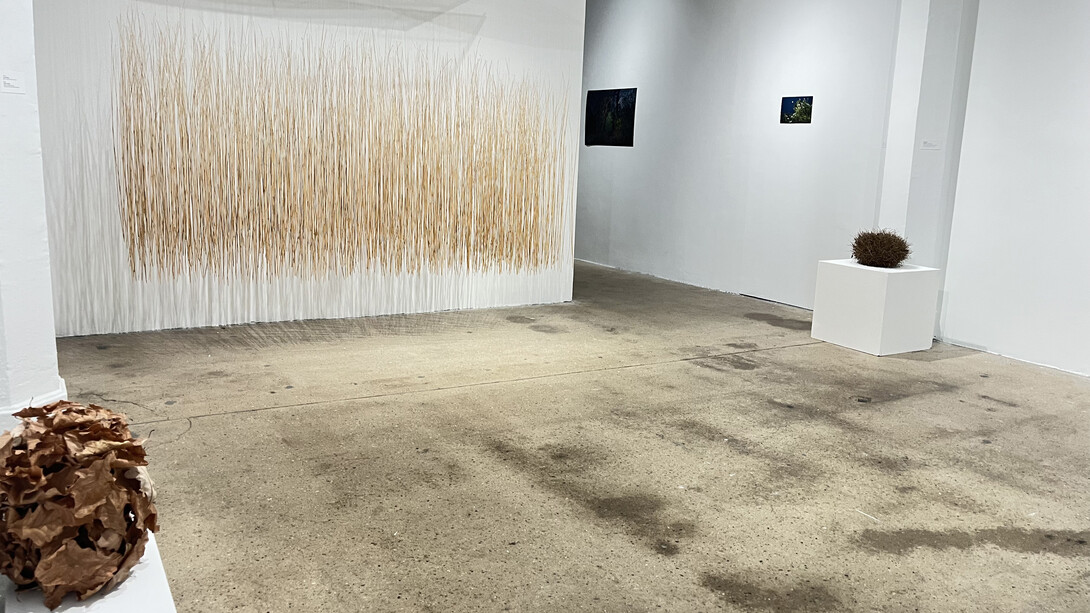
The United States interstate system spans 46,876 miles of highways. Discreetly tucked alongside the many on and off-ramps are small patches of wild, untended land. These “freeway islands” mostly go unnoticed, but they are intentionally designed and positioned to function as drainage areas.
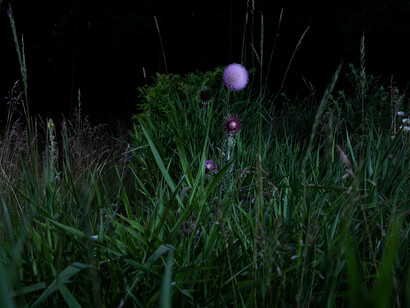
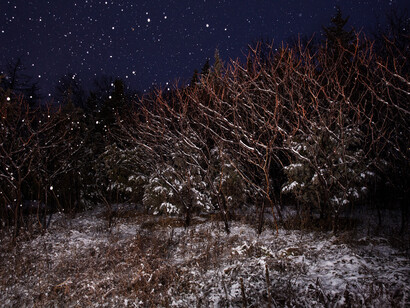
During travels across the country while attending the California Institute of the Arts (CalArts), artist Lois Bielefeld became captivated by these overlooked landscapes. Amid exhaust fumes and concrete expanses, Bielefeld observed thriving pockets of life—miniature biomes existing at the edge of human dominance. Her photographic series, its own pristine devices, documents these spaces at night, when the line between human-made environment and natural habitat blurs. Street lamps resemble moonlight; a fox slips past a semi truck; the ordinary becomes cinematic. The images reveal intimate moments of survival and beauty within heavily trafficked locations.
Each image in the series is titled with corresponding ramp number and location, guiding the viewer on a journey through seasons and terrain. Large-scale, unframed prints, with velvety blacks and deep blue skies, quietly reveal private dramas: a glowing young pine tree under tangled vines, giant snowflakes creating storybook wonder, a blossoming thistle almost operatically radiant in its hidden glory. A related video work employs an endoscopic camera to explore other concealed natural spaces.
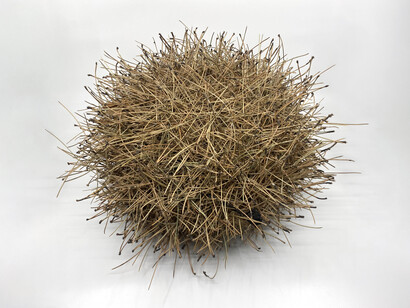
Bielefeld is joined in this exhibition by Chicago-based artist, Marzena Ziejka, whose interdisciplinary work cultivates memories of her agricultural roots in Poland. Ziejka builds sculptures out of common plants. Her working materials — a bundle of Oak leaves, a mound of egg shells, pine needles, or Hawthorn branches — stay close to their points of origin while gently morphing into sculptural objects. Ziejka’s reverence for these organic materials parallels Bielefeld’s explorations of the overlooked and in between.
Together, the artists blur boundaries between the manufactured and the wild, asking: ‘What counts as nature? What deserves our attention? What thrives in the spaces we pass without seeing?’ Their works offer a hopeful proposition that the more we notice, the more we might value and preserve.