English
 Español
 Français
 Deutsch
 Italiano
 Português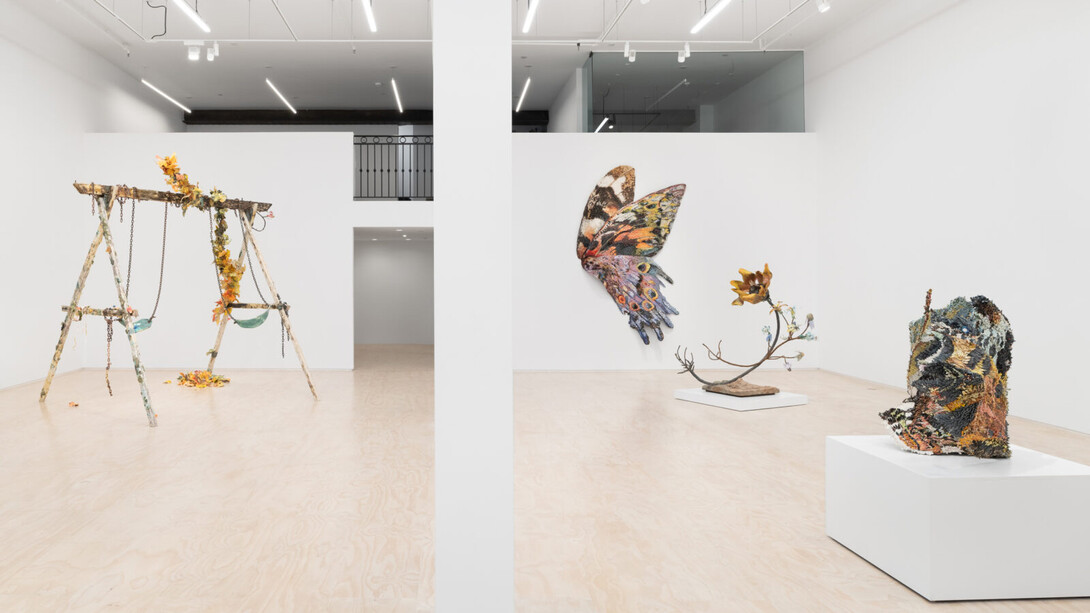
Jessica Silverman is delighted to announce representation of Rebecca Manson, whose debut solo show with the gallery opens on January 8 and runs through February 28, 2026. The New York-based artist is a virtuoso sculptor who explores nature’s microcosms, magnifying delicate details into large, intensely tactile forms. Her practice reimagines ceramics as visceral fantasies where sight is subverted by touch and form surpasses function.
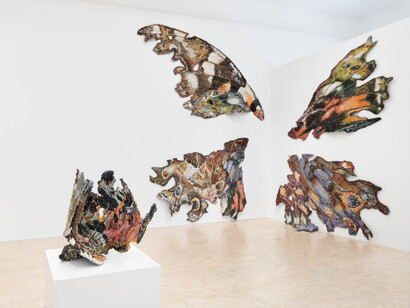
A four-part winged wall installation titled Exploding butterfly (2025) elicits another suspended moment. Monumental butterfly wings appear to drift apart, magnifying a miniscule rupture into a visceral drama, where beauty shatters in slow motion. Their gradual fragmentation conjures awe and angst. The work reflects Manson’s interest in the beauty of decay.
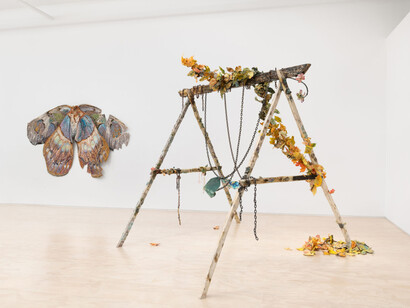
At the center of the exhibition is The swing (2022–2025), an eight-by-eight-foot trompe-l’œil construction made of ceramic and glass. Modeled after Manson’s childhood swing set, its porcelain posts mimic worn lichen-covered wood. An uncannily realistic bag litters a pile of ceramic leaves, while a glass bikini hangs nearby. Both playful and elegiac, the joys of youth and freedom feel tangible but slippery, as if on the brink of expiration.
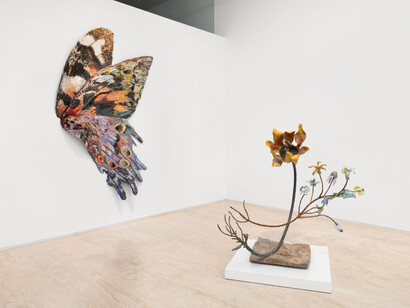
Manson’s polychromatic glazes create optically rich ecosystems that simulate iridescence, vibration, and motion. Wall works such as Shelly and Blue admiral wing (both 2025) exemplify Manson’s technical precision. Shelly shimmers through high-contrast and complementary color rather than reflective glazes. Meanwhile, intricate veining reminiscent of leaves and gem-like glass inlays in Blue admiral wing refer to the species’ camouflage. Enlarged many times over, these details evoke the fragility and resilience of natural life cycles and human experience.
The title of the exhibition, Time, you must be laughing, draws from Joni Mitchell’s 1975 song “Sweet Bird” and evokes the dark humor of impermanence. The exhibition features 13 sculptures, made primarily of porcelain, depicting larger-than-life butterfly and moth wings, flowers, and a swing set. Together, these works explore the relationships between bodies and the natural world, and time as a force that reshapes both.
After graduating from Rhode Island School of Design (RISD), Manson received a Windgate-Lamar Fellowship that ultimately led to an outdoor public work in Tribeca Park. A later collaboration with engineers yielded a flexible adhesive that enabled bonded pieces of porcelain to behave like textiles. This innovation opened the door to the signature moth and butterfly wings. Composed of thousands of hand-shaped glazed clay that she calls “smushes,” the works roar with material intelligence. Manson’s work is in conversation with the history of impressionist and post-impressionist painting as well as the witty ceramics of Grayson Perry and Arlene Shechet.
Manson’s relationship to clay began at age eight when she started taking pottery classes. She has since spent her career leveraging its materiality to examine embodiment, empathy, and the relationship between vitality and decay. Though her sculptures often assume abstract or winged forms, they are rooted in the figure. Her journey from pottery to sculpture has embraced clay furniture, porcelain sunflowers, and animal pelts, all acting as proxies for the human body.
Throughout the exhibition, beginnings and endings coexist. Manson embraces change as a constant, positioning her work as a place where grief lifts and the persistence of nature offers grounded hope. Embodying both strength and vulnerability, Manson’s work insists that transformation—emotional, ecological, and material—is not merely a condition to endure but a site where new meaning forms.


![Paul Klee, Komiker (Comedian) [Invention 4] (detail), 1904. Courtesy of San Francisco Museum of Modern Art](/attachments/04df4ade6b4e470f095f311cf9fe61061207f309/store/fill/330/330/9c191f0baf62001530291521d7da91c9dc6cfcfa380da17510698c809d2c/Paul-Klee-Komiker-Comedian-Invention-4-detail-1904-Courtesy-of-San-Francisco-Museum-of-Modern.jpg)