English
 Español
 Français
 Deutsch
 Italiano
 Português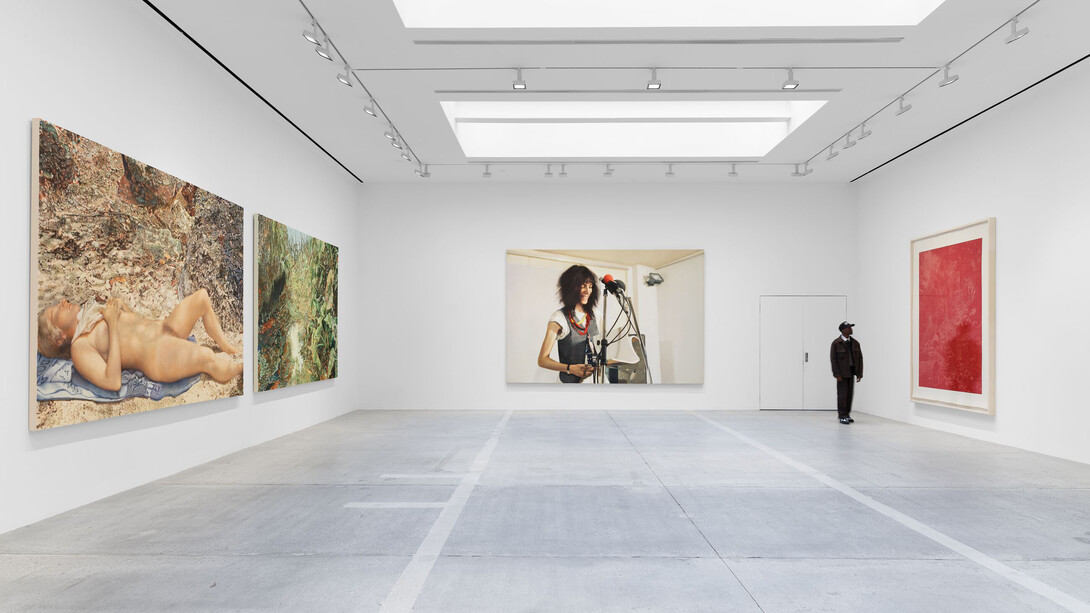
We are honored to present Franz Gertsch. Presence, an exhibition devoted to the distinctive vision of late Swiss artist Franz Gertsch (1930 – 2022).
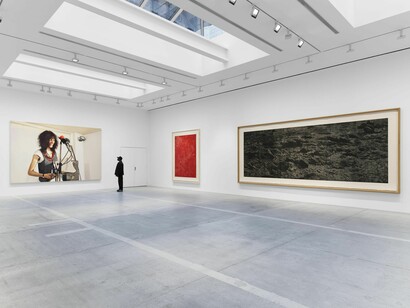
This focused presentation brings together eight monumental works spanning Gertsch’s career, elucidating the ways in which he transformed photographic imagery into hyperrealist paintings and woodcuts. What appears at first glance to be a project of exacting replication emerges instead as a deeply investigative practice––one that enshrines the poetry of fugitive moments through a disciplined material language. Gertsch’s work stands as a testament to his relentless pursuit of a new way to represent reality by challenging the very boundaries of realism.Curated by Dr. Tobia Bezzola, Director of the Museo d’arte della Svizzera italiana (MASI) in Lugano, Franz Gertsch. Presence is the gallery’s first comprehensive presentation of the late artist’s work in New York, offering American audiences a rare opportunity to experience the full visual and emotional impact of his singular practice.
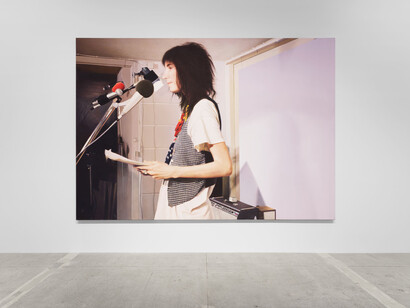
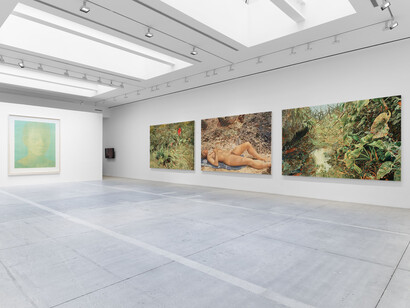
A highlight of the exhibition is a pair of large-scale canvases—Patti Smith III (1979) and Patti Smith IV (1979)—from a series inspired by photographs Gertsch took during a live rock performance in Cologne, Germany. Painstakingly rendered by Gertsch’s own hand, every meticulous strand of Smith’s hair and subtle gesture coalesce into an image that feels alive and three dimensional, suspending the subject’s energy and charisma within the stillness of paint. Gertsch’s exploration of landscape unfolds in the immersive triptych Guadeloupe (2011 – 2013). Drawn from extensive photographic studies of the Caribbean forest, its dense foliage and shifting light verge on abstraction, dissolving documentary precision into a near-hallucinatory vision of nature. As with his human subjects, Gertsch approaches the landscape not merely as something to depict, but as a living presence to encounter and engage with.
Guadaloupe invites the viewer into a contemplative space where time seems to pause and invite reflection. The works titled Natascha IV (1987 – 88), Rüschegg (1988 – 89) and Schwarzwasser II (1993 – 94) exemplify Gertsch’s pioneering approach to woodcuts. Over the course of many years, he developed a personal approach to this centuries-old technique, carving raw wood with bespoke tools, mixing natural pigments and hand-printing onto delicate Japanese paper. The apparent contradiction at the heart of his method—and his quest to prove that a woodcut could capture the complexity of light and space—became the driving force behind some of the medium’s most profound reinventions. Gertsch himself remarked that, ‘There is truly nothing less suited to capturing light and three-dimensionality than a woodcut’—yet it was precisely this challenge that drove him to reimagine what the medium could achieve.