English
 Español
 Français
 Deutsch
 Italiano
 Português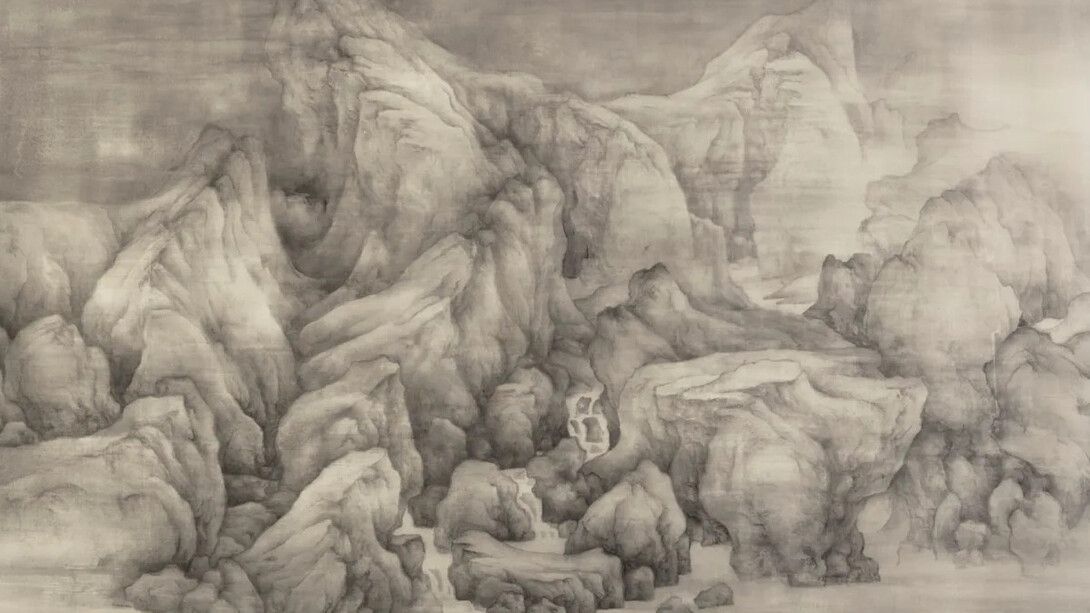
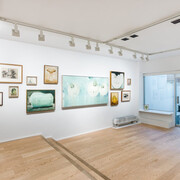
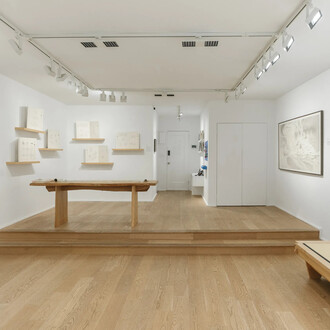
Fu Qiumeng Fine Art is delighted to present our second solo exhibition with Tai Xiangzhou, Under heaven and beyond form: celestial tales of Tai Xiangzhou. The exhibition brings together three significant series that span the artist’s career—Celestial Tales, Milky Way, and Kunlun—juxtaposed to form a sustained dialogue. Taking ink as its conceptual and material foundation, the exhibition systematically traces Tai’s artistic inquiry into cosmological thought, material elements, and pictorial traditions, articulating his sustained engagement with the transformation of ink painting in a contemporary context. The exhibition will be on view from January 3 to February 21, 2026, at 65 East 80th Street.
Rooted in ancient Chinese cosmology and the historiography of landscape painting (shan shui), Tai Xiangzhou’s practice engages in parallel with contemporary scientific discourse. Rather than pursuing a mimetic representation of the natural world, Tai interrogates the internal pictorial structures, spatial logic, and metaphysical principles that underlie the Chinese landscape tradition, using them as a framework through which to articulate an understanding of cosmic order. Through three closely related series, the exhibition unfolds as a cumulative and stratified viewing experience.
Celestial tales: primordial indeterminacy
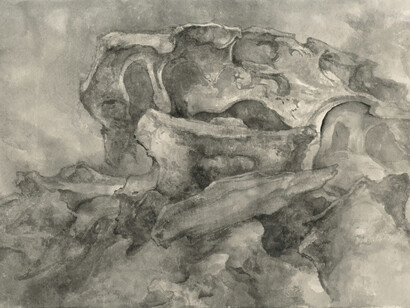
This series constitutes the core of Tai Xiangzhou’s artistic language and may be understood as a response to questions concerning the visual origins of shan shui painting. In these works, the artist deconstructs the canonical texture strokes (cunfa) and compositional conventions of Northern Song landscape painting, transforming mountainous forms into primordial matter suspended within a state of chaos. Drawing upon ink-wash techniques developed in Song dynasty silk painting, Tai creatively translates these material and procedural practices across different supports, including paper and canvas. Through the penetration and accumulation of layered ink washes, the works rearticulate the Song pursuit of qiyun (spirit resonance), extending it into a visual metaphor for cosmogenesis. In doing so, the series establishes a distinctive visual dialogue between classical landscape cosmology and contemporary imaginings of astrophysics.
The Milky Way: Water as Pictorial Structure
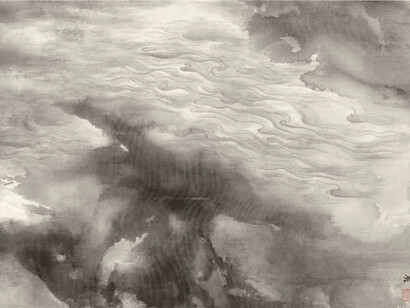
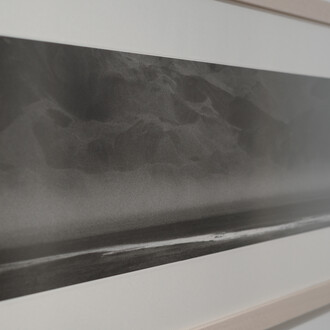
In this series, Tai enacts a deliberate shift in pictorial hierarchy: water supplants mountain as the primary structuring element of the image. Drawing upon the Southern Song lineage of Ma Yuan and Xia Gui, particularly their treatment of water and negative space, Tai subjects these historical brush conventions to a process of abstraction. Waterfalls emerge from indeterminate sources or suspended rock formations, traversing void-like pictorial spaces and converging into riverine and stellar configurations. Here, water is no longer a descriptive motif tied to a specific landscape, but functions as an organizing principle that articulates spatial continuity, temporality, and movement within the pictorial field.
Kunlun: Contemporary Reconfiguration of Mythic Iconography
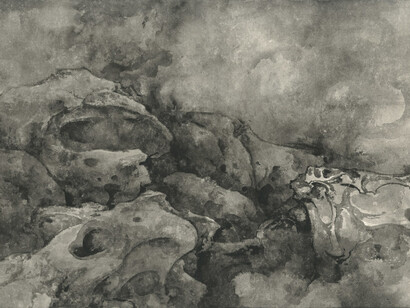
This series signals a shift from an engagement with universal physical order toward an investigation of iconographic history. The figures of dragons, phoenixes, and qilin in Tai’s work derive from visual and textual sources such as The Classic of Mountains and Seas (Shan Hai Jing), as well as auspicious imagery found in Han dynasty stone reliefs and lacquer painting. Tai extracts these historically embedded motifs from their original ritualistic, narrative, or decorative contexts and rearticulates them within his own landscape structures constructed through ink and nebula-like spatial fields. This process does not constitute a revivalist return to ancient imagery; rather, it represents a critical and generative reconfiguration in which traditional symbols are activated within a contemporary pictorial system, pointing toward questions of temporality, transcendence, and the afterlife of images.
Taken together, these works reveal Tai Xiangzhou’s practice as one that does not seek to reconcile tradition and the contemporary, but rather treats tradition as an active, generative framework. By repositioning ink painting as a site of cosmological inquiry and material experimentation, Between Heaven and Earth: Formless Images foregrounds ink not as a historical medium, but as an evolving system of thought capable of engaging both ancient philosophy and contemporary modes of understanding the universe.