English
 Español
 Français
 Deutsch
 Italiano
 Português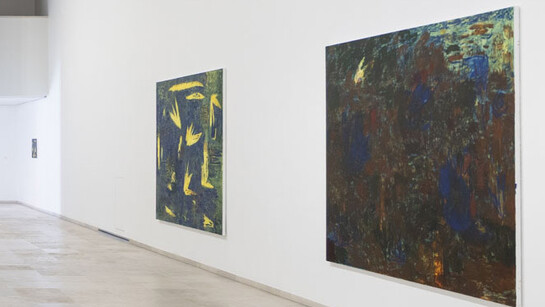
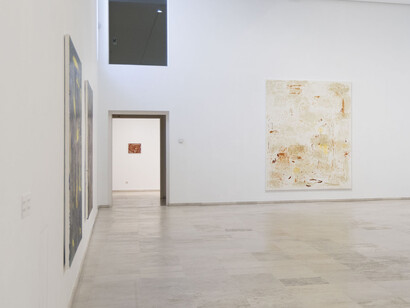
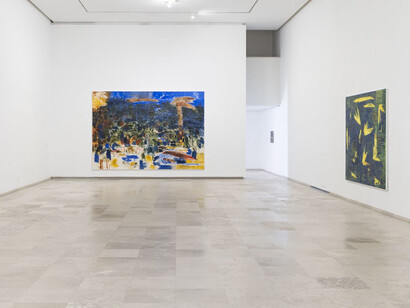
This collection of paintings by Miguel Marina (Madrid, 1989), all of them recent, were painted with this exhibition in mind after he had carefully examined the characteristics of the space, one of the most emblematic and demanding in the museum with its high walls and appealing rhythms. It is quite true that artists do not usually feel the demand for specificity that the Chapel tends to impose in this space, and yet it is also true that even those who paint today seek to activate the space in question so that it becomes more than just a container for their paintings – it should also be eloquent content in itself. This is what happened in this very space with Damaris Pan, who created a striking column, and it is happening now with Miguel Marina, who extends one of the short walls, endowing the room with a different cadence.
Marina has titled his exhibition So far. There are few expressions that convey the idea of the end of a journey, of the last stop, as well as this one does. In the field of creation, few expressions are as delicate. Accepting a painting as good is always one of the painter’s great dilemmas; how irreversible this is, the desire for irrefutability, is always a disturbing component in artistic work, which is why a title like this can be misleading because of its vehemence, even paradoxically sliding us into the realm of uncertainty, or at least one in which nothing should be taken for granted. Anyone who has followed Miguel Marina’s painting over the last few years will be familiar with the ease he circumvents the constraints of any pictorial register with. When viewing his work, it is difficult to discern whether what we see in the painting is the result of a germinal situation or the last gasp of something else. Thus, a “so far” will invariably bring with it a sequence of questions: where from and where to? When from and till when?
Actually, we think we know what is going on. The invitation from the Patio Herreriano to exhibit the work in Room 8 is not meant to be a break, an internal pause in his work to satisfy our proposal. If what is presented here is new compared to what was painted just a few months ago, this is due to a core issue in all his work, which is none other than the uninhibited way he approaches new registers in and the permeability he welcomes unexpected stimuli with. He tells us that everything stems from a firm predisposition to search. Marina’s pictorial decalogue is flexible, not because it lacks solidity, but because it is built from a state of constant becoming. We are presented with the foundations of this poetics of the unpredictable, in which there is no plan other than to let the painting find its place, so that all discursive spirit is revealed in a single way: by painting and not by speaking.
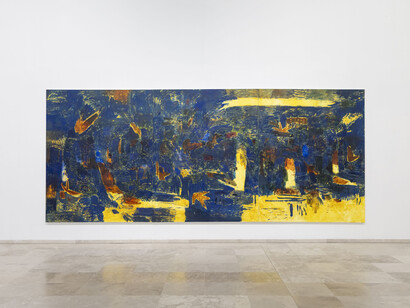
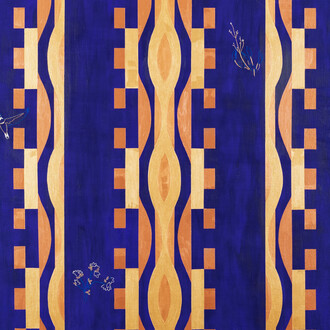
There is an exuberant palette in this latest painting. It is not entirely new, as we already came across bright ranges in previous pieces that tended, however, to be arranged in extensive monochromes, or on surfaces with tones always related to a specific temperature. The tones evocative of distant, historical latitudes persist, with blues that take us to overseas territories, and at the same time, that final patina remains, giving the surfaces that past condition that was so evident in pieces from a different time, such as those that came out of his Roman experience at the Spanish Academy, which was so decisive. This is because in many paintings, Miguel applies the wealth of accumulated time to the bright and fiery – and therefore decidedly lively – quality of colour, and thus temporal notions such as “now” and “always” are poured into the same place, a common space. We find it quite difficult to find the right word when it comes to temporality, as it is no easy task to know whether Marina contrasts one layer with another, whether one attempts to mitigate the other... The relationship between a fervent brightness and the opaque density that comes with antiquity is decidedly ambiguous.
In these recent paintings, the range of action expands, enriching the resounding repertoire of his abstraction. Vigorous strokes coexist with forms that have something embryonic, something incipient about them. Anyone observing these paintings will distinguish forms that can be seen in quite a few different pieces. Given that they are radically abstract, they may be reminiscent, perhaps because of their repeated presence or their evocative potential. In any case, we recognise them here and there. They are triggering forms that grow at different temperatures, sometimes amid agitated and visceral activity in the stroke, other times in a void of slow and therefore scarce expressiveness.
Let us now go back to the space that houses these paintings. The walls accept, or rather demand, large-format pieces. Marina handles pieces of varying sizes with great ease, satisfying the grandiose demands of the space while subtly dotting the empty space with very little. The architecture of the space encourages those who activate it to see as many things outside the painting as inside it. This is what we were referring to at the beginning: the balance that Marina achieves inside the painting is echoed outside it. In the end the rhythm of both is one and the same; coherent, like speed, like temperature.