English
 Español
 Français
 Deutsch
 Italiano
 Português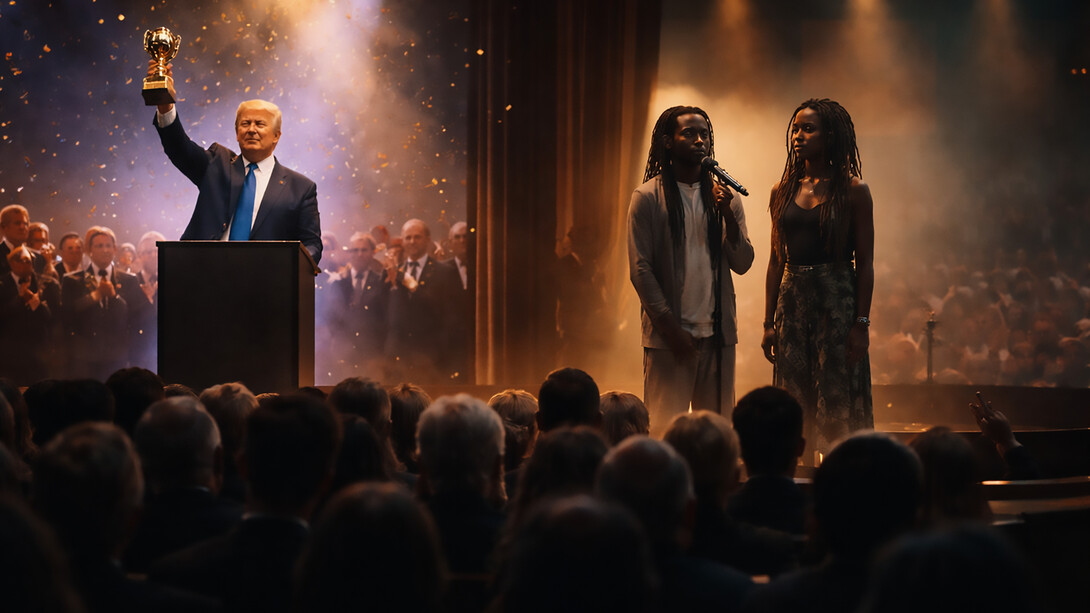
At the FIFA draw for the 2026 World Cup, held on December 5, 2025, at the John F. Kennedy Memorial Center for the Performing Arts, U.S. President Donald Trump was awarded the organization’s newly created Peace Prize. The award was presented amid applause and celebratory stage lighting. Organizers praised Trump for his "leadership" and "contributions to global dialogue." However, there was no mention of his record on immigration, racial rhetoric, misogynistic discourse, or repeated attacks on democratic norms. The moment passed, and no one protested within the room.
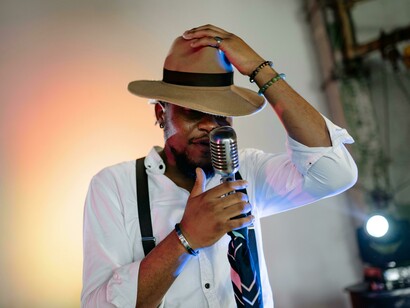
During the same ceremony, Lauryn Hill eventually took the stage for a musical interlude. She performed a high-energy medley of her songs, including "Doo Wop (That Thing)." Midway through, she introduced her son, Joshua "Y.G." Marley, who stepped forward and addressed the audience with "How y’all feeling?!?!"—a call repeated twice. The crowd did not respond. No applause, no vocal feedback; silence was the loudest sound one could hear besides the musicians on stage. Hill continued with the set, bringing more of her children onstage, including a tribute to Bob Marley. But the audience remained disengaged throughout.
Trump’s peace prize and Lauryn Hill’s silence reveal the culture industry, exposed by Adorno, at work: not the suppression of resistance, but its inclusion on Babylon’s terms—where critique is staged, dissent is curated, and real danger is rendered safe by silence. This is the obscene synthesis of Orwellian doublethink, Debordian spectacle, and Saidian imperial theatre: a world in which the language of peace sanctifies the architect of division, the image of unity masks the reality of domination, and the voice of the colonized is invited only to be ignored.
But there is a world beyond Bob Marley. Which is Bob Marley’s world—not the one sold in riddim, but the one forged in fire: a world of resistance, of imagination as a weapon, of the Dionysian power to recreate the world through chants, through drums, through dances that shake the foundations of Babylon and instate a new Zion—where the weak, at last, become strong—as Clinton Fearon and the Gladiators chanted in “Rich man, poor man / Labour, no reward!” and as Bob Marley declared, long before FIFA turned pain into pageantry, in “Them belly full, but we hungry.” This is not utopia. It is memory. It is the spirit of this world that these lines want to explore.
Theodor Adorno, George Orwell, Guy Debord, and Edward W. Said; or, The Obscene Synthesis
What happened at FIFA’s World Cup draw is not an anomaly but the logical endpoint of a system that feeds on contradiction. The awarding of a “Peace Prize” to Donald Trump—a man whose politics are built on division, racial scapegoating, and authoritarian posturing—while Lauryn Hill’s invocation of reggae’s sacred lineage was met with silence, is not a glitch in the system. It is the system revealing itself. This moment is best understood not by one critical voice, but by four, sounding in unison—not because they agree, but because together, they diagnose the disease.
Theodor W. Adorno did not fear censorship but inclusion: to be swallowed, digested, and regurgitated in a phase of reproposal. In The Culture Industry, he warned that late capitalism does not ban resistance—it repackages it as spectacle. And here it is: reggae—born in the fire of Coral Gardens, shaped by oppression, forged in the rhythm of refusal—has not been silenced. It has been invited to the table so the empire can say, “Look—even the rebels celebrate us.”
In his own way, and with great inventiveness, Orwell has pointed to the way total domination twisted language and, therefore, thought. For George Orwell, totalitarianism begins not with tanks, but with words turned inside out. It may be needless to remind you that in 1984’s Oceania, war is peace. Freedom is slavery. Love is hate, and ignorance is strength. Words have subverted significance, and reality is inverted. In our real world, Orwell has acquired relevance from both the right- and left-wing sides for those who claim that freedom and individuality are in danger. In the present case, peace is given to the author of division and hatred.
Trump receives a “Peace Prize” not despite his record but because of it: the ritual redefines “peace” as stability through domination, “leadership” as the right to exclude, and “global dialogue” as the right to shout over the silenced. No one calls it a lie—because the lie has become normal. This is doublethink, perfected: to stage peace while deepening oppression and call it harmony.
No one insurges against that. Why? Because Trump is a showman, and show business dictates a large part of his behavior. He perfectly understands how the spectacle works and that global society is also what Debord dubbed the Integrated Spectacle (Spectacle Intégré). Arguably, much of Trump’s power is displayed by spectacular exhibitionism to replace reality. Guy Debord saw modern capitalism not as an economy but as an image—a continuous show that replaces lived experience. At the JFK Center, we were not witnessing politics. We were watching a spectacle: a ceremony mistaking applause for truth. An audience trained to feel unity, not justice. The silence after Joshua Marley’s “How y’all feeling?” was not a failure of energy. It was the emptiness of the social void—a crowd that knows all the cues but has forgotten how to respond to real life.
Reggae here is not music. It is aesthetic décor, pasted onto a system that has already decided its meaning. The JFK Center was the set of an Imperial Theatre. Edward Said taught us that empire does not only control land—it controls narrative, voice, and legitimacy. It says, "You may speak—but only in the form we grant you." You may be present—but only as a symbol, not a sovereign. Inviting Lauryn Hill to warm up a stage of a ceremony in honor of Trump is precisely the operation Said exposed: imperial power co-opts the symbols of resistance to legitimize its continuity. The bloodline is honored, the riddim is played, and the patois is pronounced—and all of it serves to mask the violence underneath. This is imperial theater: a global event staging reconciliation while reproducing hierarchy.
We can operate a synthesis. Alone, each thinker would see a part. Together, they offer a view of the whole: Reggae is allowed because it is no longer believed. It is celebrated because it no longer threatens. It is heard—but not allowed to change anything: This is the obscene synthesis: where Adorno’s culture industry, Orwell’s doublethink, Debord’s spectacle, and Said’s imperial narrative all converge in one gesture—a prize to award the oppressor, while the children of the downpressed stand in silence. And in that silence, the truth is loudest.
Similar patterns course beyond music. Consider Ernesto Che Guevara—the revolutionary who fought imperialism across Latin America and Africa, who was captured and executed in 1967 with the CIA’s hand on the trigger. The Empire silenced him with bullets. But in death, it brought him back—not as an insurgent, but as an icon. His face now smiles from T-shirts, mugs, and calendars, stripped of ideology, sold in boutique shops where only a few read The Motorcycle Diaries and even fewer take an interest in Guevara’s political writings and his consideration of guerrilla warfare. Guevara once said, “The true revolutionary is guided by great feelings of love.” Today, he is sold as an attitude—not love, not justice, not anti-imperialism. This is the ritual: kill the body, colonize the image, sell the dream.
Reggae—once the sonic spine of Black resistance on both sides of the Atlantic—has undergone a similar fate. Marley’s voice echoes in cafés and car commercials. He has had his biopic, just like any other show business superstar. “One Love” plays as a backdrop to corporate events where the powerful award each other “peace.” The rhythm remains—but the revolution has been de-toothed. Lauryn Hill performs “Doo Wop,” brings her child Joshua Marley to the mic, and honors a prophetic bloodline—and the system lets her speak, precisely because it knows no one will listen. This is the triumph of the culture industry: allow the chant, but extract its consequence. None seems to be impacted by words of ire and fire that warn that “until the philosophy that holds one race superior and another inferior is finally discredited and abandoned, there will always be war!” Again, this is another attempt to “fool the people all the time.”
The World Beyond Bob Marley” is not beyond history. It is within it. And it apparently is being erased in real time. The necessity arises, giving voice to an expression of musical resistance, artistic insurgency, and poetic rebellion. This is what reggae has been all about since it emerged somewhere in the 1960s.