English
 Español
 Français
 Deutsch
 Italiano
 Português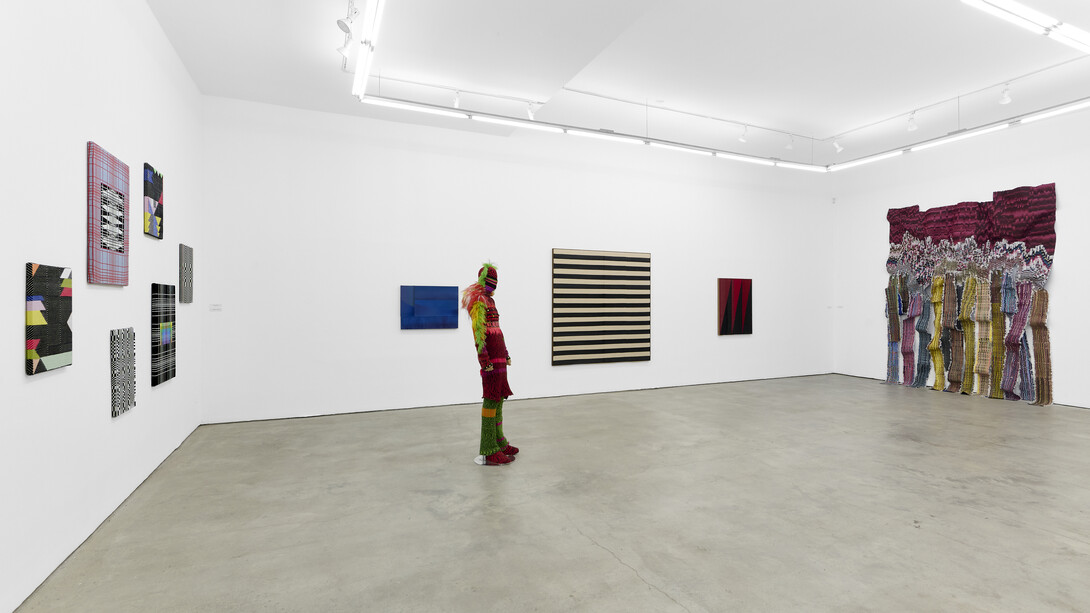
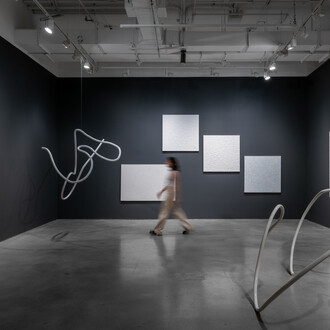
The Hole is pleased to present Thread count, a fiber-focused group exhibition curated by Charlotte Grüssing. Bringing together emerging and established artists working with textile today, the show foregrounds form, process, and tactile sensibility through the lasting influence of Anni Albers— her Bauhaus foundations, her writing, and her insistence that material and construction are the true engines of invention.
Fiber practices may be having a cultural moment, yet they remain widely misunderstood. Thread Count invites a slower kind of looking: attention to surface, texture, knots, dyes and the physical logic of how things are built. Unlike painting, the “value” of the artwork sits far from the pictorial. The title plays on the familiar metric of bed-sheet “thread count”—a reminder of how inadequate such quality measurements are for describing the complexity of textile work.
Anni Albers (1899–1994) was the 20th century’s most influential textile artist. Trained at the Bauhaus and later teaching at Black Mountain College, Albers fused weaving with modernist abstraction and produced a body of writing, especially her 1965 book On weaving, that remains the primary manifesto of the field. Her retrospective now on view at Zentrum Paul Klee affirms how deeply her ideas continue to shape contemporary practice.
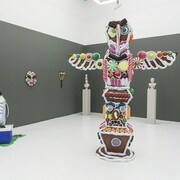
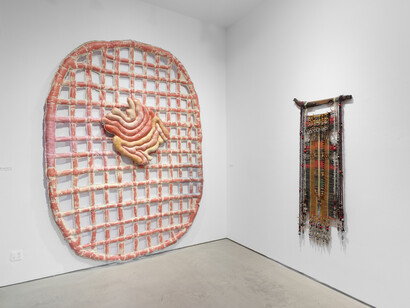
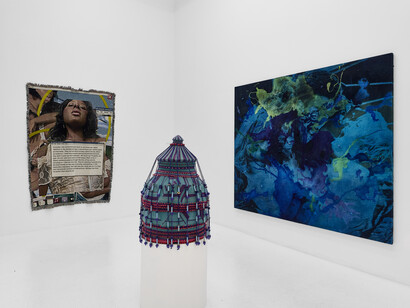
Albers warned that construction was becoming less inventive even as technology expanded. At its simplest, every fabric is defined by two elements: material and structure. Thread Count highlights how artists push those fundamentals today. Kenny Nguyen tears silk into hundreds of strips, dips them in acrylic and adheres them to canvas. Meg Lipke cuts, sews, paints and stuffs canvas forms into towering sculptural paintings. Jacqueline Surdwell and Matthew Logsdon work with rope and utility cord, emphasizing knots—one of humanity’s oldest technologies. Anne Samat merges Southeast Asian Pua Kumbu weaving with dollar-store plastics and denim, while Malaika Temba constructs a cowrie-patterned Lady in red inspired by Tanzania’s vibrant, ornamented trucks and buses.
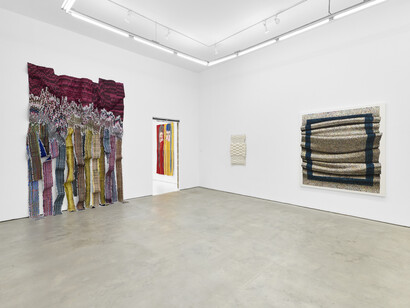
Several artists engage the clear grid of warp and weft. Brent Wadden embraces repetition and Bauhaus geometry; Victoria Manganiello uses dyed threads to investigate the grid with scientific precision; Christina Forrer inflects the Bauhaus legacy through fantastical figuration; and Samantha Bittman fuses painting with hand-woven structure, emphasizing the mathematics of pattern. Collaborative works such as LMRM x Abraham Cone and the Force!eld “Shroud” underscore the communal labor inherent to weaving and the wearable activation through performance.
To limit the loom as “domestic,” as Jerry Saltz recently observed, ignores its historical and technological force—one of the earliest machines capable of complex computation, and a precursor to digital logic. While Albers’s own entry into weaving was shaped by gender restrictions at the Bauhaus, fiber art extends far beyond domesticity or craft debates.
Technology and identity surface in Qualeasha Wood’s pixel-rendered tapestries, which merge screenshots, craft and the Black femme body. Hope Wang’s buttered tongue chokes the sky rewards close inspection of the woven substrate. Rebecca Ward deconstructs canvas to reveal its skeleton, literally pulling threads, while Jim Drain’s Big boy invites a 360° geodesic reading of color and construction.
Albers wrote of “the event of a thread” as a structure without beginning or end. That sense of open possibility animates Rachel Mica Weiss’s woven screens, rendered in subtle color-field gradients, and Shinique Smith’s Gathering stars, which binds indigo cloth, clothing, and performance remnants into a constellation held together by thread.
“Much of the potency of textile art has been lost in centuries of efforts to produce woven versions of paintings,” Albers wrote. Instead, weavers think structurally, more like architects than image- makers. Works by Molly Haynes, Noel W. Anderson, Mia Weiner, Sarah Zapata, Natasha Das, and Antonio Santín reassert textile’s physicality, daring viewers to feel its depths with their eyes.
Thread count offers not a single thesis but a linguistic field of approaches—a celebration of process, structure, and the ingenuity that emerges when form and material meet their limits.