English
 Español
 Français
 Deutsch
 Italiano
 Português
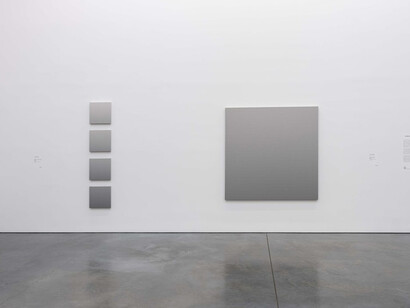
American artist James Howell (1935–2014) is best known for his minimalist paintings that explore the vast tonal range of the color gray. In the later decades of his life, he produced hundreds of paintings, prints, and drawings that explore the subtlety and scope of the neutral shade, as well as its relationship to light and perception of space. Titled Series 10 (1996–2014), this body of work emerged from a controlled set of parameters that Howell established, involving mathematical equations and carefully measured formulas of pigment. This calculated process resulted in paintings that gradually fade from light to dark and reflect Howell’s meditations on the unquantifiable aspects of life: spirituality and mysticism, chance happenings, and the mutability of atmospheric conditions.
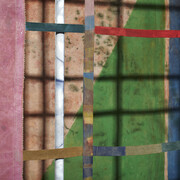
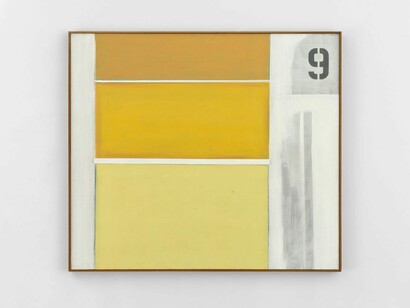
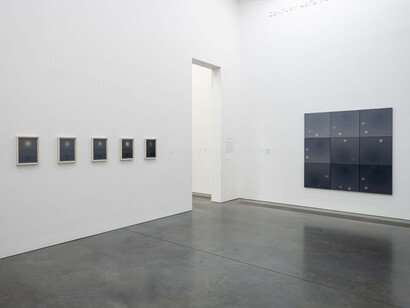
This exhibition presents the first-ever career retrospective of Howell, placing his ultimate Series 10 in conversation with his earlier bodies of work to reveal his lifelong inquiry into the effects of color, light, and compositional balance. Between the 1960s and 1980s, Howell explored figuration, expressionism, and gestural abstraction through his Flag, Boxcar, Place, Port Blakely, and Points in fields series.
As he became increasingly interested in “dissolving oppositions,” his palette reduced and the defined edges of his compositions began to soften, giving way to the near-monochrome paintings of his late work. Narrowing his process opened up infinite possibilities for the artist: “You think you might be trapped by setting limits, but I found out a long time ago that everything is in everything,” Howell once expressed. “I remember having these thoughts one day looking at snow and fog. The views were simplified and the details were erased. Yet I experienced all the richness.”