English
 Español
 Français
 Deutsch
 Italiano
 Português
We have all reflected in one way or another on the changes the world has experienced during the last decades—on the overabundance of events we are exposed to through media and digital networks, on the instant flow of information, on the easy and fast access to most corners of the planet, on the (excessive) individualism, and so on. But many of us don’t reflect with the same frequency on one of the logical consequences of these changes—the need for the infrastructure and means necessary to sustain and deepen them, and the fulfillment of this need. Airports, highways, shopping malls, hotel rooms, phone applications—all of them are necessary to make the current era possible as we know it and have a significant impact on human affairs.
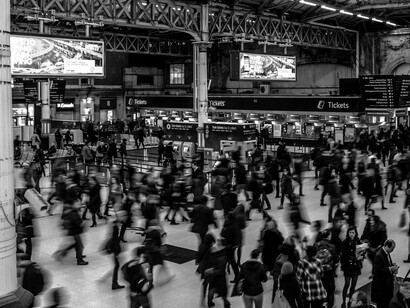
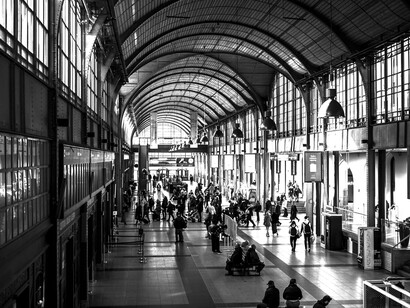
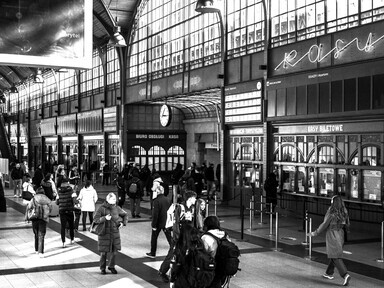
One of the thinkers who reflected on the conditions that made our current way of living possible and who became a reference in any attempt to approach them from an anthropological point of view was Marc Augé (1935–2023). He gained part of his recognition for coining the term non-places. In contrast to places—which are spaces displaying a shared history, culture, and identity, and which create the organically social—non-places lack all that. By contrast, non-places are to a great degree meant to reinforce the impersonal forces of modernity. “The installations needed for the accelerated circulation of passengers and goods (high-speed roads and railways, interchanges, airports) are just as much non-places as the means of transport themselves, or the great commercial centers, or the extended transit camps where the planet's refugees are parked.”1
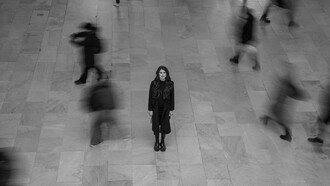
If places make you feel at home, non-places have the opposite effect. They relieve people from their usual determinants through identity loss and role-playing. At the airport, the shopping center, or the highway, a person is just a passenger, a customer, or a driver and is judged as such. However, this comes along with solitude and similitude. Thus, if places create the organically social, as I mentioned before, non-places create solitary contractuality.
This means that interactions in non-places are based on temporary, contractual relationships between anonymous individuals. Moreover, interactions in non-places between individuals and their surroundings are guided by words and texts—most of them prescriptive, prohibitive, and informative—such as “take right-hand lane,” “no smoking,” or “you are now entering the Beaujolais region” (all of these are Augé’s examples). And even when there is room for more direct interaction between individuals in non-places, the contractual character of these interactions is always in the backdrop. On social platforms, for example—where one has, in principle, the opportunity to interact with others using real names and pictures—this is not the defining aspect of these platforms. The crucial aspect is respecting the terms agreed upon when the account is created, and thus even a real person, a restaurant, and a bot can share the same space.
Certainly, all of this has implications well beyond the spaces of non-places and reaches our very behavior in (normal) places. If my free time is spent at the computer or on my smartphone instead of meeting people from the neighborhood, or if I talk about my problems on the internet instead of talking about them with my family or friends, then there is enough room to state that the omnipresence of non-places has changed our behavior forever. You may say it has culturally changed us.
A lot of this can be appreciated in a novel called Aeropuertos (Airports in English, but there is no translation of the novel into this language) written by the Chilean author Alberto Fuguet and published in 2010. I will not delve into the writing itself of the novel (although it is clear that it can be more attractive to younger people), but into what it aims to do. As the subtitle of the new edition suggests, it is a novel of non-places (“una novela de no-lugares”). It tells the story of Francisca and Álvaro, who were never a real couple but prematurely had an unplanned son, and Pablo, the son.
Here I will focus on Pablo, who was born in 1993 and whose character development takes place during different years of the 2000s. In other words, Pablo, unlike his parents (both born in 1976), was raised in a context where all the technological developments of the current time were already happening. By the end of the book, he even has an iPhone.
Pablo has an uneasy story. He knows he was a mistake; he lives with his mother in a city he hates in the south of Chile (Valdivia), his father was never very present and never established a strong bond with him, and he is constantly thinking about death and suicide. Communication with his mother was not the best either. He is much more sensitive than he openly recognizes, and the only way he found to express his feelings to his mother was through videotapes.
From the transcripts of the videos found in the book, it is possible to conclude both that Pablo was planning a suicide he never carried out and that his plan was for his mother to find the videos after his death. In fact, he never personally showed the videos to his mother. He saved them on a USB drive he left in the car’s glove compartment instead.
In a similar vein, it is telling that by the end of the novel, Pablo shared some of his thoughts on death and suicide with his father in a hotel at an airport before taking a plane to Germany. It is as if he found a way to communicate his feelings from the safety of the non-places, where no one can do anything about it unless he agrees to.
Thus, there are ambivalences in non-places that are worth reflecting upon. They free us from everyday responsibilities; they can help express ourselves by confessing what we couldn’t confess before, but we remain in solitude there with no real communication. Whether this has more benefits than drawbacks is an open question—just like the future of Pablo after departing to Germany. The only certainty about this is that non-places have changed our way of interacting with each other, and novels, movies, documentaries, and other pieces of cultural work are a good way to explore the character of these changes.
References
1 Augé, M. (1995). Non-Places. Introduction to an Anthropology of Supermodernity. Verse.