English
 Español
 Français
 Deutsch
 Italiano
 Português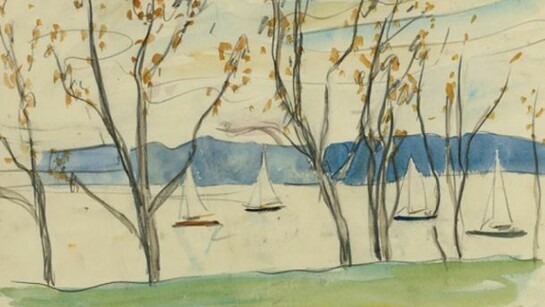
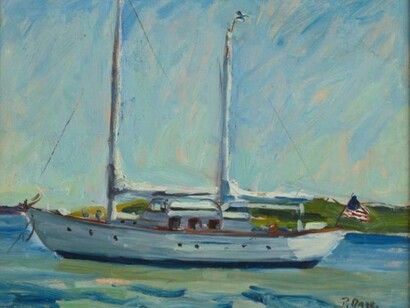
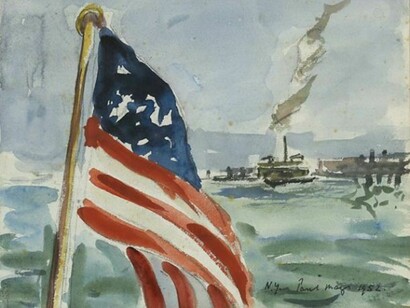
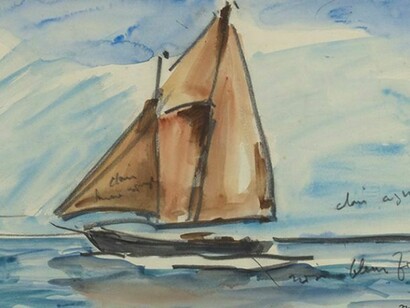
Often called the last of the Impressionists, Maze had a reputation as one of the great artists of his generation. He was born in 1887 into an artistic circle in Le Havre, where the young Maze learned the rudiments of painting from family friends that included Renoir, Monet, Dufy and Pissarro. His father, a tea merchant, sent him to school in Southampton where he began a life long love affair with all things English. On the outbreak of War, the sight of the Scots Greys disembarking at Le Havre inspired him to sign up immediately as their interpreter. A brave and highly decorated soldier, Maze was awarded the Distinguished Conduct Medal and Military Medal and bar; he sketched continually throughout the Great War, his pencil and paper never far from his bayonet.
During this time he encountered Winston Churchill and a mutual interest in painting led to a lifelong friendship, often with Maze acting as Winston’s artistic mentor. Writing from Chartwell before the Second War Winston described Maze as “an artist of whose keen eye and nimble pencil record impression with a revealing fidelity.” This facility to record the events of his life wherever and whatever they were with distinctive immediacy led a British tommy to describe his work as “pictures done in shorthand”.
Between the wars circumstances took him to Paris where he became firm friends with de Segonzac and the elderly Edouard Vuillard. It was a meeting with Vuillard in 1932 that proved pivotal in his development as a painter. He suggested the use of pastels would suit Maze’s fresh approach best and he took Maze to his own Pastel Merchant, Dr Roche. The latter had found a new formula for chalks that achieved a colour selection of 1,600 shades and Maze later described his meeting with the two great men as being “taken by God to meet God”. His undoubtedly French style is rooted in the Impressionist movement of his early experience and the direct exposure to the elderly Vuillard and his advice is a clear influence.
Painter, soldier and painter, Maze was a supreme lover of life devoted to his constant muse, his wife Jessie. This gentle Highland beauty with long red hair, often depicted sunlit at her dressing table, inspired his series of “Jessie pictures”, believed to be some of his finest work. Never far from the original principles of Impressionism he believed that “painters are born, not made” and it was fitting that a man who truly believed that “the greatest teacher is Nature” should die, at 92, pastel in hand looking across at his favourite view of the Sussex Downs.
Maze immortalized the English Season in art: Goodwood, Trooping the Colour, Henley Eights and Cowes Week where he was a familiar figure on the Squadron steps shrouded in tweed coats and a large hat, whatever the weather.
Maze exhibited at a number of major commercial art galleries in London, Paris and America. In London he had shows at Marlborough and a major retrospective ‘Paul Maze & The Guards’ at Wildenstein in 1973.
Maze’s fascinating life was reviewed in Anne Singer’s biography ‘Paul Maze – the Lost Impressionist’.
Panter & Hall Gallery
27 Bury Street, St James's
London SW1Y 6AL United Kingdom
Ph. +44 (0)20 73999999
enquiries@panterandhall.com
www.panterandhall.com
Opening hours
Monday - Friday from 10am to 6pm
Saturday by appointment