English
 Español
 Français
 Deutsch
 Italiano
 Português
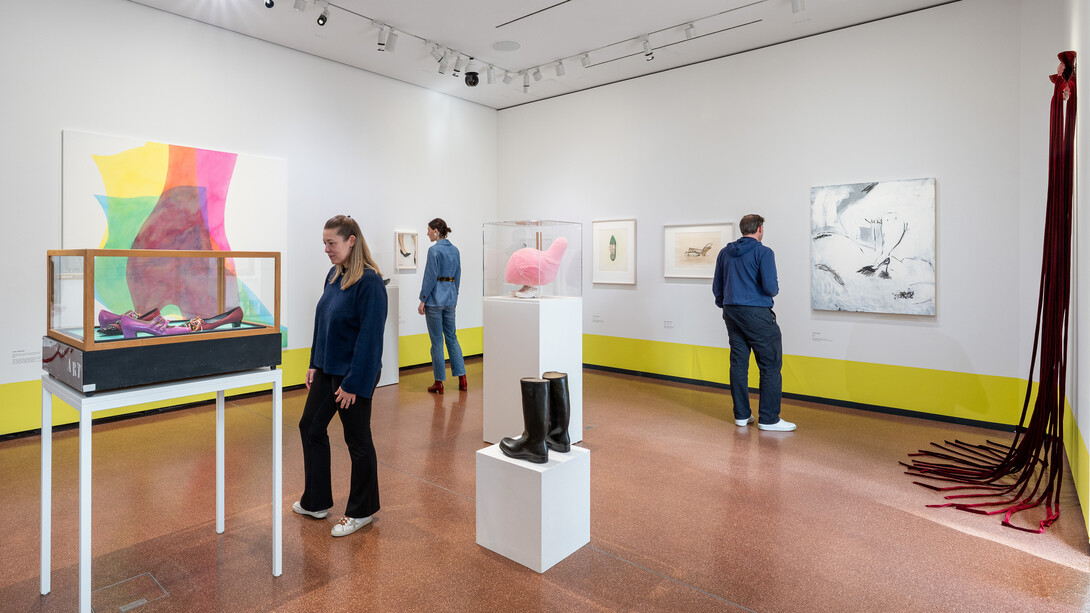
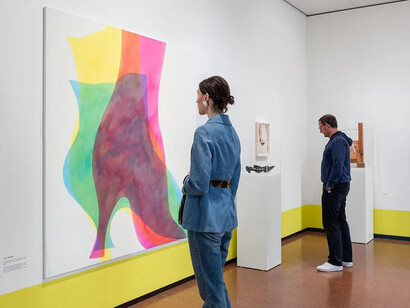
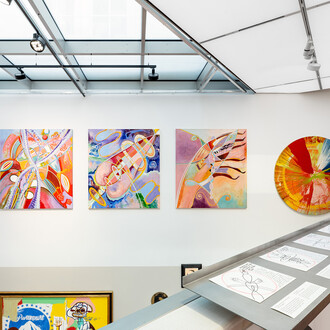
Everyday objects and fashion accessories, status symbols and objects of fetish: shoes tell stories of social conventions, personal desires and cultural belonging. With the focused exhibition To shoe or not to shoe – Warhol and others, the Heidi Horten Collection adds a thematic dimension to the museum’s collection display. Around 20 works from the collection, complemented by selected loans, reveal the many ways in which artists explore the shoe as a motif, a bearer of meaning and a surface for projection.
The exhibition takes as its starting point Andy Warhol’s series À la recherche du shoe perdu, created in the mid-1950s. Its title alludes to Marcel Proust’s novel À la recherche du temps perdu. The titles of the individual works play on familiar expressions, pop songs and literary quotations—transforming Hamlet’s existential question “To be or not to be” into “To shoe or not to shoe”.
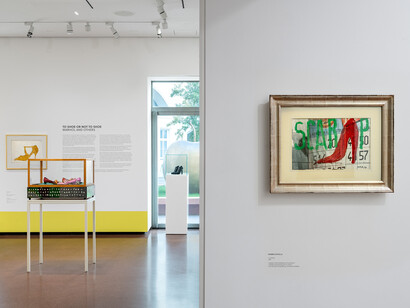
A central theme of the exhibition is the tension between seduction, socially prescribed roles and self-determination. Mimmo Rotella’s collage La scarpa depicts vivid red pumps, evoking the erotic associations of women’s shoes. At the same time, high heels can be read as an expression of constraint and restriction. Markus Schinwald shows that removing the heel alone does not necessarily bring liberation. Birgit Jürgenssen connects shoes with women’s life stories: in the sculpture Aschenbrödel, a silken shoe appears to flow down a staircase, while in the drawing sich den weg pflügen, a woman’s shoe transforms into a plough. Peter Weibel’s Gummistiefel mit bienenwachs also evokes a world of fairy tales, recalling a seven-league boot.
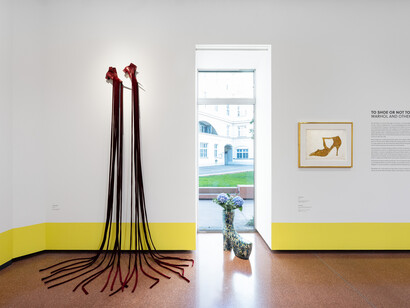
Other works invert the association between femininity and vulnerability. Gudrun Kampl’s Vorwärtsschnitt combines red velvet with blades at the tips of the shoes. In Sue Williams’s work, the high-heeled shoe becomes a potential weapon. In Boot, Jakob Lena Knebl fuses a high-heeled shoe with a work boot, bringing together their respective gender and social associations.
Shoes also appear as bearers of traces of wear and as elements of performative actions. For his work Repair, Allan Kaprow swept used shoes through the streets of Bonn in 1985, tending to the resulting “wounds” with gauze and adhesive plasters. That same year, Mona Hatoum walked barefoot through Brixton in London, dragging Doc Martens boots behind her with their laces tied around her ankles. Here, the shoes evoke different social and subcultural affiliations.
Sylvie Fleury, by contrast, explores the allure of the luxury object. For Alaïa shoes, she had a pair of ankle boots by the French luxury brand cast in bronze in meticulous detail: brand fetishism becomes material fetishism. While Curt Stenvert’s colourful women’s shoes encounter one another as if out for a stroll, the shoes and legs in Erwin Wurm’s sculpture Schlechter gedanke appear as intact counterparts to a body distorted by psychological burdens or social constraints. The exhibition offers a range of perspectives on a familiar companion. It reveals how shoes convey status and belonging, shape social roles and become expressions of desire, resistance or vulnerability.