English
 Español
 Français
 Deutsch
 Italiano
 Português
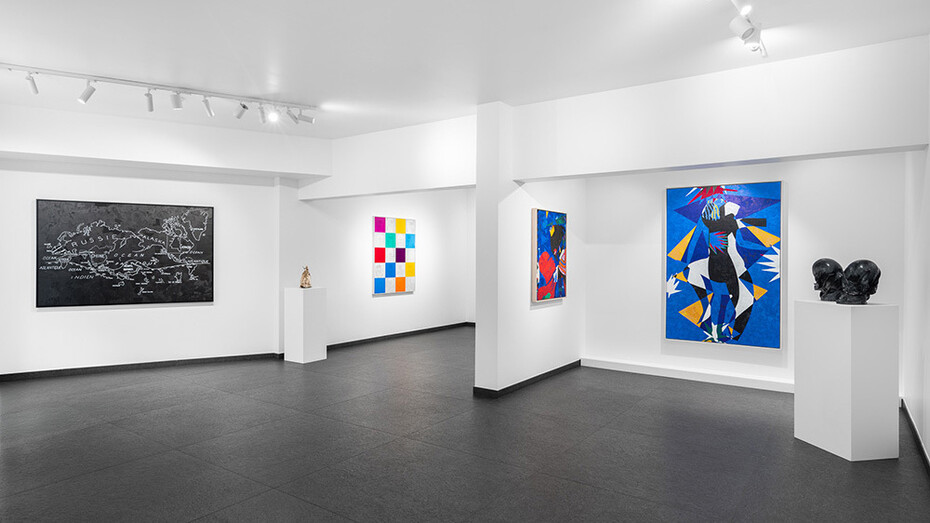
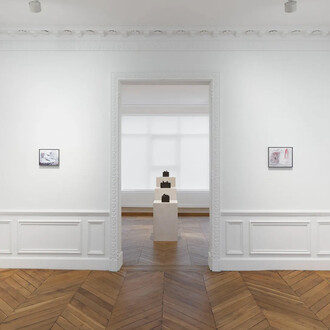
Galleria Continua / Paris Matignon is pleased to present Afterimage, an exhibition by Hank Willis Thomas that inaugurates the gallery’s collaboration with the acclaimed American artist, marking his return to Paris for the first time in nearly twenty years. Themes central to the Paris solo presentation are further explored in two concurrent exhibitions that examine Thomas’s and Man Ray’s legacies across Galleria Continua’s spaces in San Gimignano, and Rome, offering a multifaceted view of the artist’s practice. The Paris presentation focuses on his recent sculptures and retroreflective works.
Working across photography, sculpture, screen printing, installation, and video, Thomas interweaves historical references with potent symbols drawn from visual culture. His practice interrogates how historical narratives are constructed and challenges established modes of representation, drawing attention to the shifting, layered nature of historical meaning. Rather than treating history as fixed, Thomas approaches it as an ongoing construct, one continually reshaped and rewritten, exposing the ways in which dominant power structures have distorted historical narratives to serve their own ends.
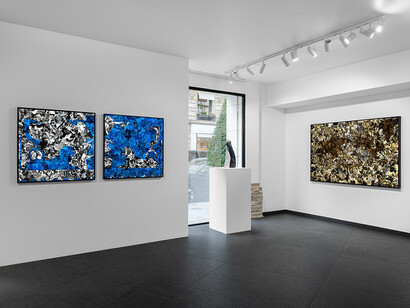
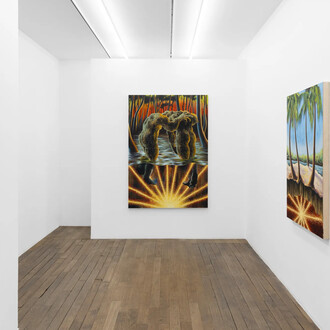
At the core of Thomas’s work is a sustained engagement with identity and its role and representation across media and popular culture. Through extensive use of archival imagery, he examines how identity and collective memory are built, while exposing the stereotypes and inequalities embedded within images. His revisiting of history through the lens of colonialism opens up a space for reflection on discrimination, social justice, and the mechanisms of power. In a moment marked by deep political division, where public discourse often favors confrontation over solidarity, Thomas invites viewers to recognize the progress achieved through social struggle, while remaining alert to how easily such gains can be eroded by shifting historical and political narratives. Over the last ten years, Thomas has mastered the retroreflective medium, creating mixed media works that reveal two distinct scenes transfigured by both ambient and flash lighting, each emerging depending on the viewer’s position and the surrounding light.
As the artist puts it: “All of my work is about framing and context, and about how, depending on where you’re standing, it really shapes your perspective of the truth, of reality, and that’s what’s important.”
The image, and its reading, is therefore doubled: from one angle, bold and saturated compositions appear; from another, fragmented archival photographs surface. As these layers shift and overlap, they engage both perception and meaning, producing new configurations of imagery that remain hidden in plain sight.
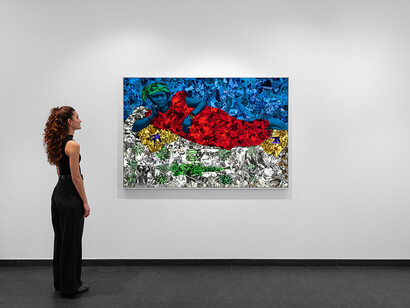
For these recent retroreflective works, shown in Paris for the first time, Thomas draws on major reference points in art history, including Seydou Keïta, Surrealism, and Henri Matisse. In Woman in the red dress (After Keïta), he brings together the iconic 1957 Bamako photograph by Seydou Keïta, known as “The Odalisque,” with a constellation of archival images. Keïta’s portraiture was instrumental in affirming African identity and individuality through photographic representation at the time of Mali’s independence. By placing this image in dialogue with archival photographs of historical protest movements, Thomas suggests that the affirmation of identity is not a singular, fixed construct, but a collective process shaped by multiple images and narratives. Collective memory thus emerges as a constellation of fragments whose coexistence speaks to the broader question of representation, underscoring the importance of allowing multiple histories and identities to exist, be recognized, and be remembered.
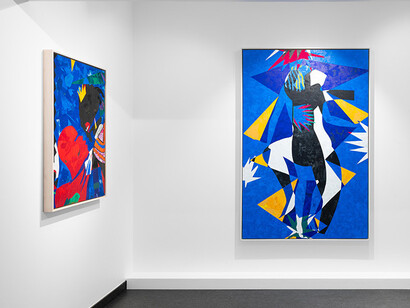
In The toiler and Circe, Thomas pairs two symbolic figures: Aaron Douglas’ toiler and Romare Bearden’s representation of Circe from Homer’s Odyssey, with archival photographs of civil rights demonstrations depicting protesters peacefully demanding their rights, and the violence they faced in return. Circe, a mythological figure tied to transformation, becomes here a stand-in for another kind of metamorphosis: the visual shift produced by the retroreflective surface, where fragmented images emerge and converge like facets of a Cubist composition. Myth, as a literary form, is itself a mode of collective storytelling, passed down orally across generations, a method Thomas mirrors in his own engagement with history, gathering dispersed images and narratives to preserve them within a shared visual memory.
Alongside his retroreflective works, Thomas has built an extensive sculptural practice centered on universal gestures of human connection: handshakes, embraces, kisses, raised fists… isolating their symbolic charge and transforming familiar acts into lasting monuments. His large-scale sculptures have been installed across American cities (notably The embrace in Boston or Unity in Brooklyn, New York), bringing these gestures of connection into public space. Carved in marble or cast in bronze, the works draw on the traditional materials and vocabulary of classical sculpture while simultaneously challenging its historical canon through the inclusion of contemporary visual symbols.
The exhibition includes Community, in which a series of hands grasp one another’s wrists to form a circular structure symbolizing unity, interdependence, and solidarity — giving physical form to the idea of collective strength. Its rainbow patina evokes plurality and diversity, pointing to the need to move past inequalities rooted in race and gender, and to embrace identity in all its complexity.
Another sculpture, Everything we see hides another thing, reveals the influence of Surrealism on Thomas’s practice. The movement’s legacy of freedom, subversion, and questioning of convention runs through his work, which, much like Surrealism in the early twentieth century, interrogates dominant systems of representation. The piece recalls René Magritte’s The Lovers, in which the two figures’ faces are veiled in cloth, disrupting the voyeuristic gaze often associated with depictions of intimacy. Thomas similarly obscures the identities of his two figures, leaving gender and race undefined, and turning the work into a meditation on freedom, identity, and the possibility of existing beyond imposed categories.
Through a compelling exhibition trajectory that reframes our understanding of symbols, images, and narratives, Hank Willis Thomas explores the interplay between past and present, urging viewers to stay vigilant and critically engaged with the forces that shape how we see and understand the world.