English
 Español
 Français
 Deutsch
 Italiano
 Português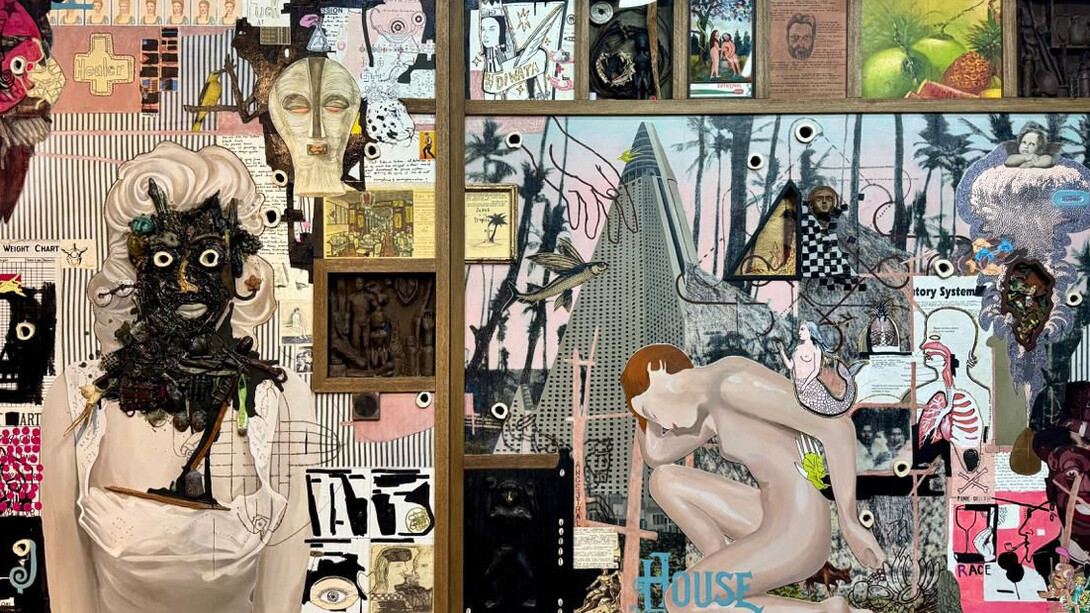
Ames Yavuz is pleased to present Elsewhere held and lingered, a group exhibition bringing together works by Isabel and Alfredo Aquilizan, Amit Berman, Isaac Chong Wai, Kawayan de Guia, Emily Floyd, Tseng Chien-Ying, Rindon Johnson, Pinaree Sanpitak, and Khairulddin Wahab. Taking its title from Filipino writer Conchitina Cruz’s collection of poems, the exhibition reflects on distance, intimacy and the body as a site of memory. The title gestures toward what we carry, experiences, desires and inheritances that are held within us and continue to linger across time and place.
The exhibition draws from the book’s fragmented structure, which moves between prose, annotations, footnotes and marginalia. It brings together disparate practices that resist a single reading and looks to the margins as spaces of possibility, where overlooked histories and partial perspectives can linger, intersect and offer alternative ways of seeing.
Isabel and Alfredo Aquilizan (b. 1965, 1962) examine the human and communal consequences of economic globalisation through the metaphor of the left wing, an emblem of movement and possibility rendered vulnerable, impaired, or restrained. Hand forged metal and wood give physical form to this vanishing knowledge, depicting the way inherited skills can become remnants of a changing economy. The works linger as material footnotes to these disappearing practices, holding space for the histories, labour, and knowledge that globalisation threatens to leave behind.
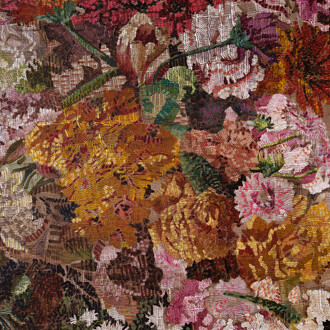
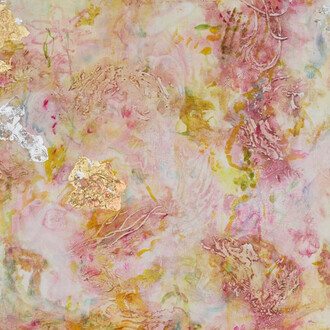
Bringing together disparate forms and references, Amit Berman’s (b. 1994) paintings approach the image as a site of accumulation. Elements appear as clues or traces, inviting the viewer to resist settling into a singular narrative. Berman occupies the space of the footnote in which peripheral details become significant and what initially appears incidental offers other ways of seeing.
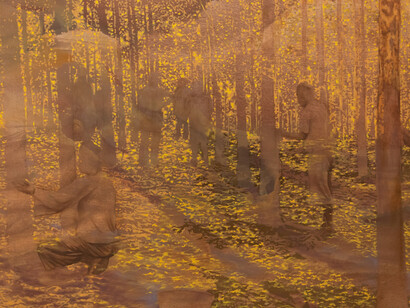
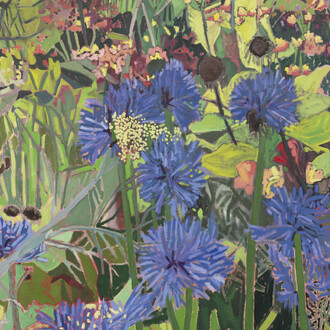
In Khairulddin Wahab’s (b. 1990) Light at the ends of the world (2026), memory emerges through the intertwined histories of labour, landscape and the people who inhabit it. Spectral figures appear and dissolve into a light-dappled plantation landscape, their gestures suggesting acts of collective labour in a state of suspension between past and present. Rather than existing apart from their surroundings, the figures seem absorbed by the environments in which they work, pointing to the social and political forces that shape both land and labour. Their individual stories may have faded from view, yet the landscape retains traces. The work attends to what lingers at the margins: fragments of lives, labour and memory embedded within the places that hold them.
Kawayan de Guia’s (b. 1979) Comfortable truths and other stories in the age of re discovery (2026) approaches memory as layered, obscured and continually excavated. Combining painting, textile, text, found objects and carved elements, the work places an idealised image of feminine beauty against a Victorian-era striped textile, questioning the cultural ideals and colonial structures that shape how beauty, identity and belonging are understood. Blackened text and fragmented imagery evoke censored records and incomplete histories, while recessed boxes and excavated openings invite the viewer beneath the work’s surface, as if revealing what has been deliberately or gradually buried. The work ultimately becomes an act of archaeological recovery: a search through accumulate layers for traces of ancestry and identity that might allow forgotten stories to be uncovered, reinterpreted, and rewritten.
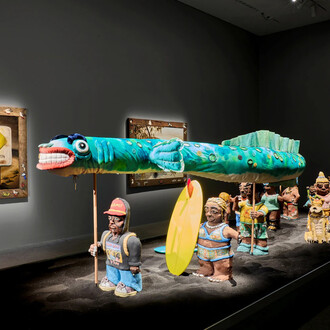
Emily Floyd’s (b. 1972) Lovebirds (King parrots) draws on her research into Australasian birdlife illustrated in the margins of medieval manuscripts, where parrots and cockatoos trace histories of movement and exchange between northern Australia, Asia, and Europe. Inspired by parrots visiting her studio garden, Floyd’s hand-painted jelutong sculptures depict chimeric King Parrots perched on a heart-shaped plinth evoking their role as pollinators and seed spreaders. Within the exhibition, Lovebirds considers how knowledge, images, and forms travel across time, while conveying a sense of devotion and care for and between bodies.
Rindon Johnson’s (b. 1990) works consider what remains when materials, bodies and systems are rendered valuable, extracted and eventually discarded. Working with leather, zinc and cobalt, Johnson connects the histories of Blackness and capital accumulation with contemporary systems of mineral extraction and technological advancement. Leather, which has served as a substrate for his practice for nearly a decade, becomes a charged material through which histories of the body and its treatment as a byproduct are brought into relation with the mineral materials that underpin contemporary technologies. Applied with brooms and squeegees, zinc and cobalt are allowed to react and determine the image, giving the materials a degree of agency beyond the artist’s control. These abstractions function as material footnotes: traces of bodies, landscapes, labour and resources whose histories are often obscured by the systems that consume them.
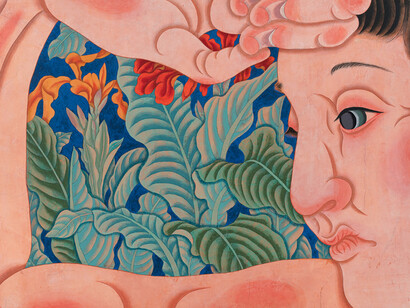
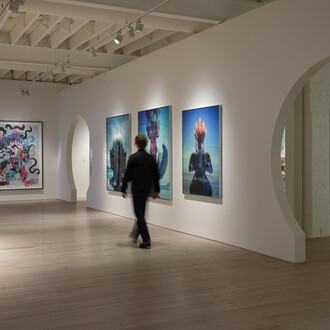
In Tropic psalms: Zephyr 南國詩篇/望春風, Tseng Chien-Ying (b. 1987) explores the relationship between the body as both a site of memory and a threshold through which landscape is experienced. Waves, mountains, and tropical vegetation appear to emerge from within the figure, collapsing the distinction between body and environment and creating an ambiguous space between desire, recollection, and nature. The work’s two titles extend this idea of memory across cultural contexts: Wang chun feng (望春風), drawn from a classic Teresa Teng Taiwanese song, evokes anticipation, youth, and desire, while Zephyr recalls the spring-bearing wind of Western classical tradition. Rather than offering a direct translation, the titles allow two cultural memories to coexist and meet. The work becomes a meditation on how memories are carried not only through images and bodies, but through language, sensation, and the stories attached to them—lingering between one place and another.
Pinaree Sanpitak’s (b. 1961) latest paintings and sculptures bring together three years of research and experimentation, shaped by site-specific cooking projects and her ongoing interest in the body and spaces of gathering, exchange, and connection. She presents a new series of doll sculptures, with the form of their heads in her iconic Breast Stupa shape, made with stacked layers of mulberry paper. The sculptures are placed in a range of gestures, their forms veiled under sheets of sasawashi paper weaves—an act of revealing and concealing that offers fragments, hints, and partial truths. Eggs also reappear as recurring forms, shifting from earlier associations with power and control toward ideas of possibility, nourishment, and sustenance. In dialogue with the breast-stupa, they evoke the body as both a source of milk and a vessel for water.
Rehearsed, mirrored is a series of hand-etched glass and mirror works by Isaac Chong Wai (b. 1990) developed from rehearsal materials from his 60th Venice Biennale performance, Falling reversely. Chong etches traces of bodily movement onto sheets of acrylic glass, one flipped and layered over the other to create a sense of mirrored balance; reuniting fragmented gestures into a resonant whole. Recalling the movement studies of Eadweard Muybridge and Umberto Boccioni’s dynamic forms, the artist translates fleeting gestures into static compositions. The overlapping glass depict figures in reciprocal acts—resting and supporting one another to reveal emotional interconnection embedded with physical movement.
Across the exhibition, the works gather at the margins, where personal and collective histories are held, transformed and transmitted through various forms. Elsewhere Held and Lingered invites us to recognise that what has been overlooked or obscured does not simply disappear, but continues to linger and shape the present.
![Cherine Fahd, The captains [Georgia Airborne] (detail), 2026. Courtesy of MCA](/attachments/a8ddfa5ce965d6214a12b995ccad3efeaa7cb3f7/store/fill/330/330/2250514c801510cec18ebb750a8e8ad50105c447ae376f5654cb924fd1ae/Cherine-Fahd-The-captains-Georgia-Airborne-detail-2026-Courtesy-of-MCA.jpg)