English
 Español
 Français
 Deutsch
 Italiano
 Português
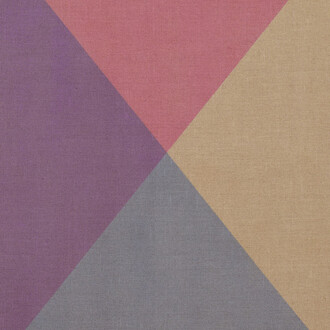
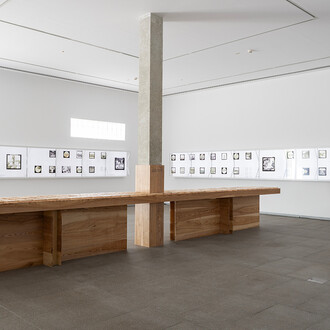
The Third Line is pleased to present No history of shapes / ﻻلﺎﻜﺷ ﻸﻟ ﺦﯾرﺎﺗ, Jordan Nassar’s second solo exhibition with the gallery, on view at Frieze No. 9 Cork Street. The exhibition brings together a new body of multi-panel embroidery works and vibrant mosaics that recontextualize the history and aesthetic traditions of Palestine. In his delicate embroidery works, Nassar introduces a new geometric language inspired by the seminal Iranian artist Monir Shahroudy Farmanfarmaian’s Convertible series, while extending his poignant inquiry of color and patterns. The mosaics echo a Byzantine mosaic found in northern Gaza, inviting viewers to imagine the whole and its embedded narratives.
Nassar’s new body of intricate embroidery works continues the artist’s exploration of color and the motifs of tatreez, a traditional Palestinian form of cross-stitched embroidery. Though dense in pattern, the works carry an airy, luminous quality through the careful use of color and fine thread, evoking the open landscapes of Palestine. At the same time, Nassar expands his practice by employing the structure of the late Iranian artist Monir Shahroudy Farmanfarmaian’s Convertible series—multipart reliefs that can be organized into diverse configurations. Similar to Farmanfarmaian’s works, Nassar’s embroidered pieces can be rearranged to form different geometric wholes, inviting viewers to generate new meanings with each arrangement.
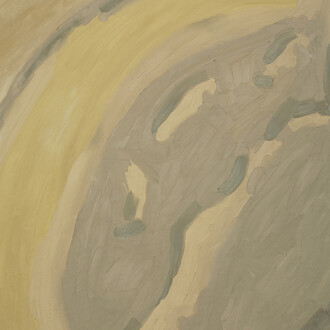
Alongside the embroidery works, Nassar presents small-scale mosaics. Created using the ancient technique of hand-cutting glass, the pieces are near-replicas of a Byzantine mosaic found in Jabalia of northern Gaza. Examining photographs of the archaeological artifact that are available online, Nassar sought to faithfully recreate parts of it, making additions and alterations at times to fill in the gaps. Each of the five mosaics depicts an orange tree, lion, human figure, and abstract patterns from the original.
Collectively, the works open up a dialogue on history, heritage, and aesthetic traditions of Palestine as they invite viewers to imagine the original mosaic in its entirety, along with its embedded narratives. The artist describes the series as “a tender gesture” that not only prevents the original mosaic—under threat of literal destruction from the ongoing violence in Palestine—from being obliterated from collective memory, but also emancipates it from being wielded for nationalistic purposes.
The exhibition’s title, No history of shapes / ﻻلﺎﻜﺷ ﻸﻟ ﺦﯾرﺎﺗ, is drawn from Mahmoud Darwish’s poem, Describing Clouds. As Darwish writes, “No final shape for this universe… / no history of shapes…” / I am looking from a height, and I see the bursting of shape / out of the frivolity of no-shape:” Nassar also sees and draws up shapes, whose manifold possibilities of configuration point to the infinite vastness of the universe.
No history of shapes / ﻻلﺎﻜﺷ ﻸﻟ ﺦﯾرﺎﺗ forms a two-part presentation with Anat Ebgi, Los Angeles, which brings together a shared body of work across both galleries.