English
 Español
 Français
 Deutsch
 Italiano
 Português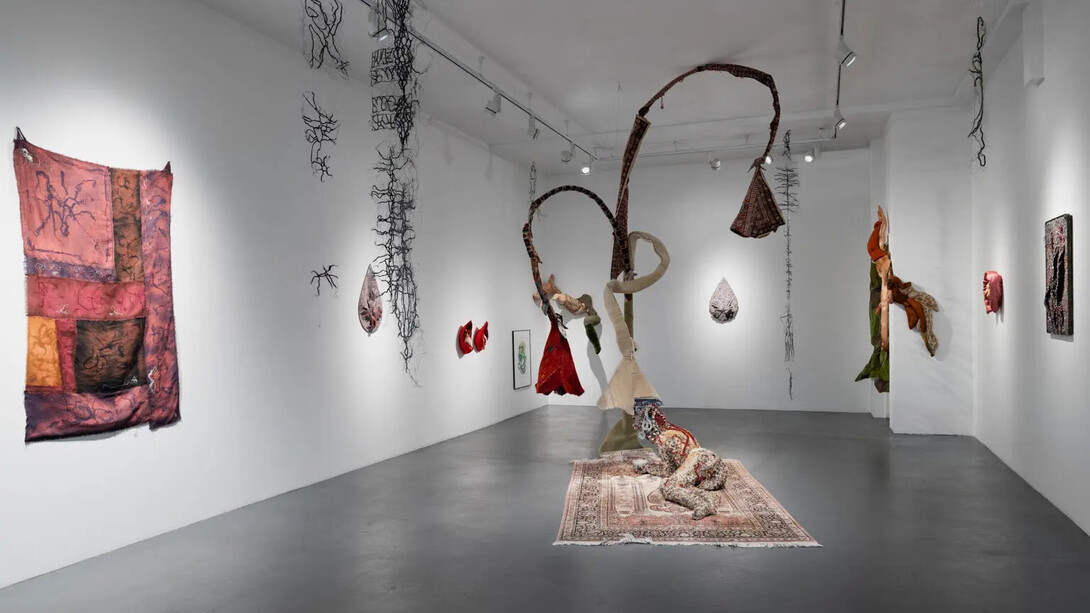
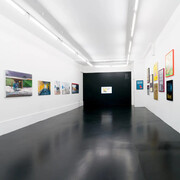
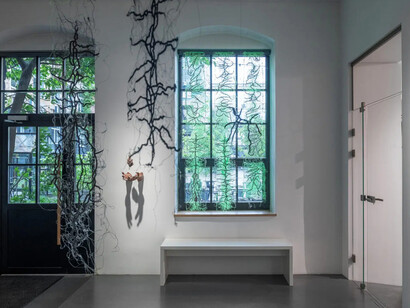
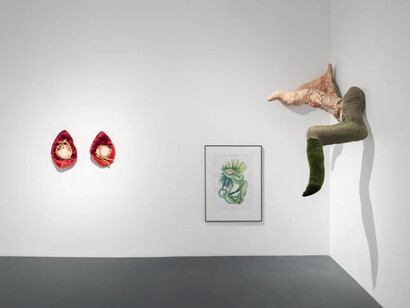
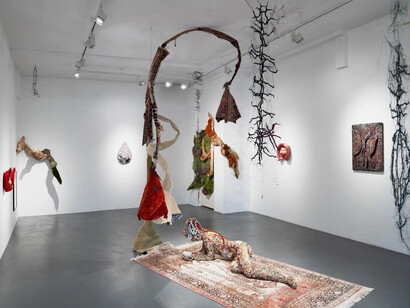
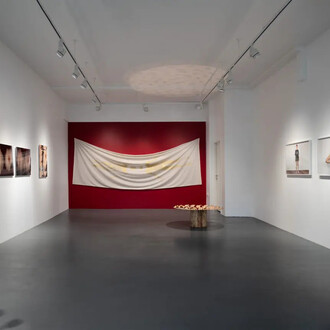
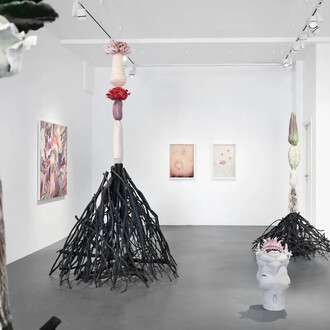
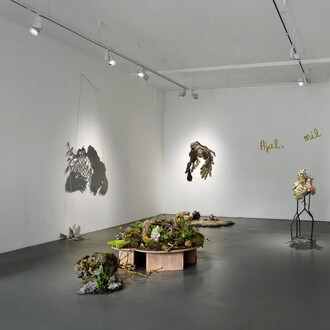
From afar, one can spot a room whose paned window is overtaken by entanglements of fibre. It appears as a strange substance forming an unravelled veil, a fluid system of threads that coalesces into abstract lace. Upon entering the space, one discovers multiple formations, resembling the one in the window, descending from different parts of the ceiling and holding within their bodies ornament-like shapes, or perhaps an alien language yet to be deciphered. In the middle of the room, a tree formed from fragments of carpet has arisen and beneath it lies a female figure with a bowl, her interior revealed, while her crystallised heart hangs near the entrance. Around this mystical scene, processes of metamorphosis unfold as plant forms emerge from the walls, transforming into visceral, human-like body parts before returning once again to vegetal states. This is the world unfolding at Kogo Gallery, where three artists, Anna Malicka, Noushin Redjaian and Kadri Liis Rääk, come together to create a room of their own: a women’s space woven from layered memories, sedimented meanings and material traces.
Thrifters and transformers brings together artists who, in a sensual and intimate manner, reshape the world’s matter through resources drawn from nature, cultural history and tradition, collective memory and embodied knowledge, as well as found objects and materials awaiting a second life. Their shared artistic trajectory foregrounds both the physical and symbolic potential of materiality, while queering ideas associated with design and fashion. At the core of their practices lies an interest in liminal states, where unconscious impulses and sensory experience become entangled with accumulated knowledge and lived experience.
Anna Malicka, who sometimes endearingly refers to herself as a moth, introduces the liquid lace inhabiting the exhibition space. Described as fibre graffiti and free-standing lace, these works unfold as embodied abstract drawings and unconscious scribbles akin to asemic writing. Made from gathered leftover threads, they weave together thrifted imagery of children’s drawings, calligraphic handwriting, murmurs of cracks in urban environments and ornamental motifs borrowed from metal railings, blurred with fragments of a personal diary. Evoking both vernacular domestic lace and the traces left on city walls, Anna Malicka’s practice navigates noisy self-reflection by allowing the unconscious mind, her alter ego – the “chaotic I” – and the sewing machine to operate as a form of witchcraft. Her works suggest a nervous pulsation or the residue of a storm, while also opening spaces of stillness where creation becomes both an escape and an act of care.
In an unconscious stream of thought, a landscape emerges by Noushin Redjaian, built from patchworks of carpets from Iran, Afghanistan, the Indo-Modern sphere, the Nepal Himalayas and Turkey, interwoven with memory and protected by crystals. In the gallery, she has planted a Tree of Life that draws together mythologies from Western culture, Kabbalah and broader symbolic traditions. The tree itself remains silent; instead, the woman beneath it, representing Mneme (unarticulated memory), conveys its stories through an act of care, offering water to sustain it. Redjaian explores the entanglement of soma, mneme and memoria, tracing relations between body, consciousness and the preservation of experience. Hands recur in her works as a motif of both care and craftsmanship, echoing the layered cultural history of carpets. Minerals are introduced as protective matter, treated like primordial inscriptions that crystallise memory into form.
The third layer is cultivated by Kadri Liis Rääk, who explores human–nature entanglements in states of flux. By sourcing and transforming both natural and synthetic materials and merging ancient craft techniques with contemporary practices, she creates works that resist fixed identities. Her sculptures shift between fleshy, human-like forms, vegetal structures and other morphologies, generating both visual and tactile intensity. Biomorphic, sensual and at times unsettling, they evoke encounters with nature experienced at close range, while their anthropomorphic qualities destabilise perception, blurring the boundaries of what is seen and felt. These works open liminal spaces where bodily experience, personal reflection and encounters with both foreign and Estonian landscapes are translated into sculptures and drawings that remain in a constant state of becoming, hovering between the familiar and the strange, and inviting engagement through imagination, sensation and touch.
Throughout the exhibition, the artists’ practices merge into a patchwork landscape of mythological scenes and symbolic gestures, everyday noise, the search for womanhood, and entanglements between nature and the human. Embroidery, craft, fairy-tale imaginaries, vulnerable bodies and forms of nature – historically framed as “feminine” and therefore diminished – coalesce into an empowered field. By gathering inherited knowledge, overlooked traditions and diverse materialities, the artists generate a visceral and transformative presence. The space they create resists conventional hierarchies of time, function and order, opening instead an entangled and expansive mode of being, grounded not in erasure, but in transformation.