English
 Español
 Français
 Deutsch
 Italiano
 Português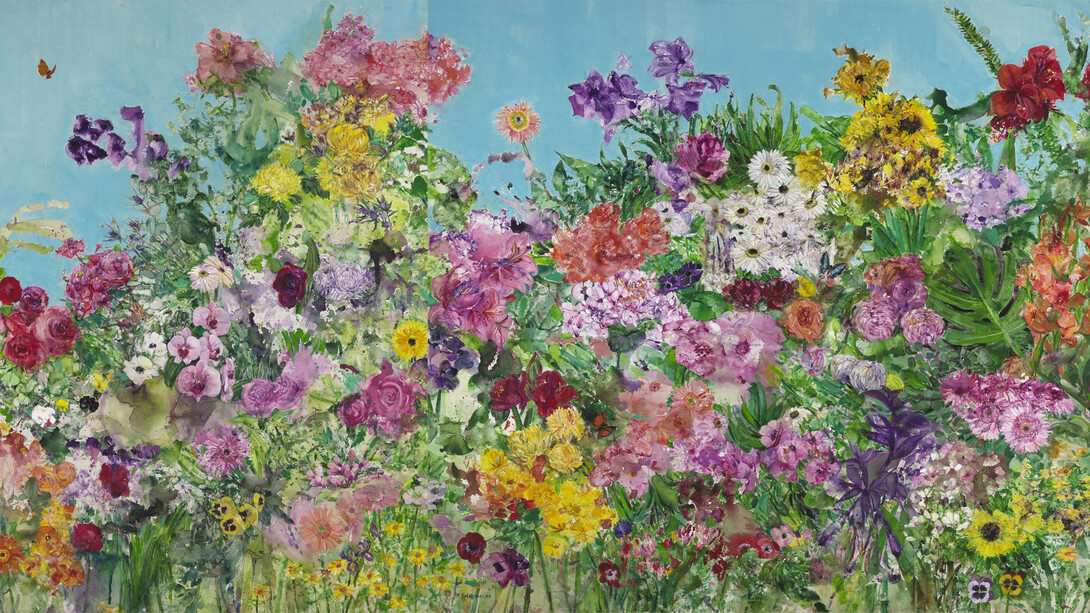
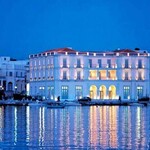
The Cultural Foundation of Tinos presents this summer the painting exhibition From chaos to cosmos, featuring works by Anna Maria Tsakali and Edouardos Sakayan.
The exhibition brings into creative dialogue two important painters of the contemporary Greek art scene who, through different points of departure yet with a shared sensibility, explore a common core: the moment in which the formless acquires shape and experience is transformed into an image of the world. A special place within the exhibition is held by new works by both artists, presented for the first time in Tinos.
In ancient Greek thought, Chaos constitutes the primordial state of things: the opening from which existence emerges, the unformed potential preceding every shape. In Hesiod’s Theogony, Chaos comes before all else, as the womb of the world. Cosmos, on the other hand, signifies order, the harmonious arrangement of things, the measure that organizes disorder and transforms the amorphous into form. Upon this fundamental idea the present exhibition is built, approaching painting as an act of genesis: a continuous transition from inner tension to image, from sensation to form.
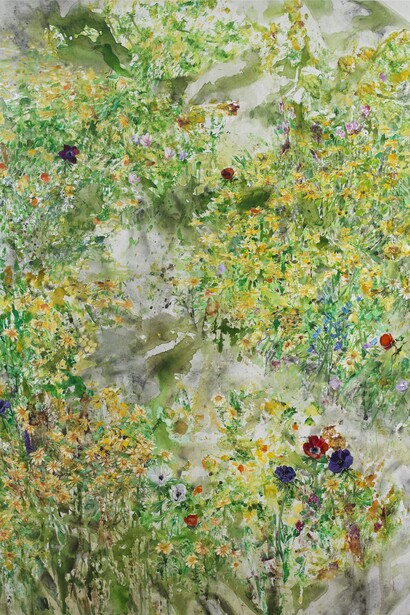
In the work of Anna Maria Tsakali, chaos functions as the generative condition of form. Organic accumulations of colour, vegetal proliferations, labyrinthine rhythms and eruptions of life compose a world that seems to emerge ceaselessly before the viewer’s gaze. Her painting moves between beauty and fragility, between the energy of nature and the anxiety of decay. Nature appears simultaneously as refuge, as the memory of a lost paradise, and as a field of reflection upon contemporary ecological deadlocks and the future of human civilization.
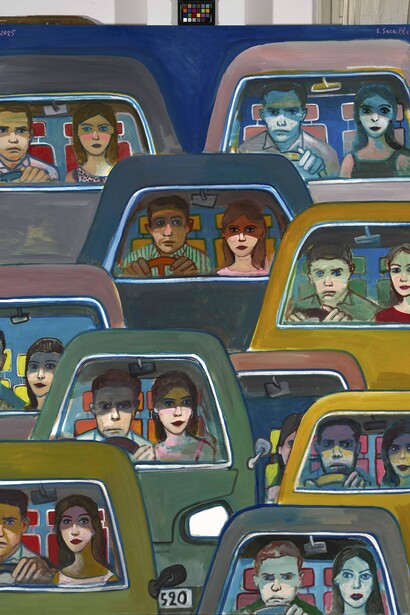
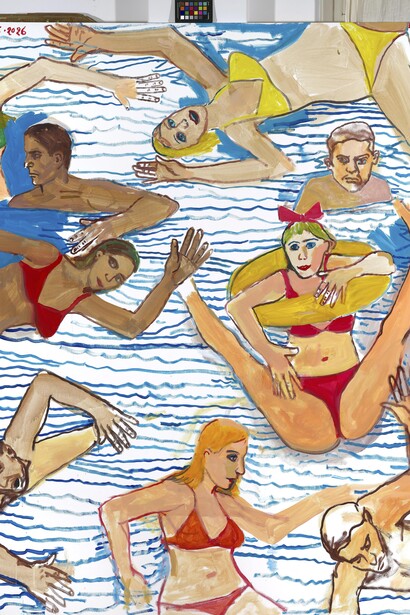
Edouardos Sakayan likewise begins from colour and the stain as the primordial material of the image. Drawing subsequently intervenes as an organizing force, granting narrative coherence and human presence to chromatic masses. Thus are formed the characteristic scenes of his painting: human gatherings, swimmers, traffic congestions, moments of public life and collective experience, such as the island fair. His works function as “human landscapes,” in which the individual becomes part of a broader social body and everyday life acquires an almost ritual character.
A shared point between the two artists is the notion of accumulation. In Tsakali’s work, it is translated into the incessant fertility of nature, into a painterly growth that appears organic and inexhaustible. In Sakayan’s work, by contrast, it is expressed through the human crowd, the geometry of bodies, and the dynamic generated when the individual becomes part of a collective experience.
Through their distinct painterly languages, the two artists shape an exhibition that engages with the existential, social and ecological questions of our time. Chaos and cosmos are presented as successive phases of the same creative process: an unceasing effort to give form to that which still remains indeterminate.