English
 Español
 Français
 Deutsch
 Italiano
 Português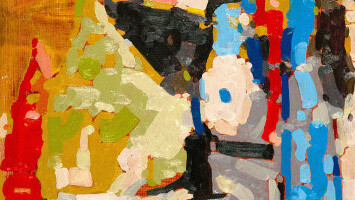
Simon Ingram (b.1971) is a transdisciplinary artist based in Tāmaki Makaurau Auckland. Within the different strands of his practice, he is interested in the historic relationships and contemporary possibilities between painting and technology. Pictorial fictions — painting from Frances Hodgkins’ latent space sees Ingram brokering a visual dialogue with the work of Frances Hodgkins, while continuing a painting and technology-based enquiry.
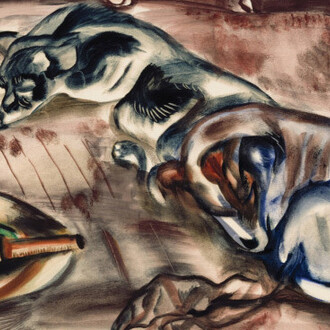
For a long time now, a certain kind of painting has experimented with technological tools and products. Belgian writer Thierry de Duve suggests that painting’s history from Manet onward can be read as a series of responses to a societal condition — painting absorbing or metabolising industrial processes rather than retreating from them. Ingram is interested in the way in which painters across time have demonstrated a willingness to encounter and engage technologies in their work — from László Moholy-Nagy’s instructional Telephone paintings of the 1920s, to Frank Stella’s early adoption of commercial enamel paints in the late 1950s, to the implied painterly gestures of Andy Warhol’s photomechanical silk screens in his Death and disaster series (1962-67). Frances Hodgkins sits firmly within this context, her wartime Purbeck paintings taking the cold metallic visual language of farm machinery and derelict buildings to reflect a sense of humanity at war. In the industrial age, mechanisation became a driving force in society and placed pressure on physical labour and the human workforce. In the digital age, work is transforming again through the advent of computer technologies and non-human simulated intelligence. Throughout all of these changes, painting has responded to these relationships between the artist’s hand and the machine.
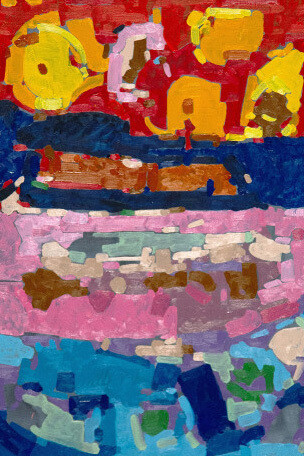
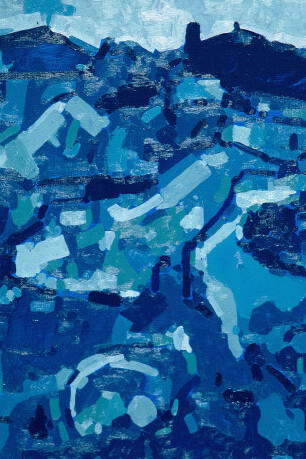
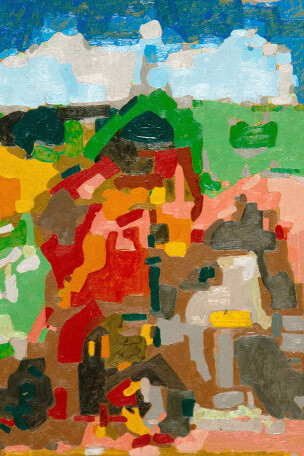
In Pictorial fictions, this kind of encounter is present within a series of customised algorithms and pictorial data that builds pictures in particular ways. Ingram has trained a machine-learning model on nineteen Hodgkins works held in the Dunedin Public Art Gallery collection — including Ibiza Harbour (c.1933), Through the trees (1932), and The farmer’s daughter (1929–30), several of which are displayed in the adjacent exhibition Panorama. When a model is trained on a set of images, it builds an internal world from what it has seen — a statistically dense, compressed space of possibility known as ‘latent’ space. In Ingram’s new paintings that space is shaped by Hodgkins’ palette, her spatiality, and her particular way of observing the world and building pictures.
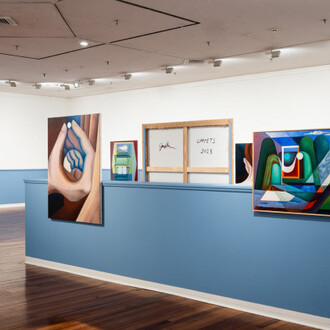
Ingram segments chosen compositions from his model into distinct chromatic zones in a way that owes something to Andy Warhol’s paint-by-numbers works such as Do it yourself (Sailboat) (1962). However, in his paintings Ingram loses himself in a slow, deliberative attentiveness, making marks by hand in a way that learns from the gestural identity of the brushmarks made by his custom machines within the ongoing series Painting assemblages. This is his process of seeking a transhistorical dialogue with Hodgkins through technology, and resolving a new kind of pictorial whole as painting.
This line of thinking has a close relationship to other artists, writers, and thinkers who have examined the generative potential of systems, sets, processes, and rules. Ingram refers to Paul Klee and Emma Kunz, whose work found new pictorial territory through internal systems; to Alfred Jensen, whose calendrical and numerical paintings investigated logic, pattern, and different theoretical positions; and to the American poet and artist Jackson Mac Low, who in the late 1970s developed a diastic method of generating poems and visual texts by using a transformational system to fragment and select elements of an existing work. Within Pictorial fictions, these connections establish potentialities and productive contradictions that emerge at the intersection of machine-led systems and artistic decision-making.