English
 Español
 Français
 Deutsch
 Italiano
 Português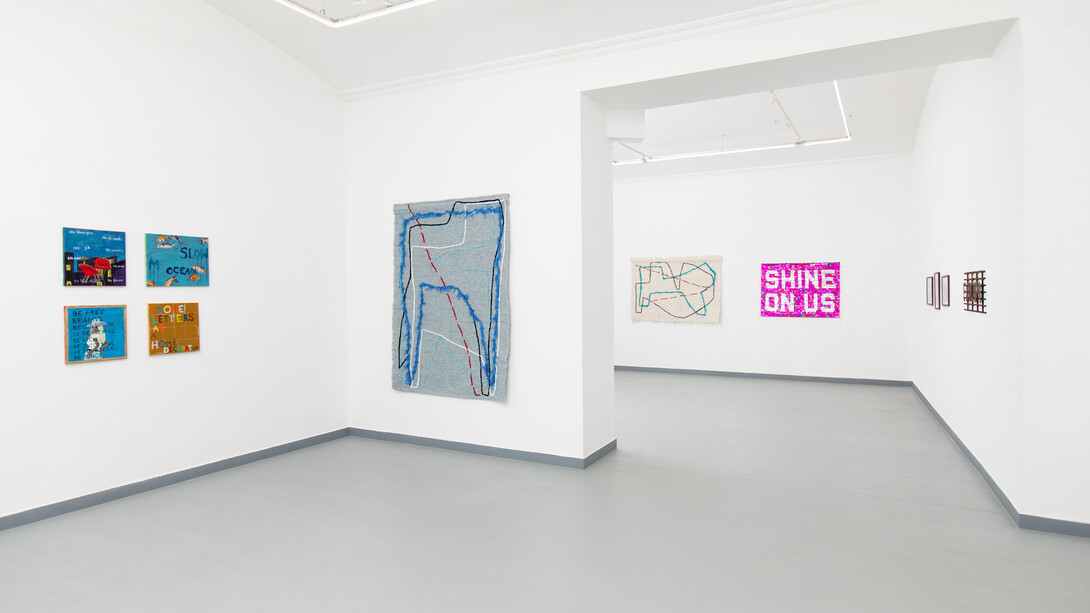
Text and textile share a common origin: the Latin word texere means to weave or to connect, so writing and weaving appear as inherently interrelated activities. In the works of Emese Benczúr, Lajos Csontó, Márton Dés, and Sonia Navarro, text does not simply convey meaning, but becomes surface, rhythm, repetition, and material. Sentences lose their clear communicative function: they accumulate, fade into one another, break apart, organize themselves into systems, and gradually become unstable. Language does not disappear, rather, it begins to refer back to its own operation.
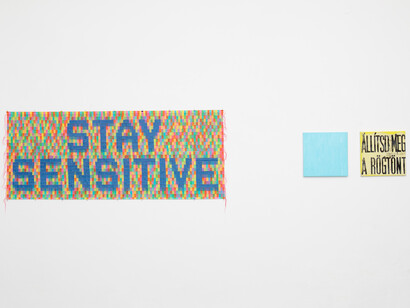
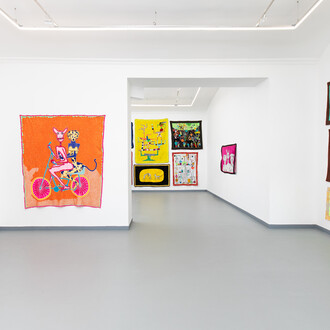
The exhibited works of Emese Benczúr are built on the contradictions between handicraft, repetition, and imperative statements. The short, slogan-like phrases in the works Stay sensitive and Shine on us evoke the language of advertising, self-help culture, and personal belief, while the repetitive process of execution gradually renders these statements self-ironic. A constant tension emerges between the meticulously crafted surfaces and the monotonous physical labor behind them, in which vulnerability, hope, and exhaustion coexist.
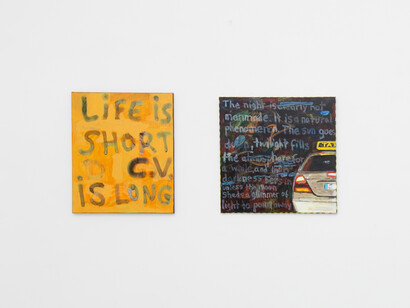
In the works of Lajos Csontó, language appears as a fragment of memory, as a ghostly imprint. The dissolving sentences and the disjointed or incomplete linguistic structures do not create stable meaning, rather, they model a state of uncertainty and the fragility of memory. The texts feel as though someone were trying to recall a sentence of which only fragments remain. The figures appearing in the images become carriers of narrative: notes of rapid associations and fleeting observations, where layers of personal and collective memory overlap.
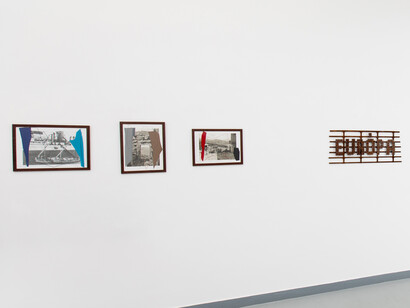
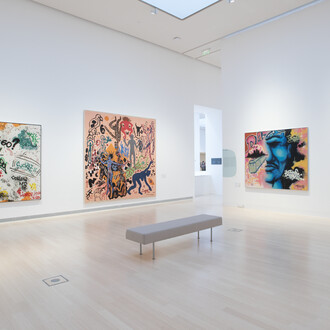
Márton Dés collects the visual information of the world and transforms it through processes of deconstruction, inversion, and the insertion of linguistic elements. In his paintings, everyday statements and slogans often accumulate and turn into visual layers. “Be yourself” easily slips into “Be Yoncé,” and the motivational message begins to reveal its own absurdity. Here, language does not liberate but echoes as noise, as an oppressive system, while humor continuously lightens this overloaded environment.
Sonia Navarro’s textile works exist at the threshold of language, her stitched structures and pathways resemble legible systems, yet their meaning does not emerge through textual reading. In her practice, embroidery and sewing function as alternative forms of writing — leaving traces, repetition, archiving, and memory making. The dashed lines evoke maps, travelled routes, or family topographies. The textile surfaces simultaneously recall landscapes and the memories attached to them, so meaning is constructed not through words but through connections, rhythms, and intersections. In Navarro’s works, the original meaning of the word “textus” becomes visible: meaning is literally woven together from threads.
In the exhibited works, language gradually loses its transparent and stable role as a conveyor of meaning. Through repetition, layering, displacement, and materiality, text transforms into image, gesture, and structure. Meaning does not disappear but remains in constant flux: rewritten, interrupted, and destabilized.