English
 Español
 Français
 Deutsch
 Italiano
 Português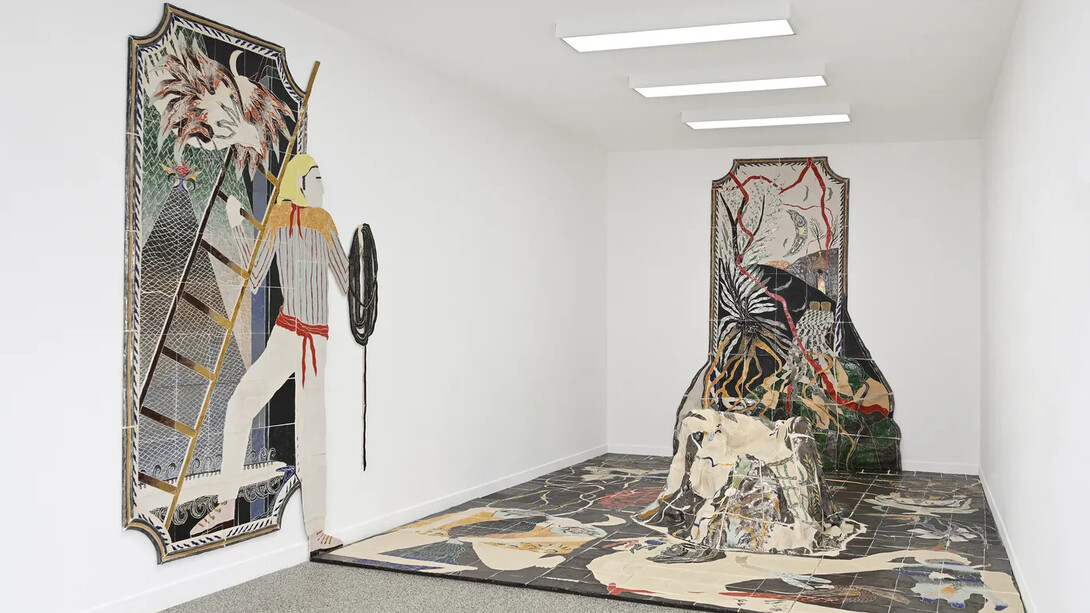
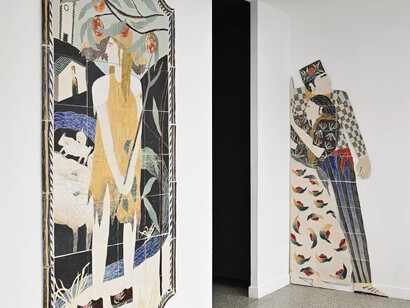
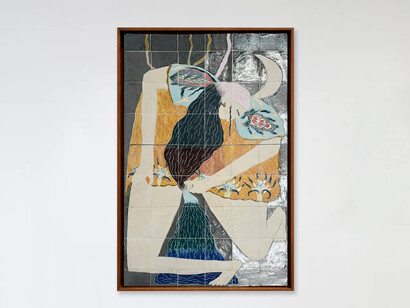
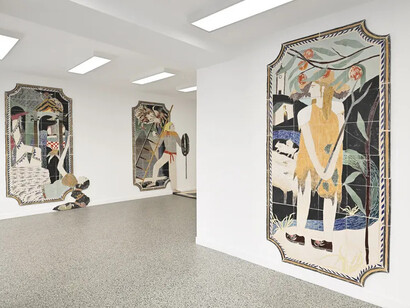
For her second exhibition at the gallery, Héloïse Rival (b. 1990, Paris) presents an entirely new body of work that marks a decisive shift in her practice. Conceived as a total installation, the exhibition unfolds as an almost theatrical narrative, a sequence of large-scale wall panels in glazed ceramic. The works are arranged like scenes from a fairy tale. For Héloïse Rival, this narrative framework is not merely decorative: it forms the very foundation of her work. The fairy tale becomes a device she constructs to engage, through the detour of fiction, with the tensions of our time, without resorting to direct illustration.
Héloïse Rival has drawn subtly from the imaginative world of the animated film The king and the mockingbird1, retaining its symbolic structure and political resonance to develop, through the figure of the Shepherdess, a meditation on confinement, waiting, and the possibility of breaking free from an assigned role. In the story, the Shepherdess and the Chimney Sweep are two painted figures, trapped within the palace's décor, ruled over by an authoritarian king. By stepping outside the frame, they cease to be elements of decoration and become beings who act in the world. Every form of confinement carries within itself the seed of a desire for freedom.
Narrative becomes the theater in which I choose to let my work coexist with a world traversed by tensions. The fairy tale is for me a poetic tool, a way of approaching the conflicts of our time, a social mirror.
(Héloïse Rival)
The Shepherdess appears first as a female figure confined within her role, embedded in the palace architecture and indistinguishable from the surrounding décor. She embodies the object of the king's desire, that recurring image of the young, vulnerable girl. This figure, endlessly revisited (from Manon des Sources to the girl in Brassens' song, to the little match girl), runs deep through our collective imagination. The work, and this character in particular, opens the exhibition like a frontispiece, heralding the emancipation to come.
The very shape of the frames contributes to this tension. Their scrolled, ornate contours evoke the decorative vocabulary of classical architecture, where the work is embedded directly into the built environment. Alberti defined painting as a finestra aperta2, an open window onto the world. But here, the opening functions as a device of fixation: it organizes presence, assigns a place, stabilizes a figure. The frame does not merely delimit the image: it organizes bodies. To cross it is not a dramatic gesture, but a gradual displacement, a slow act of disobedience. Surface and figure are no longer separate; together, they participate in the construction of the image. As for the wall, it ceases to be a simple support and forms extend all the way to the floor.
Painted in enamel and composed of assembled fragments, the works exist at the threshold between image and object. A vernacular material traditionally associated with domestic ornament, ceramic is here deployed at large scale for the first time in Héloïse Rival's practice. Frames, motifs, and ornaments no longer serve decoration alone: they structure both space and image. By fully embracing this ornamental dimension, Héloïse Rival displaces the traditional hierarchies of representation.
Takicardi is part of a broader ongoing inquiry in which images are built from a rich imaginative world, steeped in narratives and symbols. References coexist freely, without hierarchy or authority, leaving those who encounter them room to project their own associations.
Notes
1 Paul Grimault (dir.), The king and the mockingbird, screenplay by Jacques Prévert, France, 1980, 87 min.
2 Leon Battista Alberti, De pictura, 1435; French translation De la peinture, trans. Jean-Louis Schefer, Paris, Macula, 1992.
![Mary Cassatt, Fillette dans un fauteuil bleu [Enfant dans le salon bleu] (detail), 1878. Courtesy of Musée d’Orsay](/attachments/3ddcf3630b2e6b21d055a8488350d949784be8fa/store/fill/330/330/9b97dc5b17cad42577b6453f0968e961b1231ceb2b8b5ceb2c09057b2695/Mary-Cassatt-Fillette-dans-un-fauteuil-bleu-Enfant-dans-le-salon-bleu-detail-1878-Courtesy-of.jpg)