English
 Español
 Français
 Deutsch
 Italiano
 Português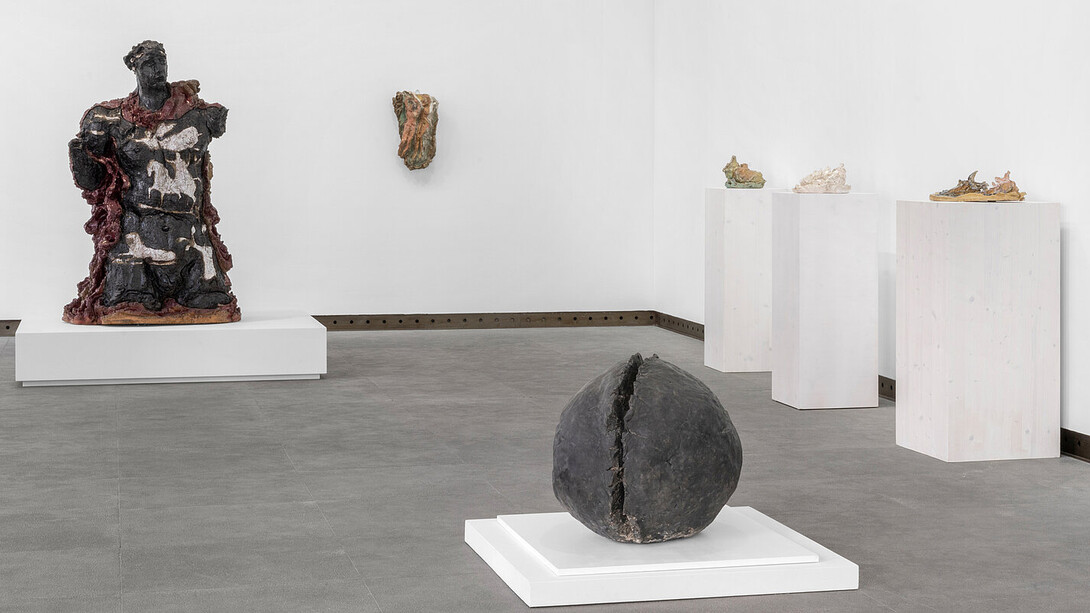
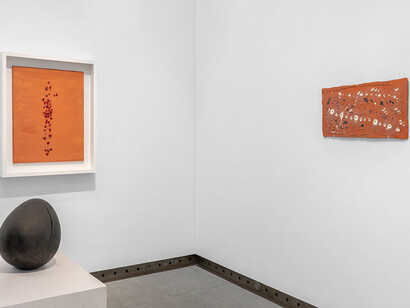
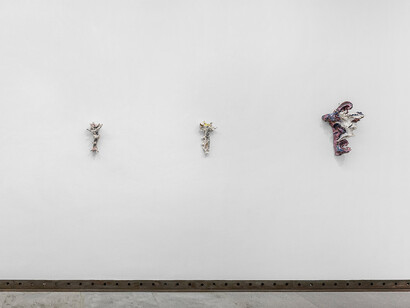
Galerie Karsten Greve is pleased to present an exhibition dedicated to the ceramics of Lucio Fontana (1899–1968), bringing together a selection of works created between the 1930s and the 1960s. The exhibition highlights an essential yet often lesser-known aspect of the artist’s practice: his work with terracotta, a founding medium that runs throughout his career and gradually nourishes his Spatialist research. Fontana’s attraction to ceramics finds its roots in his personal history as he grew up in his father’s workshop, a sculptor of funerary monuments, where he became familiar with working with clay from an early age.
The exhibition opens with Torso italico (1938), a monumental work inspired by antique statuary and imperial Rome. While drawing on traditional codes, the figure radically fragments them. This truncated body, deprived of arms, emerges as a presence that is both massive and vulnerable, where classical monumentality is diverted into a more unstable form. Modeled in a single piece, it demonstrates remarkable technical mastery, with firing constraints contributing fully to the intensity of the work. In the context of late 1930s Italy, the figure resonates with the historical imaginaries of its time while maintaining an ambiguous dimension, a silent critique of autocratic ideologies.
At the same time, Fontana explores a very different, lighter vein. His stays in Albisola, where he collaborated with the poet and ceramist Tullio Mazzotti, foster a rich and inventive production situated at the crossroads of sculpture and craftsmanship. Exotic animals, fruits, shells form a poetic universe dominated by luminous colors and organic shapes. Some pieces appear almost animated, such as the playful Coccodrillo (1936–37); surfaces ripple and unfold, colors vibrate.
From the 1940s onward, the tone shifts. The experience of war profoundly affects Fontana’s sensibility, and his works begin to reflect the political upheavals of the time. Belligerent figures and scenes of combat gradually emerge. Rather than representing violence directly, Fontana often transforms these confrontations into choreographed compositions in which bodies intersect in a theatrical movement. In Battaglia (1947), the figures seem to intertwine, indistinct and almost electric.
Themes of crucifixion and deposition provide Fontana with a field of expression for great gestural intensity, between tradition and experimentation. Shaped with vigor, the figures of Christ elongate and twist under the pressure of the artist’s gesture. The material seems to vibrate, as if the suffering of the Passion and spiritual energy were directly transmitted into the clay.
The exhibition highlights the artist’s gradual evolution toward a more radical conception of surface which becomes a boundary to be crossed, and of space as a form to be revealed. With his Concetti spaziali, small perforations punctuate the surface of the material. These simple yet decisive openings transform the sculpture: the surface ceases to be a limit and becomes a passage into space. This principle lies at the core of the research Fontana developed within the Spatialist movement, whose foundations he established in his Manifiesto blanco, published in 1946. “We want the painting to leave its frame and the sculpture to leave its glass case”, he wrote.
Fascinated by scientific progress and the emerging imaginaries associated with cosmic exploration, Fontana developed a vision in which sculpture resonates with an expanded space. In the late 1950s, with his Natura series, large terracottas with incised or hollowed forms, he engages directly with contemporary developments, drawing inspiration from the first images of lunar craters. These works reflect a keen awareness of his time: Fontana does not represent the cosmos, but captures its impact on how we conceive space and form.
![Mary Cassatt, Fillette dans un fauteuil bleu [Enfant dans le salon bleu] (detail), 1878. Courtesy of Musée d’Orsay](/attachments/3ddcf3630b2e6b21d055a8488350d949784be8fa/store/fill/330/330/9b97dc5b17cad42577b6453f0968e961b1231ceb2b8b5ceb2c09057b2695/Mary-Cassatt-Fillette-dans-un-fauteuil-bleu-Enfant-dans-le-salon-bleu-detail-1878-Courtesy-of.jpg)